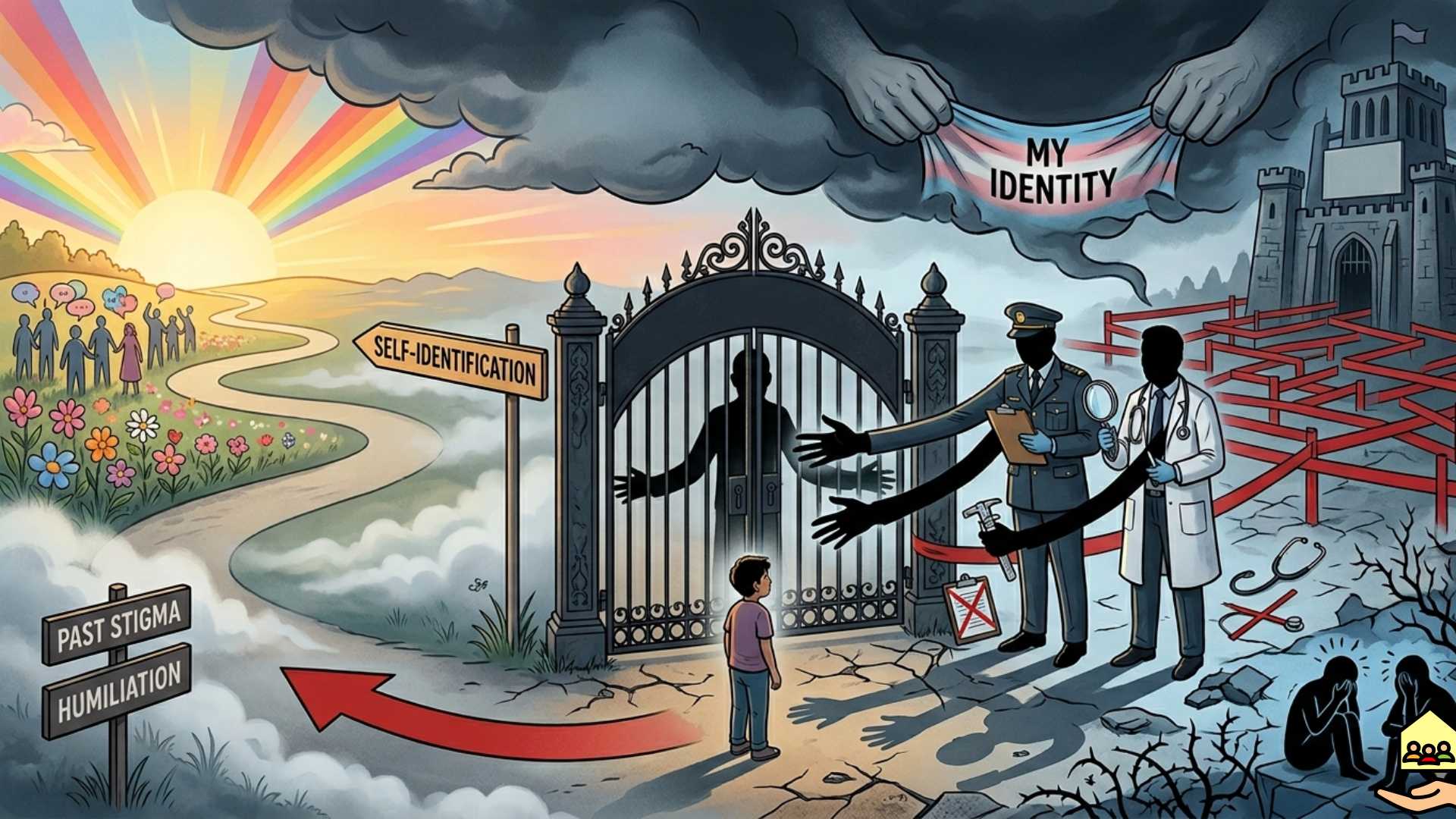
Transgender Amendment Bill: A Threat to Rights and Dignity
Introduction
India is home to an estimated 4.9 lakh transgender persons (Census 2011 — widely considered an undercount), a community that has historically faced structural exclusion from education, employment, and healthcare. A decade of legal progress — culminating in the NALSA judgment (2014) and the Transgender Persons (Protection of Rights) Act, 2019 — established self-identification as the cornerstone of gender identity recognition. The Transgender Persons (Protection of Rights) Amendment Bill, 2026, notified on March 30, 2026, fundamentally reverses this principle, replacing self-identification with medical and bureaucratic gatekeeping — reigniting a critical debate on constitutional morality, bodily autonomy, and the state's role in identity governance.
"Gender identity is self-identified. Transgender persons are the final and only authority on their gender identity." — Supreme Court of India, NALSA v. Union of India, 2014
| Indicator | Data |
|---|---|
| Estimated transgender population (Census 2011) | 4.9 lakh |
| Trans persons facing social rejection | 99% |
| Trans women facing physical/sexual violence | 57% |
| Harassment/violence in educational spaces | 52% |
| Transgender adolescent suicide attempt rate | 13%–50% (vs. national average) |
| Penalty for 'undue influence' under 2026 Amendment | Up to 15 years imprisonment |
Legal and Constitutional Timeline
| Year | Development | Significance |
|---|---|---|
| 2014 | NALSA v. Union of India | SC recognised transgender identity; established self-identification principle |
| 2019 | Transgender Persons (Protection of Rights) Act | Statutory recognition; prohibited discrimination; welfare framework |
| 2026 | Amendment Bill (notified March 30) | Replaces self-identification with medical board evaluation + District Magistrate certificate |
What the 2026 Amendment Changes
Under the amendment, a transgender person must:
- Appear before a medical board for gender identity assessment
- Undergo evaluation to "prove" their gender identity
- Await the board's recommendation forwarded to the District Magistrate
- Obtain a certificate formally declaring them transgender
This process fundamentally shifts the locus of gender identity from the individual to the state — reversing the NALSA judgment's core principle.
Additionally, the amendment:
- Criminalises 'undue influence' in helping someone identify as transgender — with penalties up to 15 years imprisonment
- Collapses distinctions between transgender, intersex, and hijra identities
- Renders trans men nearly invisible in the legal framework
Constitutional Concerns
Article 14 — Equality before Law: Cisgender persons self-declare gender without verification. Subjecting only transgender persons to medical evaluation creates an unconstitutional classification with no rational nexus.
Article 15 — Non-Discrimination: Mandating medical gatekeeping based solely on gender identity constitutes direct discrimination.
Article 19 — Freedom of Expression: The right to express one's gender identity, recognised in NALSA, is curtailed by requiring external validation.
Article 21 — Right to Life and Personal Liberty: Forced medical examination, potential genital inspection, and bureaucratic delays violate bodily autonomy, dignity, and privacy — all held to be components of Article 21 in K.S. Puttaswamy v. Union of India (2017).
Medical and Mental Health Dimensions
There is no biomarker for gender identity — no blood test, scan, or physical examination can determine an individual's deeply held gender identity. This is globally accepted medical consensus reflected in:
- WHO's removal of gender incongruence from its list of mental disorders (ICD-11, 2019)
- American Psychological Association and Indian Psychiatric Society guidelines supporting gender-affirming care
Medical boards — already overburdened and often absent at district level — lack defined criteria for evaluation, creating risk of:
- Arbitrary and invasive examinations including genital inspection
- Inconsistent outcomes across districts
- Active deterrence of transgender persons from approaching the state
The criminalisation of 'undue influence' directly threatens mental health practitioners, psychologists, educators, and community organisations providing evidence-based gender-affirming care — potentially constituting a public mental health emergency.
Implications Across Sectors
Healthcare: Fear of scrutiny will push transgender persons away from formal healthcare — worsening already poor health outcomes in an extremely vulnerable population.
Education: Ambiguity around identity certification risks disrupting welfare scheme access for enrolled students.
Legal profession: Lawyers advising transgender clients on identity rights risk criminal liability under the 'undue influence' clause.
Community organisations: Trans-affirmative NGOs face existential legal risk for routine counselling and support work.
Critical Analysis
The government's stated rationale — preventing misuse of transgender identity for welfare fraud — does not justify the scale of rights restriction imposed. If misuse constitutes 0.01% of cases (government's own figure), the proportionate response is administrative audit and verification protocols — not medicalisation of identity for the entire community.
The amendment also fails the test of administrative feasibility — district-level medical boards do not universally exist, creating implementation gaps that will translate directly into denial of rights.
Way Forward
- Withdraw or substantially revise the 2026 Amendment to restore self-identification in line with NALSA.
- Strengthen the 2019 Act's welfare provisions — housing, employment, education, healthcare access — rather than restricting identity recognition.
- Establish administrative audit mechanisms to address welfare fraud without medicalising identity.
- Train district-level officials and healthcare providers in gender-affirming practices.
- Ensure intersex and hijra identities are recognised distinctly within the legal framework.
- Involve transgender community representatives in all policy formulation processes.
Conclusion
The 2026 Amendment represents a regression from a rights-based framework to a surveillance-based one. A state that requires its citizens to prove their identity before strangers — rather than recognising their self-declared dignity — contradicts the constitutional morality articulated in NALSA, Puttaswamy, and Navtej Singh Johar. Governance frameworks must enable vulnerable communities to access rights and welfare, not erect new barriers. The measure of a just state is not how efficiently it administers identity — but how fully it protects the dignity of every citizen, particularly those it has historically failed.
Attribution
Original content sources and authors
Syllabus classification
How this article maps to GS papers
Main syllabus
GS2Government PoliciesQuick Q&A
What are the key provisions of the Transgender Persons (Protection of Rights) Amendment Bill, 2026, and how does it differ from earlier legal frameworks?
Departure from Earlier Frameworks: The 2014 NALSA judgment by the Supreme Court established that gender identity is based on self-identification, rooted in dignity, autonomy, and constitutional rights. The 2019 Act broadly aligned with this principle, aiming to provide welfare measures and prohibit discrimination.
Implications: The 2026 amendment represents a shift from a rights-based approach to a regulatory approach, potentially undermining the autonomy of transgender individuals. It replaces self-declaration with external validation, raising concerns about dignity, privacy, and feasibility within existing administrative structures.
Why is the principle of self-identification of gender considered crucial from a constitutional and human rights perspective?
Human Rights Perspective: Globally, gender identity is understood as a deeply personal experience that cannot be externally determined. Forcing individuals to undergo verification violates bodily autonomy, privacy, and dignity. There is no scientific or medical test that can objectively determine gender identity.
Broader Implications: Denying self-identification can lead to exclusion from welfare schemes, healthcare, and legal recognition. It also reinforces stigma and discrimination.
Conclusion: Upholding self-identification is essential for ensuring inclusive governance, social justice, and mental well-being of transgender individuals.
How might the requirement of medical and bureaucratic certification impact access to rights and welfare for transgender persons?
Impact on Welfare Access: Welfare schemes related to education, employment, and healthcare are often linked to legal identity. If certification becomes difficult, many transgender individuals may be excluded from these benefits.
Risk of Abuse: In the absence of clear guidelines, there is a risk of arbitrary, invasive, or unethical practices, including physical examinations. This can deter individuals from seeking recognition altogether.
Conclusion: Instead of facilitating inclusion, the certification process may create structural barriers, pushing transgender persons further to the margins of society.
What are the potential mental health consequences of the 2026 amendment for the transgender community?
Impact of the Amendment: Introducing mandatory verification processes can lead to anticipatory anxiety, humiliation, and psychological distress. The fear of scrutiny by medical boards may discourage individuals from seeking legal recognition or healthcare.
Healthcare Disruptions: The amendment may also affect ongoing gender-affirming treatments, as legal ambiguity could disrupt access to services.
Conclusion: The policy risks triggering a public mental health crisis, as it adds layers of stigma and institutional barriers to an already vulnerable population.
Critically analyze the argument that stricter verification mechanisms are necessary to prevent misuse of transgender identity.
Counterarguments: Critics highlight that such misuse is minimal and does not justify undermining fundamental rights. Imposing blanket restrictions can harm the entire community for the actions of a negligible minority.
Practical Concerns: Verification mechanisms are difficult to implement due to the absence of objective criteria for determining gender identity. This may lead to arbitrary decisions and abuse of power.
Balanced View: Instead of restrictive measures, the focus should be on administrative audits, grievance redressal, and strengthening implementation of existing schemes.
Conclusion: The costs of over-regulation outweigh the benefits, making the amendment counterproductive.
What global and Indian examples illustrate progressive approaches to transgender rights and inclusion?
Global Practices: Countries like Argentina and Ireland have adopted self-identification models, allowing individuals to change their gender on official documents without medical certification. These frameworks emphasise dignity and autonomy.
Lessons Learned: Progressive policies focus on inclusion, accessibility, and rights-based approaches rather than control and verification.
Conclusion: These examples demonstrate that empowering individuals through self-identification leads to better social and health outcomes.
As a policymaker, how would you redesign the amendment to balance administrative concerns with the rights and dignity of transgender persons?
Key Recommendations:
- Strengthen Implementation: Improve delivery of welfare schemes through better data systems and monitoring.
- Capacity Building: Train officials and healthcare providers in gender sensitivity.
- Grievance Redressal: Establish accessible mechanisms to address misuse or disputes.
Legal Safeguards: Ensure alignment with constitutional principles and Supreme Court judgments. Avoid criminalising support systems such as mental health practitioners and community organisations.
Outcome: Such a framework would promote inclusive governance, protect rights, and ensure administrative efficiency without compromising dignity.
The 2026 Amendment Bill shifts transgender identity recognition from self-identification to state-controlled medical evaluation, challenging constitutional rights.
Practice questions
1 question for mains preparation