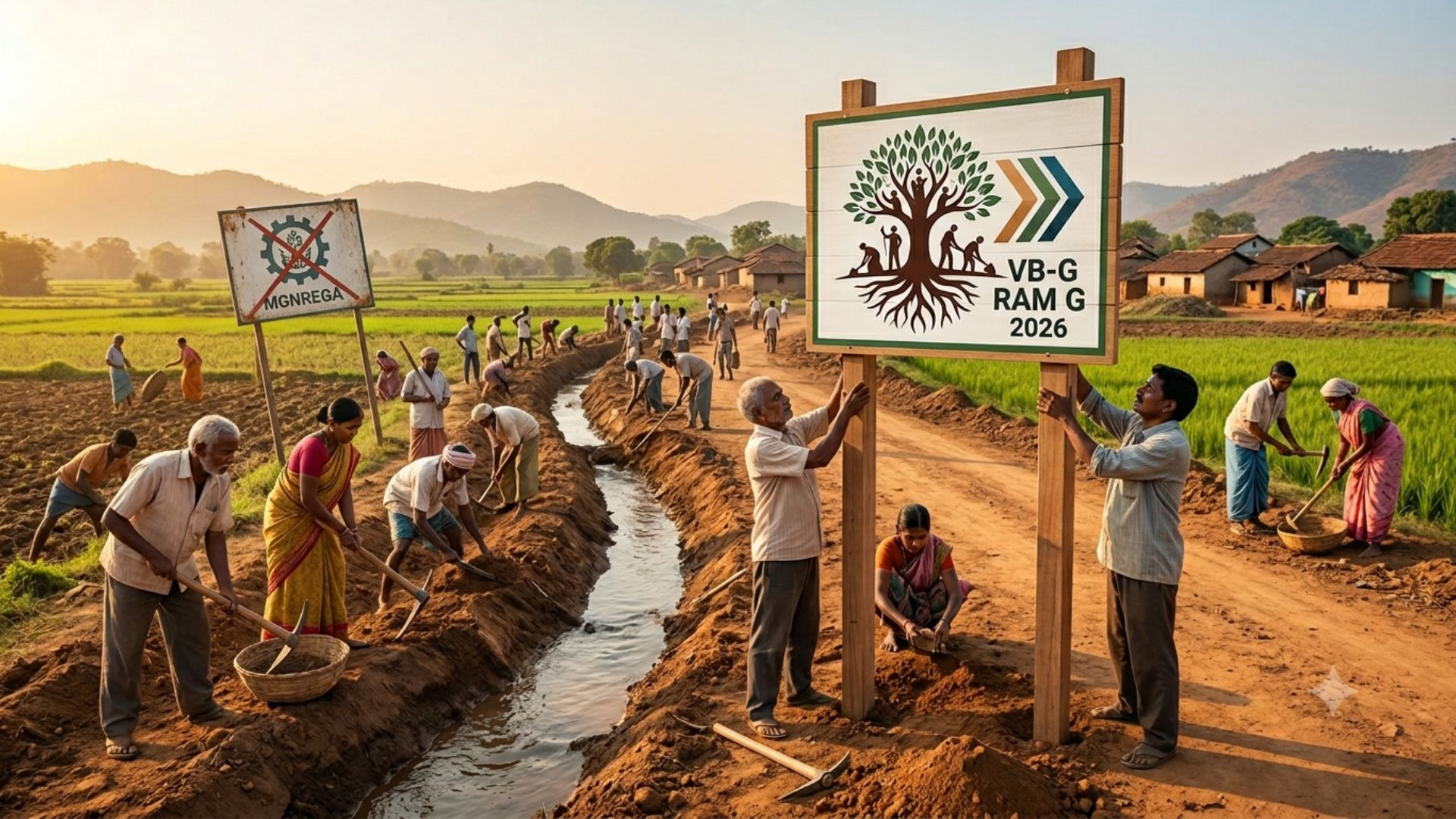
VB-GRAM G: Reimagining Rural Employment and Livelihood Security in India

“Without causing any inconvenience to workers, we are moving from MGNREGA to VB-GRAM G. There will not be a gap of even a single day in the availability of work.” — Shivraj Singh Chouhan
Why is it in News?
The Union Government has announced an interim allocation of ₹95,962 crore for the newly launched Vikshit Bharat Guarantee for Rozgar and Ajeevika Mission Gramin (VB-GRAM G), which will replace the Mahatma Gandhi National Rural Employment Guarantee Scheme (MGNREGS).
The allocation has been made even before the scheme's final rules are notified to ensure a smooth transition and uninterrupted employment for rural workers.
What is VB-GRAM G?
VB-GRAM G is the Centre's new flagship rural employment and livelihood programme aimed at:
- Providing wage employment in rural areas.
- Strengthening livelihood opportunities.
- Ensuring continuity of rural work availability.
- Enhancing the presence of employment support in economically weaker States.
The scheme will officially replace MGNREGS without disrupting ongoing work.
Financial Outlay of the Scheme
| Component | Allocation |
|---|---|
| Central Interim Allocation | ₹95,962 crore |
| States' Contribution | Generally 40% of State allocation |
| Combined Outlay | ₹1.25 lakh crore |
Additional Allocations
| Category | Amount |
|---|---|
| States | ₹92,550.17 crore |
| Union Territories | ₹1,291.52 crore |
| Administration & Social Audits | ₹1,850.62 crore |
| Total | ₹95,692.31 crore* |
*Figures announced as interim allocation by the Ministry.
State-wise Allocation Highlights
| State | Allocation |
|---|---|
| Uttar Pradesh | ₹9,721.48 crore |
| West Bengal | ₹8,508 crore |
| Andhra Pradesh | ₹7,707.21 crore |
| Tamil Nadu | ₹7,585.49 crore |
| Rajasthan | ₹7,581.87 crore |
| Bihar | ₹6,715.83 crore |
Key Observation
The allocations broadly mirror the funding pattern followed under MGNREGS in previous years, ensuring continuity and stability during the transition phase.
Proposed Funding Formula
A major reform under VB-GRAM G is the proposal to use the:
16th Finance Commission's Horizontal Devolution Formula
This formula seeks to distribute resources based on factors such as:
- Population
- Income levels
- Demographic performance
- Area
- Fiscal needs
Expected Outcome
- Greater focus on economically weaker States.
- More equitable distribution of Central resources.
- Stronger regional balance in rural development spending.
The final allocation formula is expected to be notified on July 1, 2026, which may alter future State-wise shares.
Example:

If a poorer State scores higher under the
Finance Commission's devolution criteria,
it may receive a larger share of future
VB-GRAM G allocations compared to the
previous MGNREGS framework.
Preparedness of States
According to the Rural Development Ministry:
States Ready for Implementation
- 26 States have completed required procedures.
States Yet to Complete Formalities
- Jharkhand
- Karnataka
- Telangana
- Mizoram
Representatives from these States have assured the Centre that preparations are underway.
Pre-Implementation Requirements
Before operationalising VB-GRAM G, States must:
- Frame State-specific rules.
- Complete beneficiary e-KYC.
- Determine agricultural-cycle-based blackout periods.
- Conduct district-level capacity building.
- Train block-level implementation teams.
Example:

Blackout periods are expected to prevent
overlap between government employment
works and peak agricultural seasons,
ensuring adequate labour availability
for farming activities.
West Bengal Dues Issue
An unresolved issue relates to pending MGNREGS dues in West Bengal.
Current Status
- Pending amount: ₹8,508 crore.
- Dispute remains unresolved despite a change in government.
Centre's Position
“Till those disputes are settled, that question does not arise.”
The West Bengal government has informed the Centre in writing that it is willing to comply with all conditions and guidelines prescribed under the new scheme.
Significance of VB-GRAM G
Expected Benefits
- Continuity of rural employment.
- Strengthening of livelihood security.
- Improved transparency through e-KYC.
- Better targeting of disadvantaged regions.
- Enhanced accountability through social audits.
- Greater alignment with fiscal devolution principles.
Way Forward
- Notify final rules and allocation formula on schedule.
- Ensure timely completion of State-level formalities.
- Resolve pending financial disputes with States.
- Strengthen digital verification and beneficiary databases.
- Conduct regular social audits and monitoring.
- Align employment generation with local development needs.
Conclusion
VB-GRAM G marks a major transition in India's rural employment architecture. By ensuring uninterrupted work opportunities, introducing a potentially more equitable funding formula, and strengthening administrative preparedness, the scheme seeks to enhance livelihood security while promoting balanced rural development across States.
Attribution
Original content sources and authors


Syllabus classification
How this article maps to GS papers
Main syllabus
GS2Government PoliciesAlso covers
Quick Q&A
What is the Vikshit Bharat Guarantee for Rozgar and Ajeevika Mission Gramin (VB-GRAM G), and what is its significance in India's rural employment architecture?
Why is the transition from MGNREGS to VB-GRAM G important for social welfare and inclusive development in India?
How does the funding mechanism and distribution formula under VB-GRAM G reflect the principles of cooperative federalism?
What are the major reasons behind introducing VB-GRAM G and reforming the existing rural employment framework?
What is the critical analysis of the opportunities and challenges associated with the implementation of VB-GRAM G?
How does the issue of pending dues in West Bengal serve as a case study in Centre-State relations and welfare governance?
Practice questions
1 question for mains preparation