
Introduction
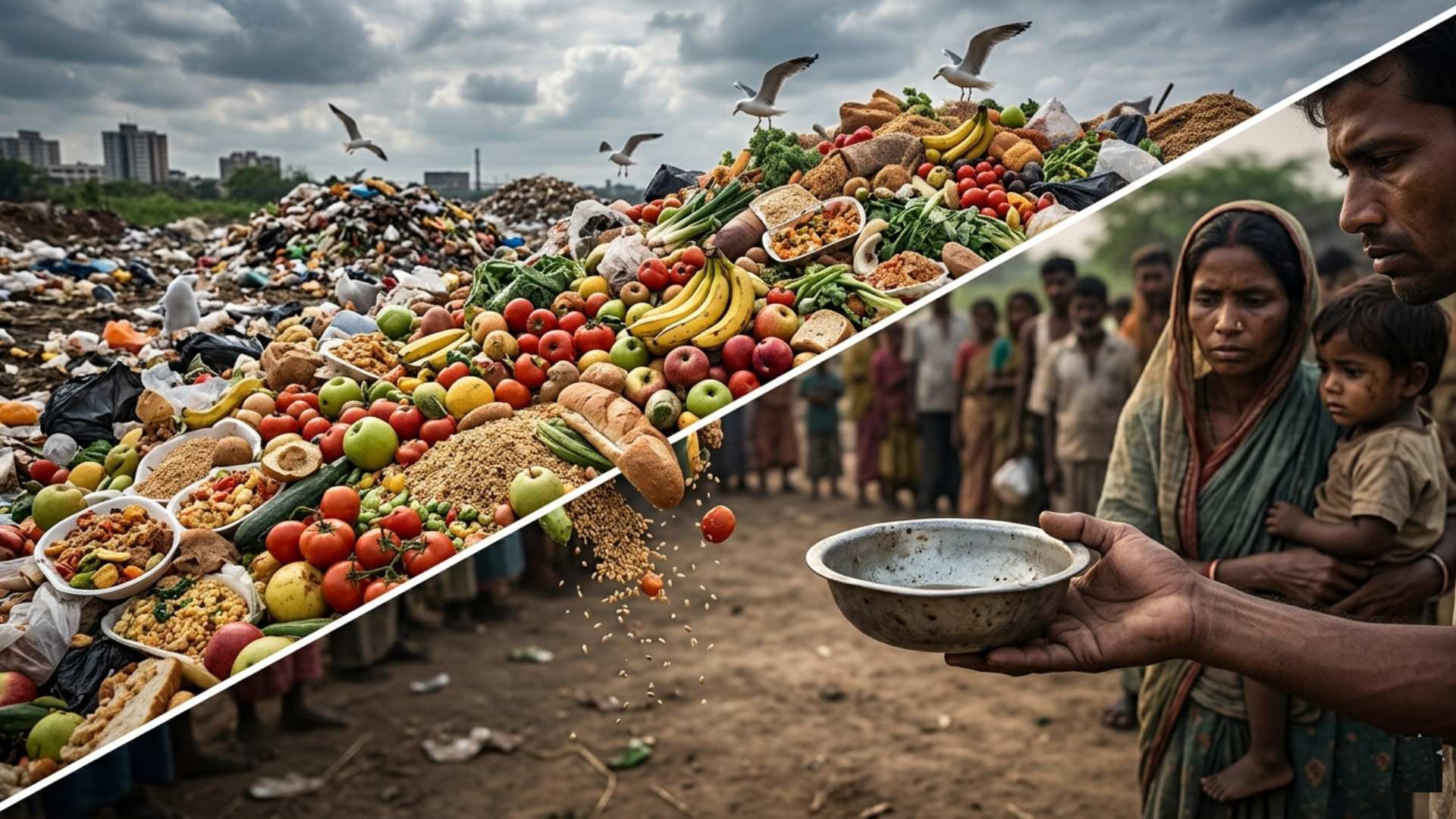
India wastes 78–80 million tonnes of food worth ₹1.55 lakh crore annually — ranking second globally after China — while 194 million people go hungry and the country sits at 111th position in the Global Hunger Index. The coexistence of a billion tonnes of food waste and a billion hungry stomachs is not an irony; it is an indictment of systemic inefficiency.
"Food waste is not a statistic; it is stolen meals from millions of mouths." — UNEP Food Waste Index Report 2024
| Country | Annual Food Waste | Per Capita Household Waste |
|---|---|---|
| China | 108 million tonnes | — |
| India | 78–80 million tonnes | 55 kg/year |
| USA | 24.7 million tonnes | 73 kg/year |
| Germany | — | 75 kg/year |
| Japan | 5.2 million tonnes | — |
Background & Context
The UN marks March 30 as International Day of Zero Waste. The UNEP Food Waste Index Report 2024 reveals that 1.05 billion tonnes of food is wasted globally each year — households account for 60%, food services 28%, and retail 12%. Yet 783 million people face hunger and 3.1 billion cannot afford a healthy diet. Food waste is simultaneously a hunger crisis, an ecological emergency, and a governance failure.
Key Concepts
Food Loss vs. Food Waste: Food loss occurs at production, post-harvest, and processing stages; food waste occurs at retail and consumption stages. Both demand distinct policy interventions.
Mottainai (Japan): A cultural ethic of zero waste — deep-rooted reverence for resources — that has kept Japan's food waste at just 5.2 million tonnes despite being a large economy. A cultural counterpoint to India's challenge.
Anna Brahma: India's own civilisational ethic treating food as sacred — a philosophical foundation for behavioural change that predates modern sustainability discourse.
India-Specific Dimensions
1. Scale of the Crisis
India processes only ~8% of its produce compared to 65% in the USA and 23% in China. With 194 million hungry people and per capita food waste at 55 kg/year, the structural disconnect between production and consumption is stark.
2. Punjab: A Microcosm of Systemic Failure
Punjab — India's food bowl — exemplifies the paradox acutely:
| Issue | Data |
|---|---|
| Post-harvest loss (fruits & vegetables) | ~20% |
| Foodgrains spoiled in FCI storage (2019–24) | 8,200+ tonnes |
| Primary bottlenecks | Inadequate cold chain, poor packaging, no grading standards |
NITI Aayog identifies inadequate covered storage, under-investment in cold-chain infrastructure, and the Jute Packaging Materials Act (mandating porous jute sacks prone to rodent damage) as key structural failures.
3. Ecological Cost
Food loss and waste account for 8–10% of global greenhouse gas emissions. If food waste were a country, it would be the third-largest GHG emitter. Decomposing food releases methane — far more potent than CO₂. Producing 1 kg of rice requires ~5,000 litres of water; wasting it compounds Punjab's already critical groundwater depletion crisis.
Governance & Policy Gaps
- No consolidated national database tracking food waste at retail/hospitality level.
- Jute Packaging Materials Act mandates storage technology that accelerates loss.
- India processes only 8% of produce — cold-chain investment treated as optional, not food security infrastructure.
- No legal mandate for surplus food redistribution (unlike several EU nations).
- Food loss not integrated into India's Nationally Determined Contributions (NDCs) under Paris Agreement.
Five-Point Reform Framework
| Reform | Action |
|---|---|
| Cold chain mission | National infrastructure programme for Punjab, Haryana, UP — treat as food security, not optional investment |
| Anti-waste legislation | Mandate surplus food donation by supermarkets/institutions; tax incentives for donors |
| Farm-gate empowerment | FPOs equipped with hermetic storage, mobile cold units, mechanised drying; review Jute Packaging Act |
| Mandatory waste reporting | National food waste database; public reporting for large businesses, caterers, institutional kitchens |
| Cultural revival | Anna Brahma ethic in schools and civic institutions — food reverence as civic responsibility |
Conclusion
India's food waste crisis sits at the intersection of agricultural infrastructure deficit, policy incoherence, and cultural amnesia. The solution is not a single scheme but a systemic reconfiguration — cold chains as food security infrastructure, legal frameworks for redistribution, farm-gate technology, and a revival of India's own civilisational ethic of food as sacred. Reducing food waste is simultaneously a hunger intervention, a climate action, and an affirmation of human dignity. The question is not whether India can afford to act — it is whether it can afford not to.
