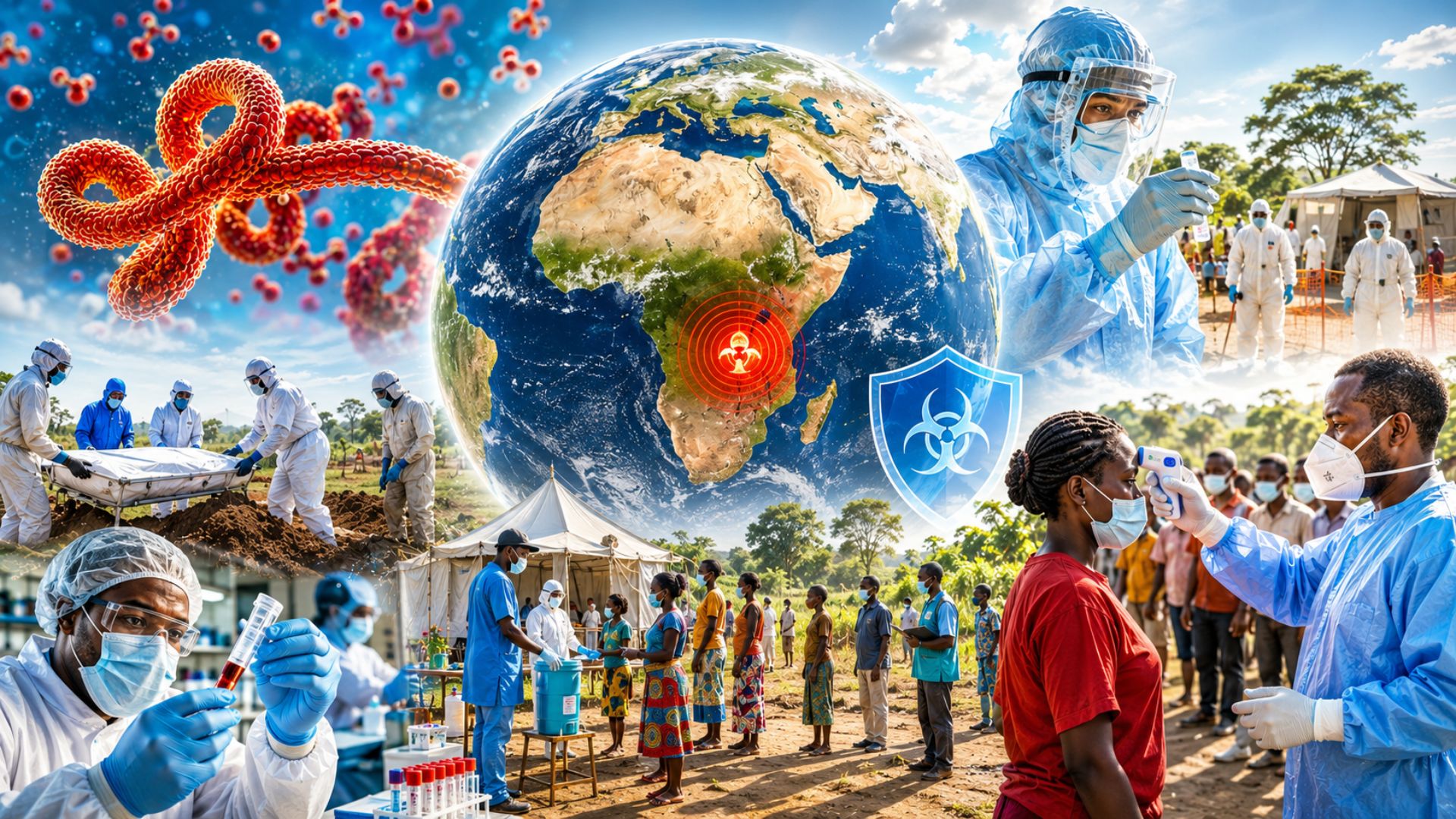
International Response to the Ebola Outbreak: A Cautious Approach
 Surya
Surya
With unusual alacrity, the World Health Organization declared a Public Health Emergency of International Concern (PHEIC) over a fresh Ebola outbreak in central Africa — bypassing its own convention of waiting for an emergency committee of expert panellists before doing so. Far from drawing criticism, the move has been widely applauded by global health experts. The reason: this outbreak carries a unique set of unknowns that demand a risk-averse approach from the outset.
The Outbreak: Where and What
The new Ebola outbreak was notified in the eastern Democratic Republic of Congo (DRC) and Uganda, confined to a limited cross-border region between the two nations. As of May 16, 2026:
Location              Confirmed Cases    Suspected Cases    Deaths (Suspected)
──────────────────────────────────────────────────────────────────────────────
DRC (Ituri Province)  8 lab-confirmed    246                80
Uganda (Kampala)      2 lab-confirmed    —                  1 confirmed death
──────────────────────────────────────────────────────────────────────────────
Note: The 2 Kampala cases have no apparent epidemiological link to each other
While the outbreak appears smaller in scale, WHO has flagged several indicators suggesting the true spread may be significantly larger than what is currently being detected:
- High positivity rate — 8 positives among 13 initial samples
- Confirmation of geographically separated cases in Kampala
- Increasing trends in syndromic reporting of suspected cases
- Clusters of deaths spread across Ituri province
Why the Bundibugyo Strain Is Different
This outbreak is caused by the Bundibugyo strain — an uncommon variant that has caused far fewer outbreaks historically compared to the well-studied Zaire strain. This distinction is critical:
- Vaccines currently in use (highly effective against Zaire) are untested against Bundibugyo
- Other therapies similarly lack proven efficacy against this strain
- The fatality rate of Ebola ranges between 25% and 50% depending on strain, access to care, and speed of treatment — the Bundibugyo strain's specific mortality profile remains uncertain
The unknowns surrounding Bundibugyo are precisely why WHO chose to act before its expert committee convened — a calculated departure from protocol in the interest of speed.
Why the Context Makes It Worse
Even a geographically confined outbreak becomes dangerous when the surrounding conditions are fragile:
- Ongoing armed conflict and displacement in eastern DRC means cases may go undetected
- Conflict impairs access to care and disrupts contact tracing
- The two Kampala cases — with no apparent link to each other — signal possible community transmission beyond the original cluster
History provides the starkest warning. The 2014–16 West Africa outbreak, caused by the Zaire strain, resulted in:
Countries affected:   Guinea, Liberia, Sierra Leone
Reported cases:       28,600+
Deaths:               11,325
That outbreak began as a contained cluster too.
What a PHEIC Actually Does
By issuing the highest level of global health alert, WHO has:
- Formally solicited international cooperation and resources
- Signalled to all member states the need for heightened surveillance
- Created a legal and diplomatic framework for coordinated response under International Health Regulations (IHR)
The PHEIC is not a declaration of pandemic — it is a call to action while containment is still possible.
Way Forward
Outbreak control at this stage must unfailingly include:
- Patient and contact tracing — rigorous, systematic, and cross-border
- Intensive clinical support for every confirmed and suspected patient
- Safe and dignified burials — a critical but culturally sensitive containment measure, as body fluids remain infectious after death
- Vaccination — if and where proven effective against Bundibugyo, pending trial results
- Social mobilisation — community-level information campaigns to reduce stigma, encourage reporting, and prevent transmission through behaviour change
- Conflict-sensitive humanitarian access — ensuring health workers can reach affected zones in Ituri despite ongoing displacement
Conclusion
WHO's decision to declare a PHEIC without waiting for its expert committee is not a procedural lapse — it is a lesson learned from past outbreaks where delay cost thousands of lives. The Bundibugyo strain introduces genuine scientific uncertainty into an already fragile humanitarian context. The world does not yet know how effective its tools are against this variant. What it does know is that Ebola with a 50% fatality rate, spreading through conflict zones, demands the earliest possible mobilisation of global attention and resources. This time, the alert came early. Whether the response matches the urgency is the question that will define the outcome.
Attribution
Original content sources and authors

Syllabus classification
How this article maps to GS papers
Main syllabus
GS2HealthcareQuick Q&A
What is a Public Health Emergency of International Concern (PHEIC), and why was the Ebola outbreak in central Africa declared under it?
In the present Ebola outbreak in the Democratic Republic of Congo (DRC) and Uganda, WHO acted with unusual speed, bypassing the conventional wait for an expert emergency committee. This decision reflects the precautionary principle because the outbreak involves the Bundibugyo strain, which is relatively uncommon and less studied than the Zaire strain. Existing vaccines and therapeutics proven against the Zaire strain have uncertain effectiveness here.
Why this matters:
- The outbreak is occurring in a conflict-affected border region with weak surveillance.
- Population displacement increases cross-border spread.
- The initial positivity rate (8 out of 13 samples) suggests under-detection.
A PHEIC declaration helps mobilize international funding, technical support, surveillance, and logistics. Similar action during COVID-19 and mpox demonstrated how early alerts can strengthen preparedness. In this case, WHO’s decision highlights that uncertainty itself can justify emergency intervention when fatality is high.
Why is the Bundibugyo strain of Ebola causing greater concern among global health authorities?
The challenge lies in the limited clinical evidence on how existing tools perform. Public health systems rely heavily on tested vaccines, rapid diagnostics, and established treatment protocols. If these are less effective against Bundibugyo, mortality and transmission could rise sharply.
Implications include:
- Delayed containment due to uncertain treatment efficacy
- Need for accelerated research trials
- Potential increase in panic and misinformation
For example, during the 2014 West Africa outbreak, delays in understanding viral spread worsened the crisis. In this outbreak, the Bundibugyo strain could similarly expose gaps in global preparedness. It underlines that disease surveillance must include genomic capacity and adaptable treatment systems.
How does conflict and displacement aggravate the management of infectious disease outbreaks such as Ebola?
Displaced populations often move across borders without medical screening. This facilitates hidden transmission chains. In addition, insecurity limits access for healthcare workers, delaying testing and treatment.
Major effects include:
- Breakdown of local reporting systems
- Increased risk of undetected community spread
- Difficulty in implementing quarantine and safe burials
A historical example is the Ebola outbreak in North Kivu (2018–20), where attacks on treatment centres delayed response. This shows that epidemics in fragile regions become not only medical crises but governance and security challenges. Effective outbreak management therefore requires humanitarian, diplomatic, and health coordination simultaneously.
Critically analyse WHO’s precautionary approach in declaring a global emergency early in this outbreak.
Advantages:
- Rapid mobilization of global resources
- Improved surveillance and laboratory support
- Political attention to affected countries
However, early emergency declarations may also have drawbacks, such as economic disruption, travel restrictions, and possible panic disproportionate to outbreak size.
Critical perspective: The key is proportionality. If the outbreak remains localized, critics may call the response excessive. But public health often values prevention over reaction. The COVID-19 experience showed the cost of delayed recognition. Therefore, WHO’s action reflects institutional learning: in high-fatality outbreaks, over-preparation is preferable to underestimation.
What lessons from the 2014–16 West Africa Ebola outbreak are relevant to the current crisis?
Key lessons:
- Early detection and declaration are critical
- Community trust is essential for containment
- Safe burials significantly reduce transmission
- Global financing mechanisms must activate rapidly
One major issue was misinformation and community resistance to health teams, which increased transmission.
The current outbreak must apply these lessons by prioritizing contact tracing, local communication, and dignified burial practices. The case demonstrates that epidemic management is as much about social trust and governance as clinical intervention.
Why is contact tracing considered central to Ebola outbreak control?
This process involves identifying every person who had physical contact with an infected individual and monitoring them during the incubation period. This helps prevent silent spread.
Importance:
- Interrupts transmission before symptoms spread further
- Supports targeted quarantine rather than broad lockdowns
- Improves outbreak mapping for resource allocation
For example, Nigeria’s 2014 Ebola response successfully controlled spread through aggressive contact tracing. The case shows that surveillance systems, trained personnel, and public cooperation are decisive. In fragile states, this becomes challenging but remains the cornerstone of response.
What broader lessons does this outbreak offer for global health governance and pandemic preparedness?
Broader lessons include:
- Need for strong WHO-led multilateral coordination
- Importance of genomic surveillance for new strains
- Investment in local health systems in fragile states
- Balancing emergency action with economic stability
The Bundibugyo outbreak shows how a localized event can have international implications. Similar to COVID-19, delays in transparency and testing can transform local outbreaks into global threats.
For India and other developing countries, this underscores the importance of strengthening disease surveillance, emergency response capacity, and international cooperation. Public health preparedness is now inseparable from national security and foreign policy.
Practice questions
1 question for mains preparation