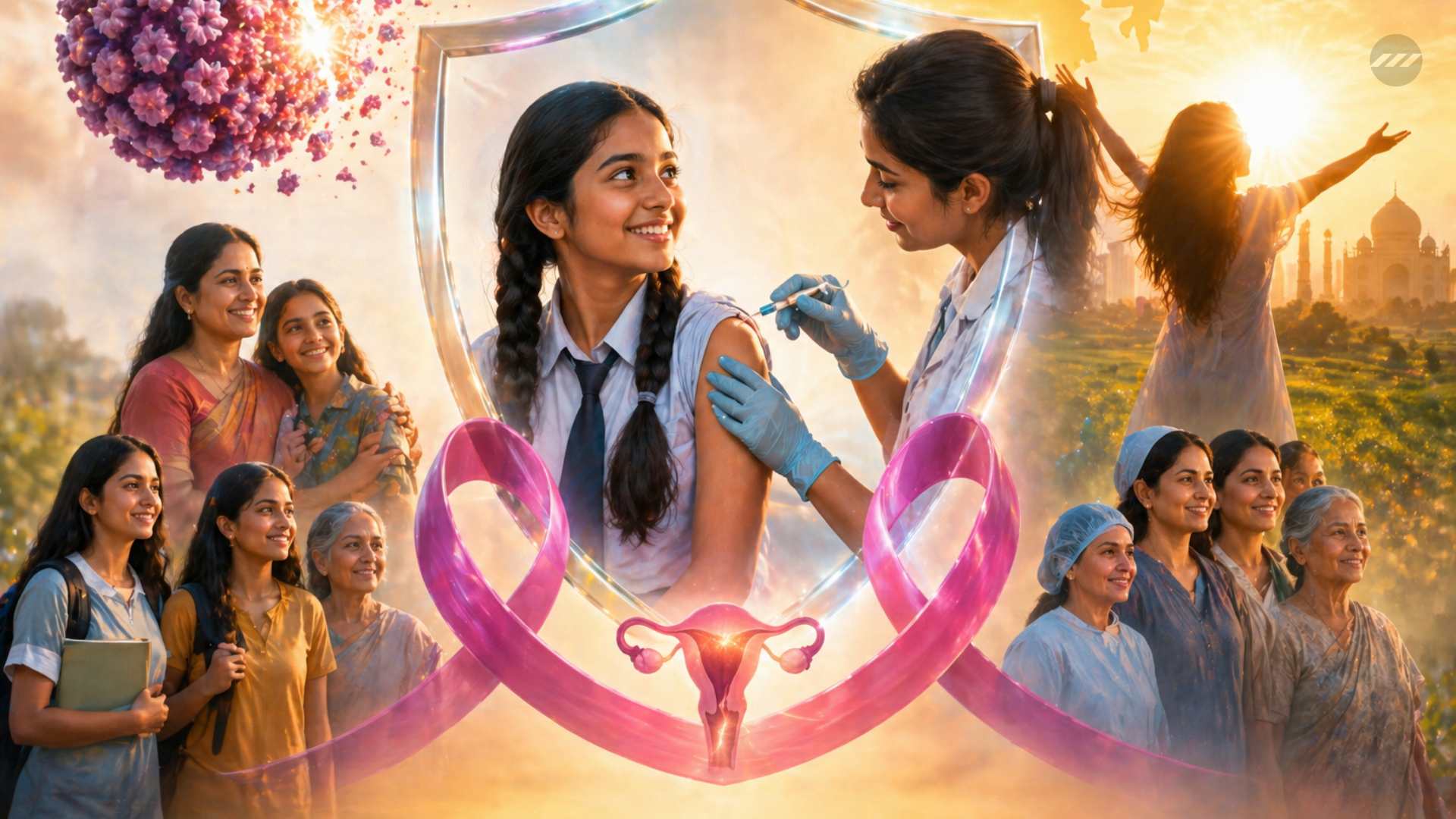
The Global Fight to Eliminate Cervical Cancer

Introduction
-
Cervical cancer remains the second most common cancer among women in India, with nearly 1 lakh new cases and ~50,000 deaths annually, accounting for ~25% of global burden.
-
The discovery of HPV’s role in cervical cancer led to preventive vaccines, making it one of the few cancers that can be eliminated through public health intervention.
“Prevention is better than cure.” — Desiderius Erasmus
Key Data Snapshot
| Indicator | Details |
|---|---|
| Cause | Human Papillomavirus (HPV) infection |
| Major Strains | HPV 16 & 18 (≈85% cases in India) |
| Annual Cases (India) | ~1,00,000 |
| Deaths (India) | ~50,000 |
| Screening Coverage | <5% |
| Vaccine Effectiveness | ~85–90% protection |
1. Background & Context
-
Cervical cancer develops due to persistent HPV infection.
-
It has a long precancerous phase (10–15 years):
- Known as Cervical Intraepithelial Neoplasia (CIN)
-
This provides a window for early detection and prevention
Global efforts:
- WHO launched Cervical Cancer Elimination Strategy (2020)
- Target: Reduce incidence to <4 per 1 lakh women
India:
- Endorsed the global strategy
- Recently launched National HPV Vaccination Campaign (2026)
2. Disease & Prevention Mechanism
A. Pathogenesis
- HPV infects cervical cells → causes abnormal cell growth → cancer
B. Types of Prevention
| Type | Method | Purpose |
|---|---|---|
| Primary | HPV vaccination | Prevent infection |
| Secondary | Pap smear / screening | Early detection |
| Tertiary | Surgery, chemo | Treatment |
3. HPV Vaccine: Key Features
-
Introduced globally in 2006
-
Initially 3-dose → now single-dose effective
-
Protects against:
- High-risk HPV strains
Advantages
-
Prevents 85–90% of cervical cancers
-
Safe:
- No major adverse effects
- No impact on fertility
Global Evidence
-
Countries like:
- Australia
- UK
- Sweden → Significant decline in cancer cases
4. Challenges in India
A. Low Screening Coverage
-
Less than 5% women screened
-
Reasons:
- Infrastructure gaps
- Lack of awareness
B. Healthcare Constraints
-
Limited:
- Labs
- Trained manpower
C. Social Barriers
-
Stigma around:
- Reproductive health
-
Poor follow-up compliance
D. Financial Burden
-
Treatment involves:
- Expensive surgeries
- Long-term care
5. Government & Global Initiatives
A. WHO Targets (2030)
| Target | Goal |
|---|---|
| Vaccination | 90% girls (before 15 yrs) |
| Screening | 70% women |
| Treatment | 90% cases treated |
B. India’s Response
-
National HPV Vaccination Campaign (2026)
-
Focus:
- Free vaccination for adolescent girls
- Expansion of screening programmes
6. Implications
A. Public Health
-
Reduces:
- Mortality
- Disease burden
B. Economic
-
Lowers:
- Healthcare expenditure
- Productivity loss
C. Gender Equity
-
Improves:
- Women’s health outcomes
- Reproductive rights
7. Way Forward
-
Scale up:
- HPV vaccination coverage
-
Strengthen:
- Screening infrastructure
-
Increase:
- Awareness campaigns
-
Ensure:
- Follow-up and treatment access
Conclusion
Cervical cancer is a preventable and potentially eliminable disease, yet it continues to impose a heavy burden in India. A combination of vaccination, screening, and awareness can transform outcomes and align with the vision of a healthy and equitable society.
Attribution
Original content sources and authors


Syllabus classification
How this article maps to GS papers
Main syllabus
GS2HealthcareQuick Q&A
What is the link between Human Papillomavirus (HPV) infection and cervical cancer, and why is it significant for public health?
Public health significance: This understanding has major implications for prevention. It enables both primary prevention through vaccination and secondary prevention through screening (Pap smear and HPV testing). In India, cervical cancer is the second most common cancer among women, with around one lakh new cases annually, accounting for nearly a quarter of the global burden. The relatively young age of affected women increases the social and economic impact.
Transformative impact: The identification of HPV as the cause has allowed policymakers to design targeted interventions such as mass vaccination campaigns and screening programs. Countries that adopted these measures early, like Australia and the U.K., have witnessed dramatic declines in incidence. Thus, the HPV-cervical cancer link represents a model for disease elimination through scientific discovery and public health intervention.
Why is cervical cancer considered a critical public health issue in India and other low- and middle-income countries (LMICs)?
Healthcare system constraints: One of the major reasons for this burden is the lack of adequate screening infrastructure. Pap smear programs, which have been highly successful in the West, are difficult to scale in India due to shortages of trained personnel, laboratory capacity, and logistical challenges. Screening coverage in India remains below 5%, and follow-up compliance is poor. This results in late-stage diagnosis, where treatment is more complex and costly.
Socio-economic and awareness factors: सामाजिक stigma, lack of awareness, and gender inequality further hinder early detection and treatment. Women often delay seeking care due to social or financial constraints. These factors collectively make cervical cancer not just a medical issue but a developmental and equity challenge. Addressing it is essential for achieving broader goals such as women’s health, gender equality, and universal health coverage.
How does HPV vaccination contribute to the prevention of cervical cancer, and what are its advantages over traditional screening methods?
Advantages over screening: While screening methods like Pap smears detect disease at an early stage, vaccination prevents it altogether. Screening requires repeated testing, laboratory infrastructure, and follow-up, which are challenging in resource-limited settings. In contrast, vaccination is a one-time or limited-dose intervention with long-term benefits. It reduces dependence on complex healthcare systems and ensures broader coverage, especially in rural areas.
Evidence of effectiveness: Countries like Australia, which implemented early vaccination programs, are on track to eliminate cervical cancer as a public health problem. Studies from Sweden, Denmark, and the U.K. show significant reductions in both HPV infections and cervical cancer incidence. In India, the rollout of the National HPV Vaccination Campaign (2026) marks a major step toward replicating these successes. Thus, vaccination offers a cost-effective and scalable solution for disease prevention.
What are the reasons for low screening coverage and poor compliance in cervical cancer prevention programs in India?
Socio-cultural barriers: Cultural factors play a significant role in limiting participation. महिलाओं may feel hesitant to undergo gynecological examinations due to stigma, lack of privacy, or social taboos. Additionally, awareness about cervical cancer and its prevention remains low, leading to delayed or no participation in screening programs.
Systemic and logistical challenges: Even when screening is conducted, follow-up and treatment compliance is poor. Women who test positive often fail to return for confirmatory tests or treatment due to financial constraints, distance from healthcare facilities, or lack of support systems. Outreach camps, though helpful, are insufficient to address the scale of the problem. These combined factors result in a weak screening ecosystem, underscoring the need for alternative strategies like vaccination.
Critically analyze the challenges and opportunities in achieving WHO’s cervical cancer elimination targets by 2030.
Key challenges: Despite these opportunities, significant barriers remain. Achieving high vaccination coverage requires addressing vaccine hesitancy, logistical constraints, and funding limitations. Screening targets are even more challenging due to existing infrastructure gaps. Additionally, disparities between urban and rural areas may widen if interventions are not equitably distributed.
Way forward: A multi-pronged approach is needed, combining vaccination, screening, and treatment with strong community engagement. Public awareness campaigns, integration with school health programs, and digital health tracking can improve coverage. Learning from countries like Australia, which adopted a comprehensive strategy, India can tailor solutions to its context. While ambitious, the targets are achievable with sustained commitment and coordinated action.
What lessons can India learn from global experiences in reducing cervical cancer burden through HPV vaccination and screening?
Key lessons for India:
- Early and widespread vaccination: स्कूल-based vaccination programs ensure high coverage among adolescents.
- Integration with screening: Combining vaccination with regular screening maximizes effectiveness.
- Strong public awareness: Campaigns addressing myths and misinformation improve acceptance.
Adaptation to Indian context: India must tailor these lessons to its socio-economic realities. Leveraging existing programs like Ayushman Bharat and school health initiatives can improve outreach. Additionally, focusing on affordability and accessibility, especially in rural areas, is crucial. By adopting and adapting global best practices, India can significantly reduce its cervical cancer burden and move toward elimination.
Practice questions
1 question for mains preparation