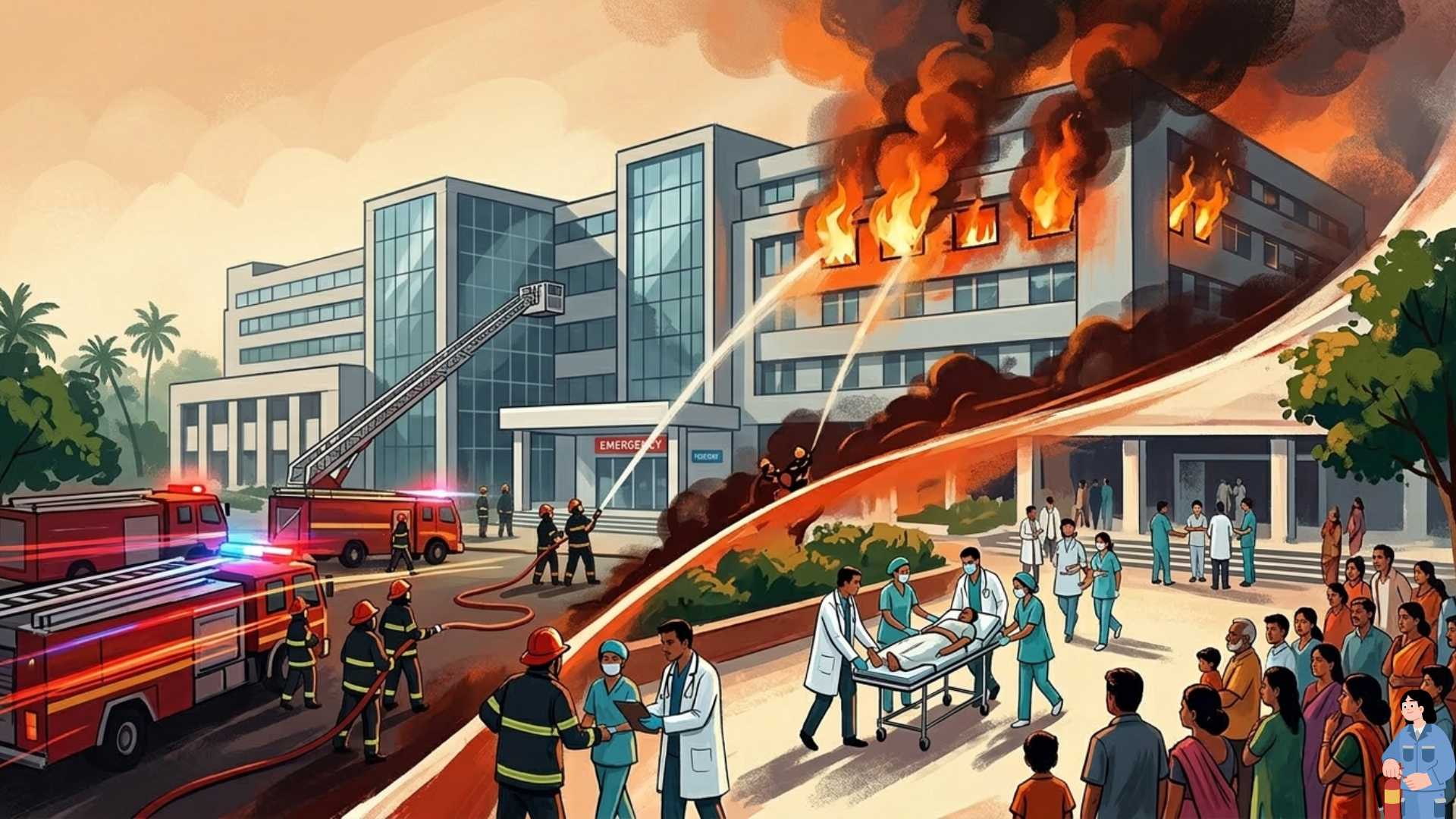
Tragic Fire Incident in Odisha Hospital Claims Ten Lives

A devastating blaze in SCB Medical College Hospital's ICU critically injures many, prompting an urgent investigation and reflection on hospital safety protocols.
G
Gopi
3 mins read
ICU Fire Tragedy: A Wake-Up Call for Hospital Safety in India

Introduction

Hospital fires remain a critical yet under-addressed public safety issue in India. According to NCRB data, over 7,500 fire incidents in public buildings were reported annually in recent years, with hospitals being particularly vulnerable due to oxygen-rich environments. Globally, WHO emphasizes that healthcare infrastructure safety is integral to resilient health systems. The SCB Medical College fire incident highlights systemic gaps in safety protocols, emergency preparedness, and regulatory enforcement.


Background / Context

The fire in the ICU of SCB Medical College Hospital, Odisha, allegedly caused by a short circuit, led to multiple deaths and injuries.

  • Fire broke out in a high-dependency ICU setting.
  • Patients suffered primarily due to asphyxia (smoke inhalation).
  • Delays in emergency response and evacuation worsened the situation.
  • Government ordered judicial inquiry under Commissions of Inquiry Act, 1952.

Key Concepts: Fire Risks in Hospitals

FactorExplanation
Oxygen-rich environmentHigh risk of rapid fire spread
Electrical overloadFrequent cause of short circuits
Flammable materialsCurtains, bedding, chemicals
ICU vulnerabilityImmobile patients require assisted evacuation
Poor infrastructureLack of fire exits, alarms, sprinklers

Regulatory Framework in India

  • National Building Code (NBC), 2016

    • Specifies fire safety norms for hospitals (Part 4: Fire & Life Safety).
  • State Fire Services Acts

    • Enforcement and periodic inspections.
  • Clinical Establishments Act, 2010

    • Mandates minimum standards, including safety.
  • Disaster Management Act, 2005

    • Hospitals categorized as critical infrastructure.

Gap: Weak enforcement, irregular audits, and compliance failures.


Major Challenges Identified

Infrastructure Deficiencies

  • Non-functional fire alarms and sprinklers.
  • Poor electrical maintenance leading to short circuits.

Emergency Preparedness Gaps

  • Lack of trained staff for evacuation.
  • Absence of mock drills.

Administrative Lapses

  • Delayed fire service response.
  • Inadequate coordination between hospital and emergency services.

Accountability Issues

  • Safety audits often treated as procedural formalities.
  • Limited penal consequences for violations.

Implications

Public Health Impact

  • Loss of lives in critical care settings.
  • Erosion of trust in public healthcare institutions.

Governance Concerns

  • Highlights failure of regulatory oversight.
  • Raises questions about cooperative federalism in safety compliance.

Ethical Dimension

  • Hospitals as “safe spaces” becoming sites of preventable disasters.

Case Study: SCB Medical College Fire (2026)

  • Cause: Suspected electrical short circuit.

  • Casualties: 10 deaths, several injured.

  • Systemic issues: Delayed fire response (~30 minutes), lack of rapid evacuation mechanisms.

  • Government response:

    • Judicial Commission of Inquiry (60-day timeline)
    • Ex gratia compensation (₹25 lakh by State, ₹2 lakh by Centre)

Comparative Insight

CountryBest Practice
USAMandatory fire drills and accreditation-linked safety audits
UKFire Risk Assessment under Regulatory Reform Order
IndiaNorms exist but enforcement remains weak

Expert Opinion / Quotes

  • WHO: “Safe hospitals are a cornerstone of disaster-resilient health systems.”
  • NDMA Guidelines: Emphasize “prevention, preparedness, and mitigation” in hospital safety.

Way Forward

Strengthening Infrastructure

  • Mandatory installation of automatic fire detection and suppression systems.
  • Periodic electrical safety audits.

Institutional Reforms

  • Linking hospital accreditation (NABH) with strict fire safety compliance.
  • Third-party safety audits.

Capacity Building

  • Regular fire drills and staff training.
  • Emergency evacuation protocols for ICUs.

Technology Integration

  • Use of IoT-based fire detection systems.
  • Real-time monitoring and alert systems.

Accountability Mechanisms

  • Fixing responsibility for lapses.
  • Strict penalties for non-compliance.

Conclusion

The SCB Medical College fire underscores a recurring governance failure in ensuring hospital safety in India. While regulatory frameworks exist, their weak implementation continues to cost lives. Strengthening institutional accountability, enforcing safety norms, and building resilient healthcare infrastructure are imperative to prevent such tragedies and ensure public trust in the health system.


UPSC Mains Question (250 words)

“Hospital fire incidents in India reveal systemic governance and infrastructural failures rather than isolated accidents.” Critically examine with suitable examples and suggest reforms.

Quick Q&A

Everything you need to know

The fire incident at SCB Medical College Hospital highlights multiple systemic issues in India's public healthcare infrastructure. At its core, the tragedy points to lapses in hospital safety standards, emergency preparedness, and infrastructure maintenance. The alleged cause—a short circuit—suggests inadequate electrical safety audits and poor upkeep of critical facilities, especially in high-risk zones like ICUs where oxygen supply and electrical equipment coexist.

Key concerns include:

  • Infrastructure vulnerability: Overburdened public hospitals often operate with outdated wiring and insufficient fire safety systems.
  • Delayed emergency response: The fire services reportedly took around 30 minutes to reach, which is critical in fire-related emergencies.
  • Evacuation challenges: ICU patients are highly dependent on life-support systems, making evacuation complex and time-sensitive.
  • Accountability gaps: The need for judicial inquiry indicates possible administrative negligence.

Broader implications: Such incidents reflect structural weaknesses in healthcare governance and raise questions about compliance with the National Building Code and fire safety norms. Similar incidents, like the 2021 fire in a COVID hospital in Maharashtra, underscore that this is not an isolated problem but a recurring national concern requiring systemic reforms.

Fire safety in hospitals, especially ICUs, is critical due to the vulnerability of patients and the complex medical environment. ICUs house patients who are often unconscious or immobile and dependent on life-support systems such as ventilators, oxygen cylinders, and monitoring devices. This makes rapid evacuation extremely difficult and increases the risk of casualties during emergencies.

Key reasons include:

  • Presence of flammable materials: Oxygen-rich environments significantly increase fire hazards.
  • High electrical load: Continuous use of medical equipment raises the risk of short circuits.
  • Limited mobility of patients: Patients cannot be moved quickly without trained personnel and backup systems.
  • Psychological panic: Fires can lead to chaos among staff and attendants, further complicating evacuation.

Implications for governance: The incident underscores the need for strict adherence to fire safety audits, mock drills, and installation of automated fire suppression systems. Globally, countries like the UK mandate rigorous hospital safety certifications, which India can emulate. Strengthening safety protocols is essential not only to prevent loss of life but also to maintain public trust in healthcare institutions.

Improving emergency response in hospitals requires a multi-layered approach involving infrastructure, training, and coordination. The SCB incident demonstrates that even a short delay in response can lead to significant loss of life, particularly in critical care settings.

Key measures include:

  • Establishing in-house fire response units: Hospitals should have trained emergency teams equipped with firefighting tools.
  • Regular mock drills: Staff must be trained in evacuation protocols, especially for ICU patients.
  • Integration with local fire departments: Real-time coordination systems can reduce response time.
  • Use of technology: Installation of fire alarms, smoke detectors, and automated suppression systems.

Administrative reforms: Governments should enforce mandatory safety audits and real-time monitoring systems in hospitals. The National Disaster Management Authority (NDMA) guidelines on hospital safety should be strictly implemented. Additionally, learning from global best practices, such as Japan’s disaster-resilient hospital systems, can help India build more robust emergency frameworks.

Recurring fire accidents in Indian hospitals are the result of systemic and institutional shortcomings. These incidents are rarely isolated; instead, they reflect deeper issues in governance, infrastructure, and regulatory enforcement.

Major causes include:

  • Poor infrastructure maintenance: Aging buildings and outdated electrical systems increase vulnerability.
  • Non-compliance with safety norms: Many hospitals lack valid fire safety certificates or ignore renewal requirements.
  • Overcrowding: High patient load leads to overuse of facilities beyond designed capacity.
  • Weak regulatory oversight: Inspections are often irregular and lack strict enforcement mechanisms.

Structural issues: Public hospitals, in particular, suffer from resource constraints and administrative inefficiencies. For example, the Ahmedabad COVID hospital fire (2020) and Bhandara hospital fire (2021) revealed similar patterns of negligence. Addressing these issues requires not just reactive measures but proactive investments in infrastructure, stricter accountability, and a culture of safety compliance.

Government response in disaster situations typically includes immediate relief measures and long-term accountability mechanisms. In the SCB hospital case, the announcement of ex gratia compensation and the ordering of a judicial inquiry reflect a standard administrative response.

Positive aspects:

  • Immediate financial relief: Compensation helps affected families cope with sudden loss.
  • Judicial inquiry: Ensures an independent investigation into lapses and accountability.
  • High-level committees: Fact-finding teams can identify systemic gaps.

Limitations:
  • Reactive approach: Such measures are often taken after tragedies rather than preventing them.
  • Delayed justice: Judicial inquiries may take time, reducing immediate accountability.
  • Limited deterrence: Without strict punitive action, similar incidents may recur.

Way forward: The government must shift from a compensation-based approach to a prevention-focused framework. This includes stricter enforcement of safety norms, real-time audits, and fixing accountability at multiple levels. Lessons can be drawn from countries with strong regulatory systems where negligence leads to swift penalties and systemic reforms.

India has witnessed several hospital fire incidents in recent years, highlighting a pattern of systemic failures. Notable examples include the Bhandara District Hospital fire (2021), where newborns died in a neonatal unit, and the Ahmedabad COVID hospital fire (2020), which killed several patients.

Lessons from these incidents:

  • Need for strict compliance: Many hospitals lacked functional fire safety equipment.
  • Importance of audits: Regular inspections could have identified risks earlier.
  • Training of staff: Lack of preparedness worsened the impact.
  • Infrastructure modernization: Old buildings need urgent upgrades.

Global perspective: Countries like the United States enforce stringent hospital accreditation standards through bodies like the Joint Commission. These include regular safety drills and mandatory reporting systems.

Way forward for India: Institutionalizing best practices, strengthening regulatory bodies, and ensuring accountability are crucial. Learning from past failures is essential to prevent recurrence and to build a resilient healthcare system.

Designing a comprehensive fire safety and disaster management plan requires a proactive and integrated approach. As a hospital administrator, the focus would be on prevention, preparedness, and response.

Key components of the plan:

  • Risk assessment: Identify high-risk zones such as ICUs, operation theatres, and oxygen supply units.
  • Infrastructure upgrades: Install fire-resistant materials, modern wiring, and automated suppression systems.
  • Emergency protocols: Develop clear evacuation plans, especially for critical patients.
  • Training and drills: Conduct regular mock drills for staff and ensure awareness among patients' attendants.

Coordination and technology: Integrate hospital systems with local fire departments and use real-time monitoring tools like smoke detectors and alarm systems. Digital dashboards can help track emergencies instantly.

Accountability and review: Establish a system of periodic audits and third-party inspections. Lessons from incidents should be incorporated into updated protocols. Such a holistic approach can significantly reduce risks and ensure patient safety, aligning with NDMA guidelines and global best practices.

Attribution

Original content sources and authors

Sign in to track your reading progress

Comments (0)

Please sign in to comment

No comments yet. Be the first to comment!