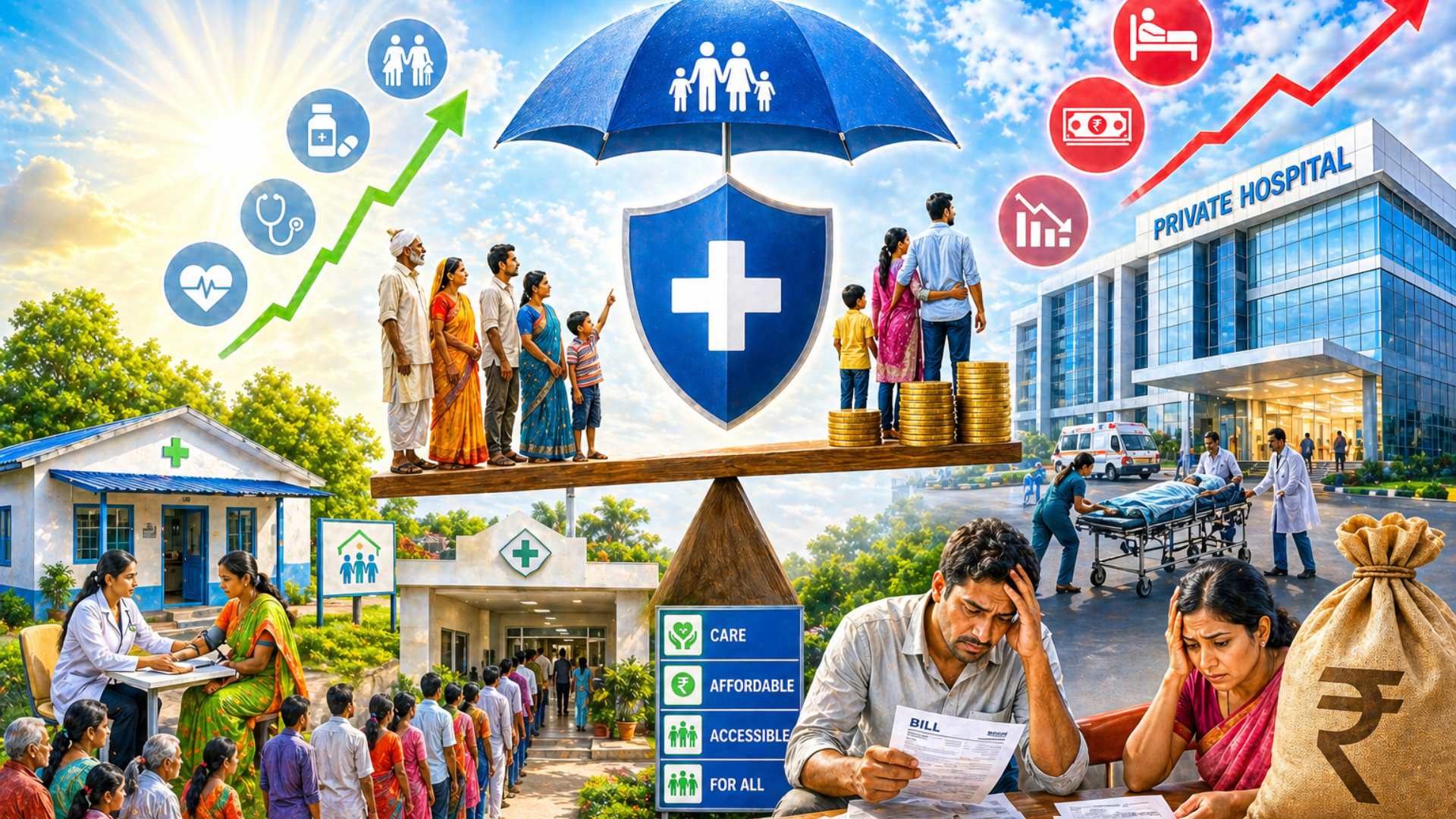
Increasing Coverage Yet Growing Distress in Healthcare

"The experience of the first seven years of PMJAY shows these schemes are 'of the rich', 'for the profit', and 'by the poor people'!" — Indranil & Montu Bose, 2026
The NSS 80th Round (2025) reveals a fundamental paradox at the heart of India's health policy: insurance coverage has more than doubled, yet hospitalisation rates remain below 2014 levels, out-of-pocket expenditure has doubled, and the poorest beneficiaries are the least likely to actually use the schemes designed for them.
| Indicator | 2017-18 | 2025 | Direction |
|---|---|---|---|
| Rural insurance coverage | ~18% | 47.4% | ↑ Significant |
| Urban insurance coverage | ~15% | 44.3% | ↑ Significant |
| Hospitalisation rate — Urban | Baseline | Below 2017-18 | ↓ Declined |
| Hospitalisation rate — Rural | Baseline | Marginal rise | → Stagnant |
| OOP expenditure — Rural | Baseline | More than doubled | ↑ Sharp rise |
| OOP expenditure — Urban | Baseline | More than doubled | ↑ Sharp rise |
| Private hospital costs — Rural | Baseline | +70% | ↑ Sharp rise |
| Private hospital costs — Urban | Baseline | +80% | ↑ Sharp rise |
| PMJAY enrollees using private hospitals | — | 57% | Structural concern |
| Urban poorest using GFHI hospitalisation | — | Only 13% | Equity failure |
Background & Context
India's UHC model = insurance-led
Primary instrument = PMJAY (PM Jan Arogya Yojana) + State schemes (Swasthya Saathi etc.)
Design premise: Cover high-cost, low-frequency hospitalisation for poor households
               via empanelled public and private facilities
Promise to beneficiaries: Free treatment in private hospitals
Reality check: 57% of enrolled patients went to private hospitals
               Very few received free care as promised
               Average OOP despite insurance: ₹31,250 (rural), ₹34,259 (urban)
Four Core Problems
1. Coverage ≠ Utilisation
Insurance coverage: Rose 2.5x between 2017-18 and 2025
Hospitalisation rate: Still below 2014 levels
Urban hospitalisation: Declined further despite coverage expansion
- Coverage is an input metric — utilisation is the outcome metric that matters
- Rising coverage with falling/stagnant utilisation signals access barriers beyond insurance — distance, awareness, supply-side gaps
- The scheme measures success by enrollment numbers, not by actual care delivered
2. Shift to Private Sector — With Higher Costs
2014 to 2017-18: Public sector hospital use had risen
2017-18 to 2025: Considerable reduction in public hospital and childbirth use
More people choosing private care — even for childbirth
Private hospitalisation costs: +70% rural, +80% urban
Even in public hospitals: Significant OOP due to medicine/diagnostic unavailability
                          Plus transport and non-medical costs
- PMJAY was meant to make private care free for the poor — it has instead made private care more accessible but not free
- Public hospitals remain under-resourced — driving people to costlier private alternatives
- The scheme subsidises private sector market expansion rather than strengthening public care
3. Elite Capture of Poor-Targeted Schemes
GFHI design: Targets socioeconomically backward sections
Reality: Many states extended coverage to non-poor populations
Urban poorest using GFHI hospitalisation services: Only 13%
Better-off households: Disproportionately higher utilisation
Haryana + West Bengal: ~15% of state health budget spent on GFHIs
Fiscal consequence: Delays in reimbursement to private providers
- Classic elite capture pattern — scheme designed for poor, benefits skewed toward better-off
- Non-poor inclusion crowds out poor beneficiaries and strains state budgets simultaneously
- Reimbursement delays create a vicious cycle — private providers under-serve PMJAY patients to protect margins
4. Tax Money Subsidising Private Profit
GFHI mechanism: Government pays private hospitals for treating poor patients
PMJAY reimbursement rates: Below market rates but more than CGHS
Private hospital response: Charge patients additionally above reimbursement
Private sector character: Profit-maximisation driven; largely unregulated; limited social solidarity
Net result: Public tax money opens new markets for private hospitals
           while the poor still pay out of pocket
- The model is structurally described as: "of the rich, for the profit, by the poor people"
- Government becomes a demand generator for private healthcare rather than a public healthcare provider
- No regulatory framework exists to prevent over-charging or unnecessary procedures under PMJAY
The Way Forward: Rethinking the Model
| Current Model (Insurance-Led) | Alternative (Public System Strengthening) |
|---|---|
| Pays private hospitals for poor patients | Invests in public hospital capacity directly |
| Measures success by enrollment | Measures success by utilisation and health outcomes |
| Reactive — covers hospitalisation costs | Proactive — prevents hospitalisation through primary care |
| Benefits skewed toward better-off | Universal access regardless of income |
| Fiscally strains states via reimbursement | Predictable budget line for public infrastructure |
Ayushman Arogya Mandir (AAM) — The Neglected Counterpart:
AAM = PMJAY's primary care companion
Designed for: Comprehensive primary care including NCD management
Current status: Severely underfunded — like the National Health Mission
Potential: If adequately funded, addresses the prevention gap
           that hospitalisation insurance cannot touch
Conclusion
The NSS 80th Round data delivers a structural verdict on India's insurance-led UHC model: coverage without strengthened public systems produces coverage without care. PMJAY has expanded insurance enrollment impressively — but the data shows it has simultaneously accelerated private sector dependence, failed to protect the poorest from financial hardship, and used public funds to subsidise private profit. The policy correction is not to abandon insurance but to rebalance: massively reinvest in public hospital capacity, regulate private providers under PMJAY more stringently, and fund Ayushman Arogya Mandir as a genuine primary care foundation rather than an afterthought.
Attribution
Original content sources and authors
_.jpeg)

Syllabus classification
How this article maps to GS papers
Main syllabus
GS2HealthcareQuick Q&A
What are the key findings of the NSS 80th Round on Health (2025) regarding insurance coverage, healthcare utilisation, and expenditure?
Key trends observed:
- Stagnant or declining hospitalisation rates: Despite higher coverage, hospitalisation rates remain below 2014 levels
- Shift to private sector: Increasing reliance on private hospitals for both hospitalisation and childbirth
- Rising Out-of-Pocket (OOP) expenditure: OOP costs have more than doubled between 2017–18 and 2025
For example, average hospitalisation costs in private hospitals have risen by up to 80% in urban areas, indicating that insurance is not adequately shielding households from financial shocks.
Implications: These findings suggest that insurance-led healthcare expansion alone is insufficient. Structural issues such as weak public health infrastructure, unregulated private sector pricing, and gaps in service delivery continue to undermine the goal of Universal Health Coverage (UHC).
Why has increased health insurance coverage in India not translated into better healthcare utilisation and financial protection?
Key reasons include:
- Weak public healthcare system: Shortages of medicines, diagnostics, and infrastructure force patients to seek private care
- Limited awareness and access: Beneficiaries may not fully understand entitlements or face administrative barriers
- Hidden costs: Even in public hospitals, patients incur expenses on transport, medicines, and informal payments
For instance, despite being insured, patients often pay significant amounts due to unavailability of free medicines in public facilities.
Financial protection failure: Insurance schemes often have limited coverage ceilings and exclusions, leading to high OOP expenses. Additionally, private hospitals may charge above reimbursement rates, passing the burden onto patients.
Conclusion: Without strengthening the supply side—especially public healthcare infrastructure—insurance expansion alone cannot achieve equitable access or financial risk protection.
How do Government-Financed Health Insurance (GFHI) schemes like PMJAY function, and what are their limitations?
Operational features:
- Coverage for secondary and tertiary hospitalisation
- Empanelment of both public and private healthcare providers
- Predefined package rates for treatments
However, their implementation reveals several structural limitations.
Key limitations:
- High dependence on private sector: Around 57% of beneficiaries seek care in private hospitals
- Incomplete financial protection: Patients still incur significant OOP expenses (₹30,000+ on average)
- Fiscal strain: States like Haryana and West Bengal spend up to 15% of their health budgets on these schemes
Additionally, delayed reimbursements discourage private providers, who may then charge patients extra.
Conclusion: While GFHI schemes expand coverage, their design—focused on hospitalisation and private sector participation—limits their effectiveness in delivering comprehensive and equitable healthcare.
What explains the increasing shift from public to private healthcare despite the expansion of public insurance schemes?
Key factors driving this shift:
- Perceived better quality in private sector: Shorter waiting times and better facilities
- Supply-side gaps: Inadequate availability of doctors, medicines, and diagnostics in public hospitals
- Insurance design: GFHI schemes incentivize private sector participation
For example, patients often choose private hospitals for childbirth despite higher costs, due to better perceived care.
Consequences: This shift leads to higher OOP expenditure and increased financial burden on households. It also results in public funds indirectly subsidizing private healthcare providers.
Conclusion: Unless public healthcare is strengthened, the trend toward privatization will continue, undermining the goals of affordability and equity in healthcare delivery.
Critically analyze the effectiveness of the insurance-led model of Universal Health Coverage (UHC) in India.
Limitations and concerns:
- Inadequate financial protection: Rising OOP expenditure indicates failure to shield households
- Urban bias and inequity: Better-off groups benefit more from these schemes
- Neglect of primary care: Focus on hospitalisation ignores preventive and outpatient services
- Private sector dominance: Public funds subsidize profit-driven healthcare providers
For instance, only 13% of urban beneficiaries using these schemes belong to the poorest वर्ग, highlighting inequitable utilisation.
Critical perspective: The model risks creating a system that is “of the rich, for the profit, by the poor,” where public resources disproportionately benefit private providers.
Way forward: A balanced approach is needed, combining insurance with strong public health infrastructure, regulation of private providers, and investment in primary care.
Conclusion: The insurance-led model alone cannot achieve UHC; it must be complemented by systemic reforms to ensure equity, accessibility, and affordability.
How do rising Out-of-Pocket (OOP) expenditures illustrate the gaps in India’s healthcare system? Provide examples.
Evidence from NSS data:
- OOP expenditure on hospitalisation has more than doubled between 2017–18 and 2025
- Average expenses exceed ₹30,000 even for insured individuals
- Costs in private hospitals have risen by up to 80%
For example, a rural household covered under PMJAY may still incur significant expenses due to additional charges by private hospitals or lack of free medicines in public facilities.
Broader implications: High OOP expenditure pushes households into poverty and debt, undermining the objective of financial risk protection. It also discourages timely healthcare utilisation, leading to worse health outcomes.
Conclusion: Rising OOP costs highlight the need for comprehensive reforms, including better regulation of private healthcare, improved public service delivery, and expansion of coverage to outpatient care.
As a health policy advisor, what reforms would you suggest to improve India’s progress toward Universal Health Coverage (UHC)?
Key reform measures:
- Strengthen primary healthcare: Expand and adequately fund Ayushman Arogya Mandirs (AAMs) to provide preventive and outpatient services
- Increase public health spending: Enhance investment under the National Health Mission
- Regulate private sector: Implement price caps and standard treatment guidelines
- Reduce OOP costs: Ensure availability of free medicines and diagnostics in public facilities
Case example: Countries like Thailand have successfully achieved UHC by prioritizing strong public healthcare systems alongside insurance coverage.
Implementation strategy: Integrating digital health systems, improving governance, and ensuring timely reimbursements can enhance efficiency.
Conclusion: A hybrid model that combines robust public healthcare with targeted insurance schemes is essential to achieve equitable and sustainable UHC in India.
Practice questions
3 questions for mains preparation