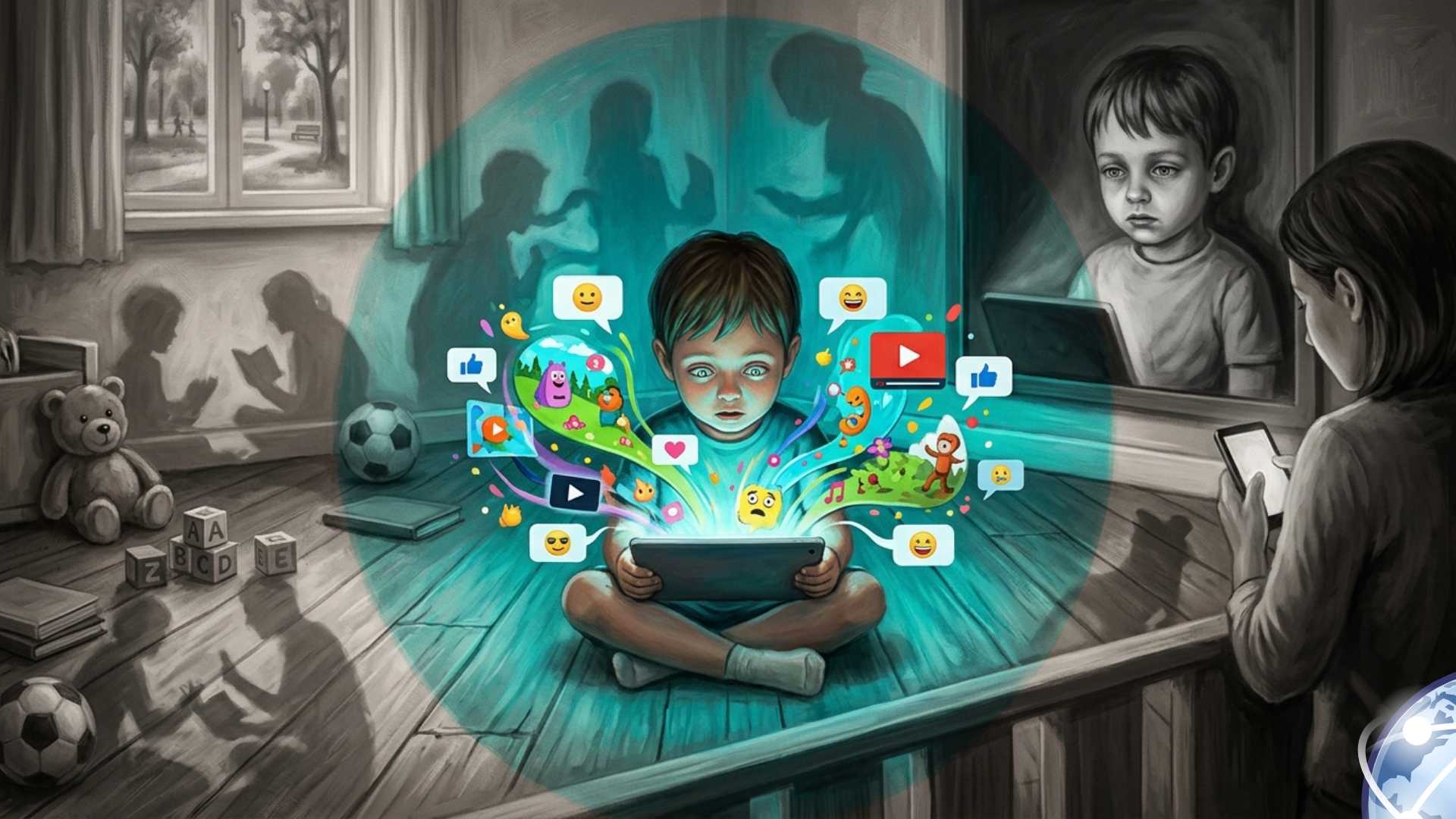
"Children who stayed within guidelines showed almost no increased risk — problems appeared when children regularly exceeded these limits." — Dr. Michael Noetel, University of Queensland
As digital penetration deepens across the world, children are being shaped less by human interaction and more by algorithmic content — with measurable consequences for mental health, social development, and cognitive growth.
| Statistic | Data |
|---|---|
| Average daily screen time — U.S. teenagers | 8.5 hours (JAMA study) |
| Studies reviewed in Queensland meta-analysis | 117 studies |
| Children tracked across studies | ~3 lakh |
| Recommended screen time — preschoolers | Under 1 hour/day |
| Recommended screen time — older children | Under 2 hours/day |
| Age of phone access linked to worst outcomes | Below 8 years old |
Background and Context
The COVID-19 pandemic accelerated children's exposure to digital screens globally, normalising early and unsupervised device use. What began as a necessity during lockdowns has persisted as a default parenting tool, raising urgent concerns among paediatricians, psychologists, and policymakers about long-term developmental consequences.
Key Concepts
Opportunity Cost of Screen Time Screen exposure does not merely harm in isolation — it displaces critical developmental activities. Infants and toddlers learn through crawling, touching, and sensory exploration. Screen absorption forecloses these experiences, affecting sensory integration and environmental awareness.
Social Skill Attrition Human interaction involves reading body language, tone of voice, facial expressions, and non-verbal cues — none of which are fully transmitted through digital interfaces. Children raised on screens risk growing up socially underprepared, struggling with conflict resolution, empathy, and group dynamics.
The Vicious Cycle Research establishes a bidirectional relationship: screen time worsens emotional problems, and children with emotional problems turn to screens to cope — creating a reinforcing cycle that is difficult to break without structured intervention.
Implications and Challenges
Mental Health Consequences
| Age Group | Documented Risks |
|---|---|
| Below 2 years | Sensory skewing, stunted motor development |
| 2–8 years | Impaired social skill formation, attention deficits |
| Adolescents | Anxiety, depression, aggression, detachment from reality |
| Phone access before 8 | Hallucinations, suicidal ideation, diminished self-worth |
Governance and Regulatory Gaps The internet currently lacks robust age-gating mechanisms. Algorithmic content delivery — designed to maximise engagement — exposes children to inappropriate material even under parental supervision, pointing to a regulatory vacuum that governments are yet to adequately address.
Parental Complicity Parents themselves are screen-dependent, modelling the very behaviour they seek to restrict. This dual vulnerability — child addiction reinforced by parental habit — makes household-level intervention insufficient without broader societal and policy support.
Case Study: Ghaziabad, Uttar Pradesh (2025)
Three minor sisters (aged 12–16) who had dropped out of school in 2020 due to digital addiction died by suicide after their parents restricted phone access. Their note cited feelings of loneliness triggered by being cut off from online content — a stark illustration of how digital dependency can reach life-threatening severity in the absence of structured intervention and mental health support.
Conclusion
Unchecked screen exposure is emerging as a silent public health crisis — one that demands coordinated action across regulation, parenting, platform design, and school policy before an entire generation bears the developmental cost.