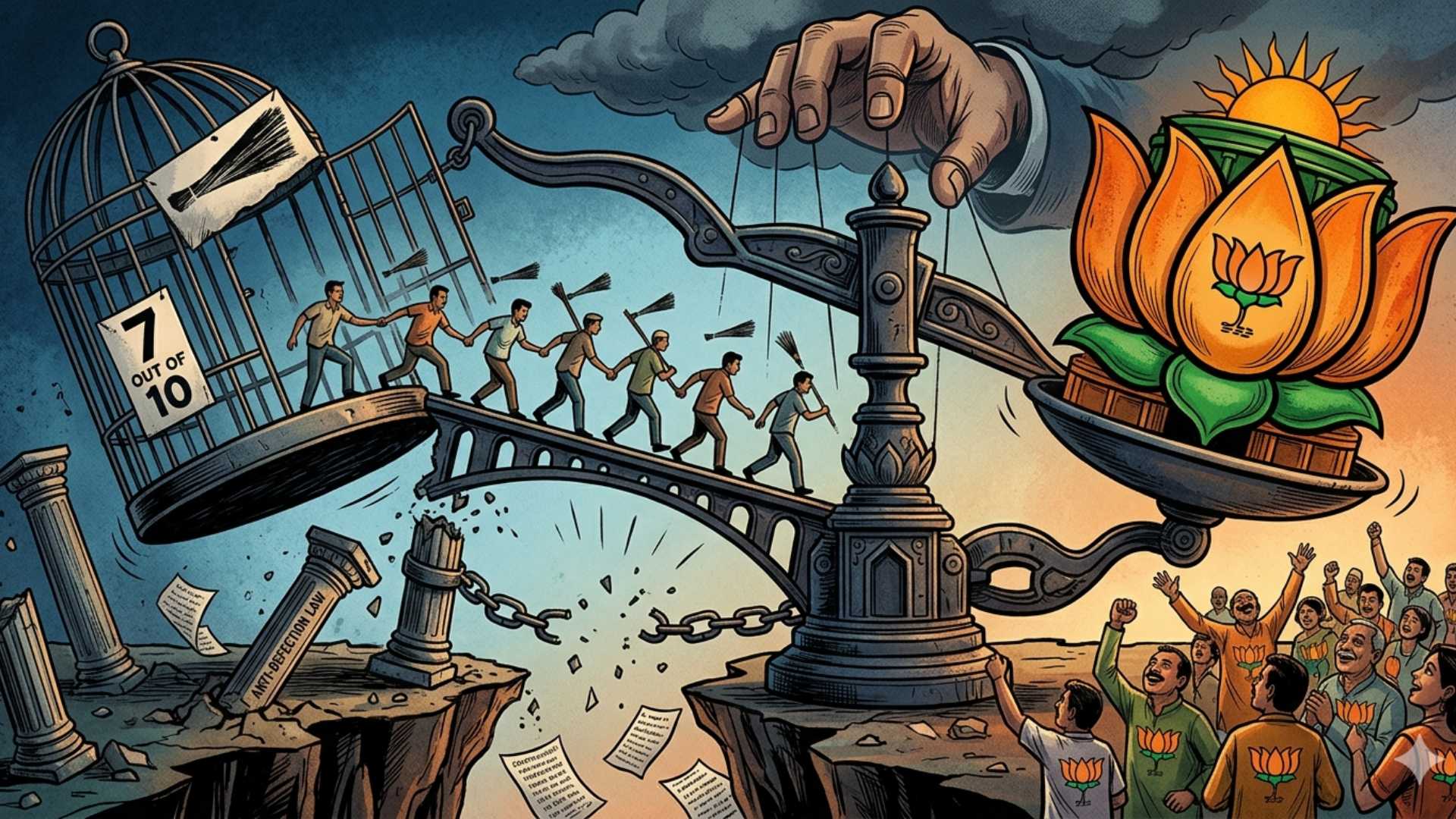
Anti-Defection Law & Party Mergers: Contemporary Challenges

Introduction
- India has faced chronic political defections since the 1960s, with ~2,000 defections recorded between 1967–72.
- Even today, mass defections via “merger loopholes” continue, affecting democratic stability and governance.
- “Defection is a symptom of political corruption” — Y.B. Chavan Committee (1968)
Background / Historical Context
- The phrase Aaya Ram Gaya Ram (1967) symbolised rampant defections.
- To curb instability, Parliament enacted the Tenth Schedule (1985) via the 52nd Amendment.
- Later strengthened by the 91st Constitutional Amendment (2003), which removed the “split” exception.
Evolution Timeline
| Year | Development |
|---|---|
| 1967–70s | Frequent defections; political instability |
| 1968 | Y.B. Chavan Committee report |
| 1985 | 52nd Amendment → Tenth Schedule |
| 1992 | Judicial review allowed |
| 2003 | 91st Amendment removes split |
Constitutional Framework
| Provision | Details |
|---|---|
| Article 102 | Disqualification of MPs |
| Article 191 | Disqualification of MLAs |
| Tenth Schedule | Anti-defection provisions |
| Para 2 | Grounds for disqualification |
| Para 4 | Merger exception (2/3rd rule) |
| Para 6 | Speaker/Chairman decides |
| Para 7 | Judicial review (via SC interpretation) |
Grounds & Exceptions
Disqualification
- Voluntarily giving up party membership
- Voting/abstaining against whip
- Independent joining a party
- Nominated member joining after 6 months
Merger Exception (Para 4)
-
Valid if 2/3rd of legislators agree to merge
-
Protects both:
- Defectors
- Those who stay with original party
Case Study: AAP Rajya Sabha Defection (2026)
- 7 out of 10 AAP Rajya Sabha MPs shifted to BJP citing merger clause.
- Accepted by Chairman → boosted NDA majority in Rajya Sabha.
- Legal challenge initiated by AAP.
Core Controversy
👉 Can 2/3rd of MPs alone defect and claim “merger” without the actual political party merging?
1. What the Law Actually Says (Textual Proof)
Tenth Schedule, Para 4 (Merger Clause)
-
A member is not disqualified if:
“his original political party merges with another political party…”
-
Condition:
- 2/3rd of members of the legislature party must agree
🔍 Legal Interpretation (Very Important)
-
Two separate conditions exist:
- Merger of political party (mandatory)
- 2/3rd legislators agreeing (supporting condition)
👉 The law does NOT say:
“2/3rd legislators can merge on their own”
2. Constitutional Articles Backing This
| Article | Legal Role |
|---|---|
| Article 102(2) | MPs disqualified under Tenth Schedule |
| Article 191(2) | Same for MLAs |
| Tenth Schedule Para 2 | Defines defection |
| Para 4 | Exception (merger) |
👉 Therefore:
- If Para 4 conditions fail, then Para 2 applies → disqualification
3. Supreme Court Interpretation (Direct Proof)
Kihoto Hollohan v. Zachillhu
-
Court upheld Tenth Schedule
-
Said:
Law exists to prevent unprincipled defections
Ravi S. Naik v. Union of India
-
“Voluntarily giving up membership”:
- Not just resignation
- Includes conduct (like joining another party)
👉 In AAP case:
- Joining BJP = clear conduct of defection
Rajendra Singh Rana v. Swami Prasad Maurya
-
Court rejected misuse of “split/merger”
-
Said:
Numbers alone cannot justify defection
Shrimanth Balasaheb Patil v. Speaker Karnataka Legislative Assembly
-
Recognised:
- Defections often politically motivated
- Law must be interpreted strictly
Supreme Court of India (2023 Observation)
-
Critical for AAP case
-
Held:
Legislature party ≠ Political party
👉 Meaning:
- MPs cannot decide merger independently
- Only political party organisation can merge
4. Applying Law to AAP Case (Step-by-Step Proof)
✔ What actually happened:
- 7/10 MPs (≥ 2/3rd) moved to BJP
❌ What is legally missing:
- No evidence that AAP (political party) merged with BJP
⚖️ Legal Test (Para 4)
| Condition | Status in AAP Case |
|---|---|
| Political party merger | ❌ Not happened |
| 2/3rd legislators support | ✔ Yes |
👉 Conclusion from law:
- Since Condition 1 fails, Para 4 cannot apply
- Therefore → Para 2 triggers → disqualification
5. Why MPs Still Claimed Valid Merger
Their Argument:
- 2/3rd MPs = legislature party
- Legislature party = party
- Therefore → merger valid
Why This is Legally Weak:
-
Directly contradicts:
- 2023 SC ruling
- Basic structure of Tenth Schedule
👉 This is called:
“Reverse interpretation of merger clause”
6. Why Chairman Accepted It (Institutional Angle)
-
Under Para 6, decision lies with:
- Speaker / Chairman
Problem:
-
Supreme Court in Kihoto Hollohan:
- Allowed this, but warned of bias risk
👉 Reality:
-
Decisions often:
- Delayed
- Politically influenced
7. Final Legal Position (Exam-Ready Conclusion)
👉 Strict Constitutional Interpretation:
-
Merger must be:
- Organisational (party-level)
- Not just numerical (MP-level)
👉 AAP Case Reality:
-
Looks like:
- Defection disguised as merger
👉 Therefore:
Under the Tenth Schedule, this should attract disqualification, unless courts reinterpret again.
“The merger clause protects genuine party realignments, not numerical defections masquerading as mergers.”
Key Constitutional Issue
Legislature Party vs Political Party
| Aspect | Legislature Party | Political Party |
|---|---|---|
| Nature | Elected members | Organisational entity |
| Role | Legislative functioning | Ideology & structure |
| In Merger | Should follow | Should initiate |
👉 The AAP case highlights misuse of this distinction.
Important Supreme Court Judgments
1. Kihoto Hollohan v. Zachillhu
- Upheld Tenth Schedule
- Allowed judicial review
- Speaker acts as quasi-judicial authority
2. Ravi S. Naik v. Union of India
- Defection includes conduct, not just resignation
3. Rajendra Singh Rana v. Swami Prasad Maurya
- Speaker’s delay subject to judicial review
4. Nabam Rebia v. Deputy Speaker
- Speaker cannot act during removal motion
5. Shrimanth Balasaheb Patil v. Speaker Karnataka Legislative Assembly
- Allowed disqualified MLAs to recontest elections
6. Supreme Court of India (2023 observation)
- Legislature party ≠ Political party
- Strengthened interpretation relevant to AAP case
Implications of AAP Episode
1. Erosion of Democratic Mandate
- Voters elect based on party ideology
- Post-election shifts distort mandate
2. Weakening of Anti-Defection Law
- Law reduced to procedural formality
3. Institutional Concerns
- Role of Chairman/Speaker questioned
- Perception of partisan decisions
4. Rise of Political Opportunism
-
Encourages:
- Strategic defections
- Power-centric politics
Major Challenges
- Ambiguity in Para 4 (merger clause)
- Distinction between party & legislature ignored
- Delayed judicial remedies
- Lack of deterrent penalties
Reform Suggestions
1. Clarify “Merger” Definition
-
Require:
- Formal organisational merger
- Not just legislative defection
2. Independent Tribunal
- Remove Speaker’s role in adjudication
3. Time-bound Decisions
- Strict constitutional timelines
4. Stronger Disincentives
-
Ban from:
- Ministerial posts
- Re-election for fixed period
5. Strengthen Inner-Party Democracy
- Reduce personality-driven parties
Value Addition (Quote)
- “The Tenth Schedule was designed to curb political immorality, but its misuse now risks legitimising it.”
Conclusion
The AAP Rajya Sabha episode underscores how constitutional provisions can be stretched to defeat their own purpose. While the anti-defection law aimed to ensure stability,
Attribution
Original content sources and authors


Syllabus classification
How this article maps to GS papers
Main syllabus
GS2Indian ConstitutionQuick Q&A
What is the anti-defection law under the Tenth Schedule of the Indian Constitution, and what are its key provisions?
Key provisions include:
- Disqualification grounds: Defection from the original political party or violation of party whip
- Decision-making authority: The Speaker/Chairman of the House decides on disqualification petitions
- Merger exception: Disqualification does not apply if at least two-thirds of members of a legislature party agree to merge with another party
Judicial interpretation: The Supreme Court has clarified that the legislature party and the political party are distinct entities. Therefore, a valid merger must reflect the decision of the original political party, not merely a group of legislators acting independently.
Significance: The law was designed to curb political instability caused by frequent defections, often referred to as “Aya Ram, Gaya Ram” politics. However, its effectiveness has been questioned due to loopholes and evolving political strategies.
Conclusion: While the anti-defection law remains a cornerstone of India’s parliamentary democracy, its interpretation and implementation continue to be contested.
Why is the recent merger of AAP Rajya Sabha members with another party controversial under the anti-defection law?
Key issues of controversy:
- Misinterpretation of law: The claim that two-thirds of legislators alone can defect without disqualification is widely seen as legally questionable
- Distinction ignored: The Supreme Court has emphasised that the legislature party cannot override the political party’s decision
- Role of Chairman: Acceptance of the merger by the Rajya Sabha Chairman has further intensified the debate
Implications: If such interpretations are upheld, it could weaken the anti-defection framework by allowing mass defections under the guise of “mergers.” This undermines the stability of political parties and the sanctity of electoral mandates.
Conclusion: The controversy highlights the need for clearer legal interpretation and stricter enforcement to prevent misuse of constitutional provisions.
How does the misuse or reinterpretation of the anti-defection law impact democratic governance in India?
Key impacts include:
- Erosion of mandate: When elected representatives switch parties, it undermines the will of the electorate
- Political instability: Large-scale defections can topple governments, as seen in several States in recent years
- Weakening of institutions: Frequent controversies reduce public trust in constitutional bodies like the Speaker and judiciary
Case examples: Instances in States like Karnataka and Madhya Pradesh have shown how defections can lead to the سقوط of elected governments. The current Rajya Sabha episode reflects similar trends at the national level.
Broader implications: Such practices encourage opportunism and reduce accountability, as legislators prioritise personal or political gains over public interest.
Conclusion: Ensuring strict adherence to the anti-defection law is essential to preserve democratic integrity and maintain the credibility of political institutions.
What are the underlying reasons for the increasing instances of political defections in India?
Key reasons include:
- Political opportunism: Legislators switch parties for better prospects, ministerial positions, or electoral advantages
- Weak party structures: Lack of internal democracy in parties leads to dissatisfaction among members
- Inadequate deterrence: Delays in disqualification decisions and judicial interventions reduce the effectiveness of the anti-defection law
Institutional factors: The discretionary powers of the Speaker/Chairman and the absence of strict timelines for decisions create loopholes that can be exploited. Additionally, the interpretation of the merger clause has allowed mass defections to be legitimised.
Example: Several State governments have fallen due to orchestrated defections, highlighting the systemic nature of the problem.
Conclusion: Addressing these root causes requires reforms in political party functioning, legal frameworks, and institutional accountability.
Critically analyse the effectiveness of the anti-defection law in achieving its objectives.
Achievements:
- Reduced frequent party switching: Individual defections have declined compared to the pre-1985 era
- Strengthened party discipline: Legislators are bound by party whips, ensuring stability in voting
Limitations:
- Merger loophole: The two-thirds provision has been exploited to justify mass defections
- Delay in decisions: Speakers often delay disqualification rulings, allowing defectors to benefit
- Judicial limitations: Courts have been unable to consistently deter such practices
Critical perspective: The law has inadvertently strengthened party leadership at the cost of individual legislative independence, raising concerns about the quality of parliamentary debate.
Conclusion: While the anti-defection law has achieved partial success, comprehensive reforms are needed to address its loopholes and ensure it aligns with democratic principles.
As a constitutional expert, how would you suggest reforms to strengthen the anti-defection framework in India?
Second, decision-making authority could be transferred from the Speaker/Chairman to an independent tribunal or the Election Commission to ensure impartiality. Time-bound decisions should be mandated to prevent undue delays.
Third, promoting internal democracy within political parties can reduce dissatisfaction and defections. Transparent candidate selection and grievance redressal mechanisms are essential.
Case reference: The Supreme Court has suggested reforms in past judgments, including the need for independent adjudication of defection cases.
Conclusion: A combination of legal clarity, institutional independence, and political reforms is necessary to ensure that the anti-defection law effectively safeguards democratic stability and integrity.
Practice questions
1 question for mains preparation