Introduction
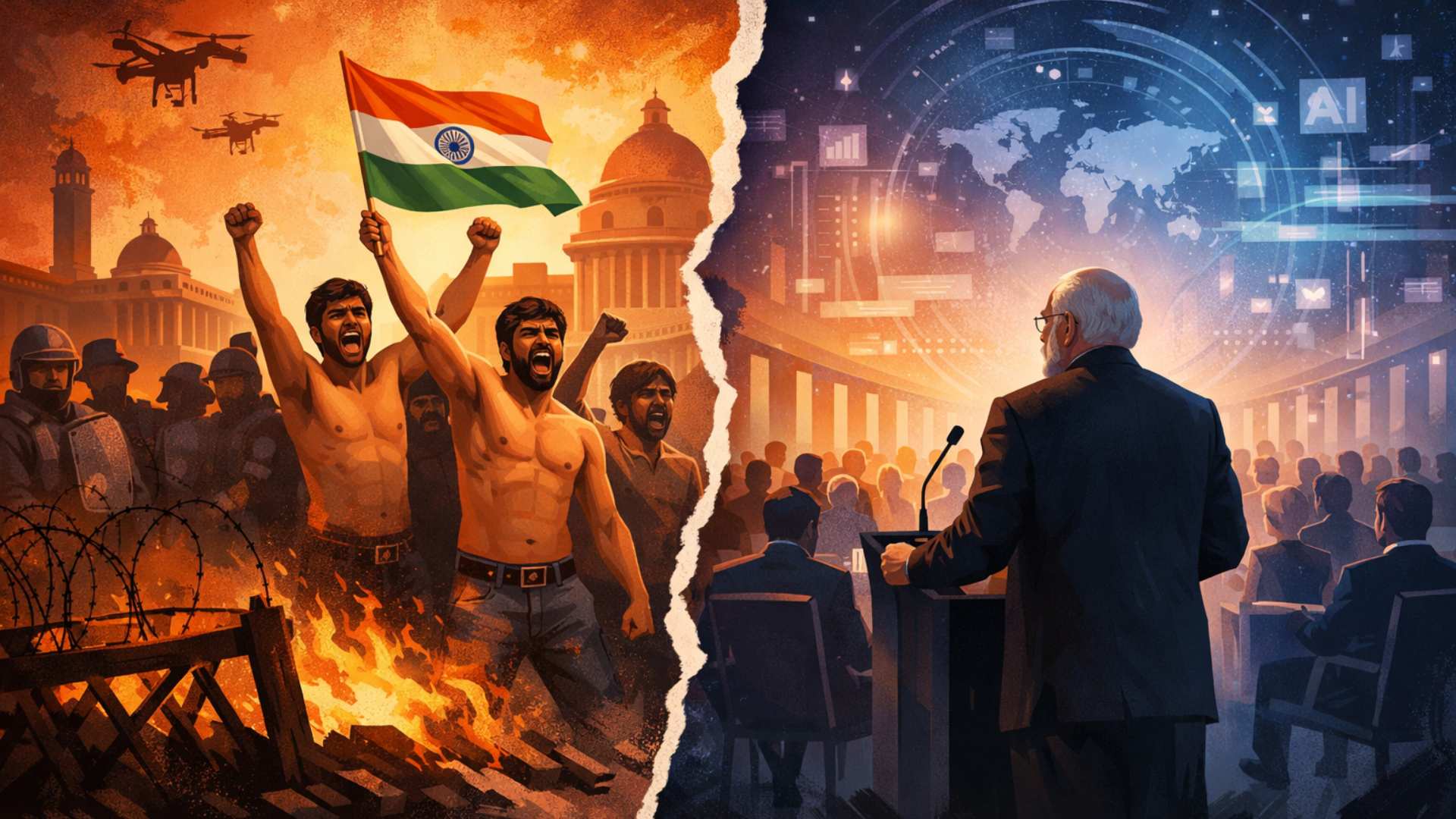
In a constitutional democracy, the right to dissent is not merely a legal entitlement — it is the lifeblood of democratic governance. The Supreme Court of India has repeatedly recognised dissent as a "symbol of a vibrant democracy." Yet the arrests of 14 Indian Youth Congress members at the India AI Impact Summit (February 2026) — charged with rioting and promoting enmity — reignited a fundamental debate: where does the state end and the government begin, and when does criticism of the latter become disloyalty to the former? This tension between national cohesion and democratic pluralism lies at the heart of India's constitutional design.
Background & Context
The Triggering Event IYC workers staged a shirtless protest at the India AI Impact Summit (February 20, 2026) against the India-U.S. trade agreement. Delhi Police filed charges including rioting and promoting enmity between groups; 14 members were arrested. BJP leaders labelled the act "anti-national." A Delhi court, however, characterised it as "political dissent" — not recidivist violence or organised crime.
Historical Parallel During the Emergency (1975–77), Congress president D.K. Barooah declared "India is Indira, Indira is India" — conflating a ruling leader with the nation itself. While no BJP leader has made an equivalent statement, the routine branding of serious governmental criticism as "an attack on the nation" raises structurally similar concerns about the government-state conflation.
Key Concepts
1. State vs. Government — The Critical Distinction
| Dimension | State | Government |
|---|---|---|
| Nature | Sovereign, permanent, supreme | Temporary, elected, accountable |
| Composition | Legislature, Executive, Judiciary + Opposition | Executive branch only |
| Criticism | Cannot be delegitimised by dissent | Subject to democratic accountability |
| Constitutional basis | Constitution itself | Derived from electoral mandate |
Blurring this distinction — treating criticism of the government as an attack on the state — is a defining feature of authoritarian drift in democracies.
2. Dissent as Democratic Safety Valve In democratic theory, dissent allows citizens to express disapproval of policy and participate in governance without electoral cycles. It acts as a corrective feedback mechanism — alerting governments to policy failures before they become systemic crises.
3. Sedition vs. Dissent The legal boundary between protected dissent and criminal sedition is constitutionally significant. The Supreme Court in Kedar Nath Singh v. State of Bihar (1962) held that only speech inciting violence or public disorder attracts sedition; mere criticism of the government does not. Charging protesters with "promoting enmity between groups" for a policy protest stretches this boundary dangerously.
Constitutional Framework
India's Federal-Unitary Tension The Constitution is described as "federal in structure, unitary in spirit."
- Federal reading: Pluralistic design — linguistic, cultural, and ideological diversity coexists within the constitutional framework.
- Unitary reading: Centre accorded primacy in the Concurrent List; regional assertions sometimes framed as centrifugal threats.
Parties projecting "strong leadership" tend to favour the unitary reading — where dissent, especially when amplified internationally, is framed as weakening the Centre or encouraging separatism.
Fundamental Rights Dimension
- Article 19(1)(a): Freedom of speech and expression
- Article 19(1)(b): Right to assemble peaceably
- Article 19(2): Reasonable restrictions — only on grounds of sovereignty, security, public order, decency, morality
- Policy disagreement, even publicly expressed at an international forum, does not meet any of these restriction thresholds constitutionally.
The Media Dimension
Mass media — particularly television — has become a force multiplier in the government-state conflation:
- Anchors routinely issue "certificates of patriotism" and adjudicate what constitutes anti-national behaviour
- Protests against CAA (2019) and the farmers' agitation (2020–21) were framed by large sections of media as playing into the hands of forces inimical to India
- Policy protest → national protest: The conflation transforms legitimate democratic dissent into an existential threat narrative
"Every evening, TV anchors sit in judgment on what constitutes an anti-national act — merging the line between the government and the country."
This media behaviour reinforces the "one nation, one identity" narrative preferred by security establishments and centralising governments — undermining the pluralistic constitutional design.
Comparative Perspective
| Country | Approach to Dissent at International Events |
|---|---|
| USA | Protected under First Amendment; arrests rare |
| UK | Protest permitted; dispersal only on public order grounds |
| France | Gilets Jaunes protesters appeared at EU events |
| India (constitutional) | Article 19 protects; restrictions only on specified grounds |
| India (practice, recent) | Arrests, sedition-adjacent charges for policy protests |
International protests at global summits are often viewed as demonstrations of democratic credentials, not threats to national image.
Implications & Challenges
1. Chilling Effect on Dissent Arrests for protest at a policy summit signal to citizens that the cost of public dissent is disproportionately high — discouraging future legitimate opposition.
2. Institutional Credibility Courts playing a corrective role (Delhi court's "political dissent" ruling) reflects healthy institutional resilience — but the burden of challenging overreach should not fall entirely on the judiciary.
3. Nationalism vs. Pluralism The deeper debate is about the nature of Indian nationalism — whether unity is best preserved through celebration of diversity or assertion of singular national identity. The Constitution clearly envisages the former.
4. Opposition Space A democracy requires a healthy, functional opposition as part of the state itself — not merely as a tolerated minority. Criminalising opposition protest compresses this constitutional space.
Way Forward
- Judicial clarity: Supreme Court should issue clearer guidelines distinguishing protected dissent from criminal incitement, reducing police discretion in political contexts.
- Media accountability: Press Council and regulatory frameworks must address the conflation of government criticism with anti-nationalism.
- Police reform: Arrests for political protest should require senior administrative oversight to prevent misuse of penal provisions.
- Political culture: Ruling parties must institutionally affirm the state-government distinction — criticism of the government strengthens, not weakens, the state.
- Constitutional literacy: Civic education on Fundamental Rights, especially Article 19, must be strengthened.
"The real test of democratic maturity lies not in the absence of dissent but in the willingness to engage with it without conflating criticism of the government with disloyalty to the nation."
Conclusion
A confident democracy derives its strength not from silencing competing voices but from its capacity to absorb, engage, and respond to them within a constitutional framework. The IYC protest episode is symptomatic of a deeper structural tension in Indian democracy — between a constitutional design that celebrates pluralism and a political culture increasingly drawn toward centralised, personality-driven governance. The state-government distinction is not a technicality; it is the foundational guarantee that citizens can hold power accountable without being accused of betraying the nation. Preserving this distinction is not the responsibility of the opposition alone — it is the constitutional duty of every institution, including the ruling party, the police, and the media.