Introduction
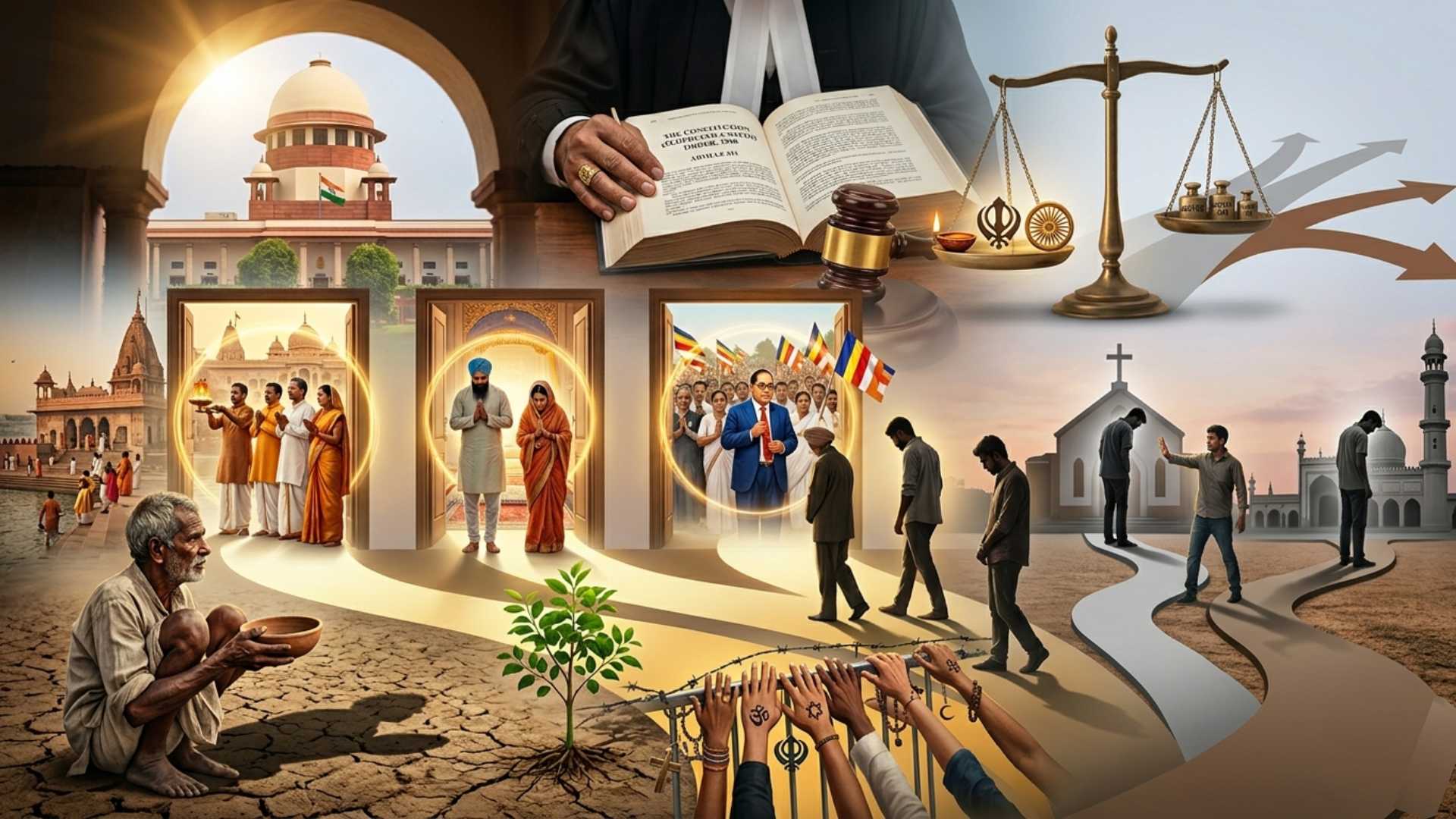
The Supreme Court (March 24, 2026) has reaffirmed that SC protections apply only to Hindus, Sikhs, and Buddhists — excluding Dalit converts to Christianity and Islam. The ruling upholds a foundational but contested principle: SC status is tied to both social origin and religious identity.
"Any member of the SC community who has converted out of the three specified religions ceases to be an SC member." — Supreme Court of India, March 2026
"Discrimination needs no theological sanction." — The Hindu Editorial, 2026
| Religion | SC Protection Available |
|---|---|
| Hinduism | ✓ (since 1950) |
| Sikhism | ✓ (since 1956) |
| Buddhism | ✓ (since 1990) |
| Christianity | ✗ |
| Islam | ✗ |
Background and Context
Evolution of the SC Definition:
| Year | Development |
|---|---|
| 1950 | Constitution (SC) Order issued under Article 341 — SC status restricted to Hindus only |
| 1956 | Extended to Sikhs — coinciding with Dr. Ambedkar's mass conversion to Buddhism |
| 1990 | Extended to Buddhists |
| Present | Christians and Muslims of SC origin remain excluded |
The Founding Rationale: India's founding leaders, including Nehru, held that untouchability — the extreme form of caste discrimination — was unique to Hindu social organisation. SC protections were designed to address this specific social evil. The original 1950 Order therefore restricted SC status to Hindus practising in a social system where untouchability was theologically and socially embedded.
Dr. Ambedkar's Conversion: Dr. B.R. Ambedkar led a mass conversion of SC members to Buddhism in 1956 — the same year Sikhs were brought under SC protections. His conversion was an act of social assertion and rejection of the Hindu caste order, not an abandonment of the social identity that warranted protection.
Key Constitutional Provisions
Article 341: Empowers the President to specify castes, races, or tribes to be deemed Scheduled Castes — and Parliament to include or exclude groups from this list. The Constitution (Scheduled Castes) Order, 1950 was issued under this provision.
Article 25(2) — Explanation II: Defines "Hindu" to include Sikhs, Buddhists, and Jains for the purposes of certain constitutional provisions — providing the textual basis for their inclusion within the SC framework.
Article 15(4): Enables special provisions for Socially and Educationally Backward Classes (SEBCs) — the provision under which many Dalit converts to Christianity and Islam currently access some benefits, though not SC-specific reservations.
Arguments For the Current Exclusion
Theological Argument: Christianity and Islam are theologically egalitarian — they do not recognise or sanction caste-based social stratification. The argument is that conversion to these faiths implies a rejection of the Hindu caste system and its associated disabilities — and therefore the basis for SC protection no longer applies.
Constitutional-Civilisational Argument: Sikhism and Buddhism are considered part of India's civilisational and dharmic tradition. Article 25(2) Explanation II treats them as part of the Hindu religious universe — providing constitutional legitimacy for their inclusion within SC provisions while excluding Abrahamic faiths.
Reservation Quantum Argument: Many Dalit activists argue that including converts within the existing SC reservation quantum would dilute benefits for those who have remained within the fold — without any expansion of the total reservation percentage.
Arguments Against the Exclusion
Empirical Reality: Caste discrimination does not disappear with religious conversion. Dalit Christians and Dalit Muslims continue to face untouchability and social discrimination — within their new religious communities and in broader society. Discrimination needs no theological sanction.
Logical Inconsistency: If the rationale for SC protection is social and economic deprivation rooted in historical caste discrimination, then the religion currently practised is irrelevant — the social reality of the convert remains unchanged.
Selective Application: The inclusion of Sikhs and Buddhists — but not Christians and Muslims — is arguably arbitrary, based more on political and civilisational considerations than on consistent constitutional principle.
The Balakrishnan Commission
A high-level commission headed by former Chief Justice of India K.G. Balakrishnan is currently examining whether Dalit converts to Christianity and Islam should be included within SC protections. Its recommendations, when submitted, will trigger a major political and legislative debate — any change to the SC Order requires Parliamentary legislation, not judicial intervention.
Current Status of Dalit Converts
| Group | SC Reservation | SC/ST PoA Act | Other Benefits |
|---|---|---|---|
| Hindu SC | ✓ | ✓ | ✓ Full SC benefits |
| Sikh SC | ✓ | ✓ | ✓ Full SC benefits |
| Buddhist SC | ✓ | ✓ | ✓ Full SC benefits |
| Christian/Muslim (SC origin) | ✗ | ✗ | Partial — Article 15(4) SEBC provisions |
Conclusion
The Supreme Court's ruling is constitutionally sound within the existing legal framework — the Constitution (Scheduled Castes) Order, 1950 and Article 341 leave little judicial room for expansion. However, the judgment highlights an unresolved tension at the heart of India's affirmative action architecture: whether SC status is a function of social reality or religious identity. The empirical evidence — that caste discrimination persists regardless of religious conversion — challenges the theological basis for exclusion. Any resolution must come through the legislative route, informed by the Balakrishnan Commission's findings and a broad political consensus. The question is not merely legal — it is a test of whether India's constitutional commitment to social justice is universal or conditional.