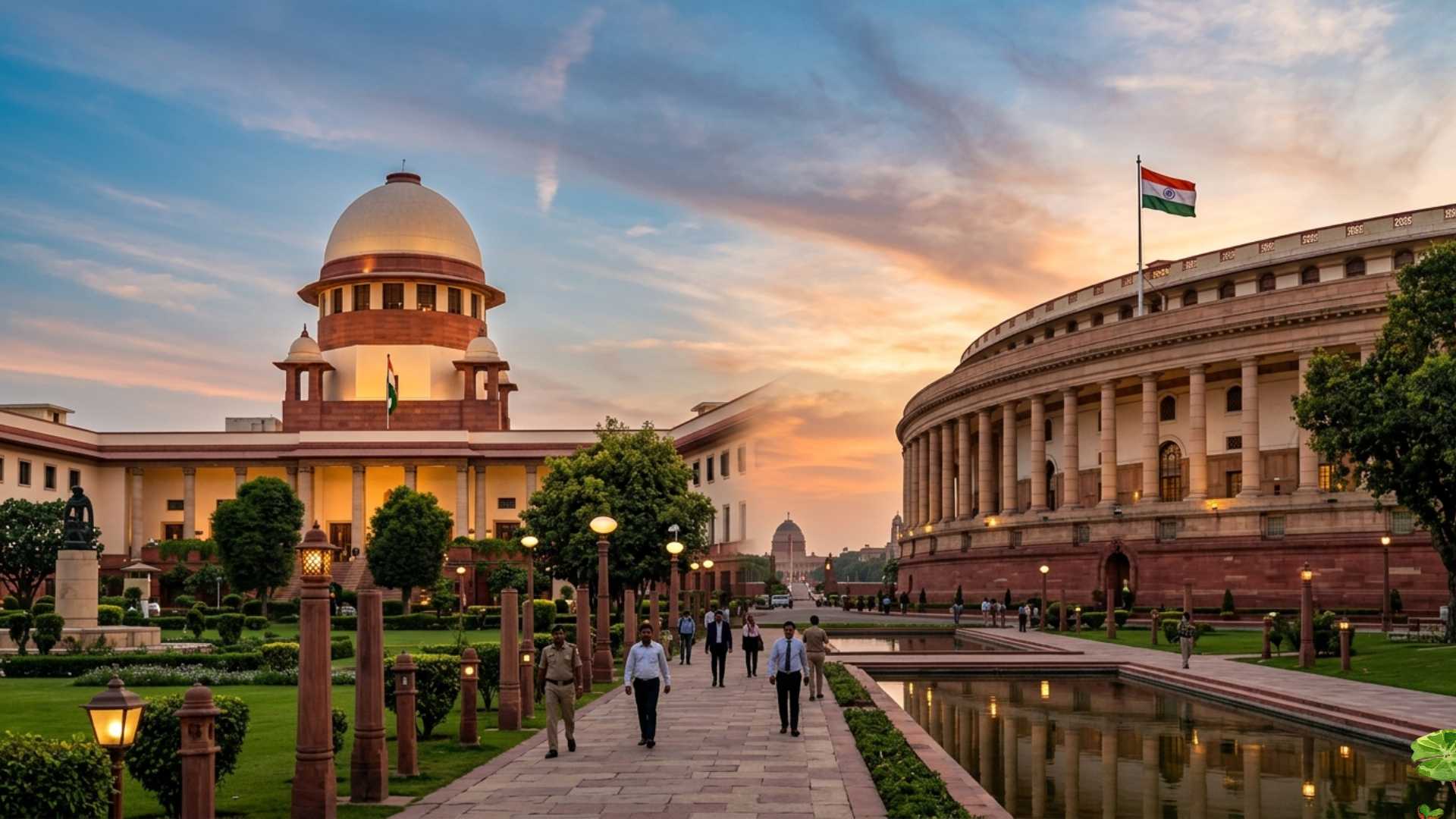
Temporary Role of CJI in CEC and EC Appointments: Supreme Court

Introduction
-
The Election Commission of India (ECI) is a constitutionally mandated body under Article 324, entrusted with superintendence, direction, and control of elections — the foundational act of Indian democracy.
-
Yet its appointment process has remained a contested constitutional question for over seven decades. The Chief Election Commissioner and Other Election Commissioners (Appointment, Conditions of Service, and Term of Office) Act, 2023 has reignited this debate by restoring executive dominance over a body meant to be independent of it.
"Fierce independence, neutrality and honesty envisaged in the institution of the Election Commission required an end to government monopoly and exclusive control over appointments." — Supreme Court, Anoop Baranwal v. Union of India (March 2023)
| Stage | Appointment Mechanism |
|---|---|
| Pre-2023 | President on advice of Prime Minister (executive monopoly) |
| March 2023 SC Judgment | Committee: PM + Leader of Opposition + CJI |
| Post-2023 Act | Committee: PM + Leader of Opposition + Cabinet Minister (CJI replaced) |
Background & Constitutional Framework
-
Article 324(2) provides that the CEC and ECs shall be appointed by the President, subject to any law made by Parliament.
-
For over 70 years, no such law existed — appointments were made solely on the Prime Minister's advice, creating a legislative vacuum that all parties in power found convenient to retain.
-
The Supreme Court's Constitution Bench in Anoop Baranwal v. Union of India (2023) addressed this vacuum by directing a three-member selection committee until Parliament legislated. The court explicitly intended its order as an interim arrangement, not a permanent constitutional mandate.
The 2023 Act: What Changed and Why It Matters
Parliament responded with the 2023 Act, which:
- Replaced the CJI with a Union Cabinet Minister in the selection committee
- Effectively restored executive dominance — now formalised through statute rather than convention
- Was challenged as unconstitutional by petitioners including the Association for Democratic Reforms
The core constitutional argument against the Act: Article 324 envisions the ECI as an independent constitutional authority. Placing its appointment exclusively under the executive — even through a legislated process — undermines the institutional independence the Constitution demands.
Key Constitutional Questions
Can Parliament legislate in any manner under Article 324(2)? The Supreme Court itself acknowledged Parliament's legislative competence. The question is not whether Parliament can make a law — it can — but whether the law made is consonant with the constitutional spirit of Article 324.
Separation of Powers The judiciary's inclusion in the 2023 SC judgment was not incidental — it was a structural safeguard. Replacing the CJI with a Cabinet Minister tips the committee's balance decisively toward the executive, compromising the separation of powers principle that underlies constitutional democracy.
Institutional Independence vs. Executive Accountability Constitutional bodies like the ECI, CBI, and CAG derive their legitimacy from perceived independence. When appointment mechanisms vest control in the very executive whose actions these bodies must oversee, institutional credibility erodes — regardless of the individual integrity of appointees.
Comparative Reference
The issue parallels debates on appointments to other constitutional and statutory bodies:
| Body | Appointment Mechanism | Independence Concern |
|---|---|---|
| CBI Director | PM + CJI + Leader of Opposition | Relatively insulated |
| CAG | President on PM's advice | Executive-controlled |
| CEC (post-2023) | PM + Cabinet Minister + LoP | Executive-dominant |
| CVC | PM + Home Minister + LoP | Partial insulation |
Conclusion
-
The appointment controversy surrounding the ECI is ultimately a question about the architecture of constitutional democracy — whether institutions designed to check the executive can retain their credibility when constituted by the same executive.
-
Parliament's legislative power under Article 324(2) is undisputed; what is contested is whether that power was exercised in a manner consistent with constitutional values of independence and neutrality.
-
A robust democracy requires not merely free and fair elections but an Election Commission whose independence is structurally guaranteed — not dependent on the goodwill of those in power.
Attribution
Original content sources and authors

Syllabus classification
How this article maps to GS papers
Main syllabus
GS2Indian ConstitutionQuick Q&A
What is the constitutional framework governing the appointment of the Chief Election Commissioner (CEC) and Election Commissioners (ECs) in India?
For several decades after independence, Parliament did not enact a specific law regulating the appointment mechanism. Consequently, appointments were effectively made by the President on the advice of the Prime Minister and the Union Council of Ministers. Critics argued that this arrangement gave excessive control to the executive and weakened the perception of institutional independence. In the landmark Anoop Baranwal v. Union of India (2023) judgment, the Supreme Court attempted to fill this legislative vacuum by directing that appointments be made by a committee consisting of the Prime Minister, Leader of Opposition, and the Chief Justice of India until Parliament enacted a law.
The Chief Election Commissioner and Other Election Commissioners (Appointment, Conditions of Service, and Term of Office) Act, 2023 replaced the CJI with a Union Cabinet Minister in the selection committee. Supporters argue that Parliament was constitutionally empowered to legislate under Article 324(2), while critics contend that the law restores executive dominance. This debate highlights the larger constitutional question of balancing parliamentary supremacy with institutional independence.
The issue is significant because:
- The ECI acts as the guardian of electoral democracy.
- Public confidence in elections depends on the neutrality of the appointment process.
- Institutional independence is part of the broader constitutional principle of checks and balances.
Why is the independence of the Election Commission considered essential for Indian democracy?
The framers of the Constitution recognized the importance of an independent election body. Dr. B.R. Ambedkar emphasized that democracy would survive only if constitutional institutions remained impartial. The Supreme Court, in the Anoop Baranwal judgment, reiterated that “fierce independence, neutrality and honesty” are indispensable qualities of the Election Commission. The Court observed that executive monopoly over appointments could undermine the institutional autonomy of the ECI.
The importance of an independent Election Commission can be understood through several dimensions:
- Electoral fairness: It ensures a level playing field for ruling and opposition parties.
- Protection of voter confidence: Citizens are more likely to accept electoral outcomes if they trust the neutrality of the institution.
- Prevention of authoritarian tendencies: Independent oversight reduces the possibility of electoral manipulation by governments.
- Constitutional governance: It strengthens the system of checks and balances within the democratic framework.
Examples from various democracies show that weak electoral institutions often lead to political instability and allegations of democratic backsliding. In contrast, India’s Election Commission has historically earned global recognition for managing large-scale elections efficiently. However, concerns regarding appointments, campaign financing, and enforcement powers have revived debates about institutional reforms.
Therefore, the independence of the Election Commission is not merely an administrative issue; it is central to preserving constitutional democracy, political accountability, and the rule of law in India.
How did the Supreme Court attempt to address the ‘legislative vacuum’ in the Anoop Baranwal judgment?
Recognizing this vacuum, a Constitution Bench of the Supreme Court held that appointments to the Election Commission should temporarily be made by a committee comprising the Prime Minister, the Leader of Opposition in the Lok Sabha, and the Chief Justice of India (CJI). The Court clarified that this arrangement would remain operative only until Parliament enacted a law under Article 324(2). The judgment was based on constitutional principles such as free and fair elections, separation of powers, and institutional integrity.
The Court’s intervention had several objectives:
- Reducing executive monopoly over appointments.
- Enhancing public confidence in the Election Commission.
- Creating bipartisan participation through inclusion of the Opposition.
- Introducing judicial neutrality via the inclusion of the CJI.
The Court drew parallels with the appointment process of institutions like the CBI Director, where a collegium-style mechanism already existed. It argued that constitutional bodies tasked with safeguarding democracy must be insulated from partisan influence.
However, the 2023 Act replaced the CJI with a Union Cabinet Minister, thereby reintroducing a stronger executive presence in the committee. Critics argue this defeats the spirit of the judgment, while supporters contend that Parliament has the constitutional authority to design the appointment process. The ongoing legal challenge reflects the tension between judicial innovation and legislative supremacy.
Thus, the Anoop Baranwal judgment represents a significant example of judicial constitutionalism aimed at strengthening democratic institutions in the absence of legislative action.
Critically analyse the constitutional debate surrounding the Chief Election Commissioner and Other Election Commissioners Act, 2023.
Supporters of the Act contend that Parliament possesses explicit constitutional authority under Article 324(2) to legislate on appointments. They argue that the Supreme Court itself stated in the Anoop Baranwal judgment that its interim arrangement would operate only until Parliament enacted a law. From this perspective, the 2023 Act represents a legitimate exercise of legislative power and respects the doctrine of parliamentary sovereignty.
However, critics raise several concerns:
- Executive dominance: Two members of the committee belong to the ruling government, potentially weakening neutrality.
- Erosion of checks and balances: Removal of the CJI reduces institutional oversight.
- Threat to electoral integrity: Perception of political influence may damage public trust in elections.
- Constitutional morality: Mere legality may not satisfy the broader democratic spirit of the Constitution.
The controversy also highlights the broader debate on judicial activism versus legislative supremacy. While courts may step in to fill constitutional gaps, elected legislatures retain the authority to frame laws. The key issue is whether such laws preserve the core constitutional value of institutional independence.
Comparatively, several democracies use bipartisan or multi-institutional appointment systems for electoral bodies to prevent concentration of power. India’s debate therefore reflects global concerns regarding democratic resilience and institutional autonomy.
In conclusion, the controversy is not simply about the composition of a committee; it concerns the larger question of how constitutional democracies can safeguard impartial institutions while respecting legislative authority. A balanced and transparent mechanism with wider consultation may provide a more durable solution.
What are the reasons behind repeated concerns regarding executive control over constitutional institutions in India?
In the case of the Election Commission, critics argue that the absence of an independent appointment mechanism for decades allowed successive governments to retain influence over appointments. Senior advocates in the present case argued before the Supreme Court that the constitutional framers never intended the CEC to become the “Prime Minister’s man.” The concern is rooted in the principle that institutions overseeing elections should not be perceived as extensions of the ruling government.
Several structural reasons explain these concerns:
- Legislative delays: Parliament often leaves constitutional gaps unaddressed for long periods.
- Centralization of authority: The executive controls appointments, transfers, and administrative resources.
- Weak institutional safeguards: Many constitutional bodies lack transparent selection mechanisms.
- Political incentives: Governments may prefer institutional arrangements that strengthen their influence.
Historical experience demonstrates that institutions become vulnerable when checks and balances weaken. During the Emergency (1975-77), concerns about institutional independence became particularly prominent. More recently, debates surrounding investigative agencies and governors have revived discussions about federalism and institutional neutrality.
Addressing these concerns requires comprehensive reforms:
- Transparent and bipartisan appointment processes.
- Fixed tenure and removal safeguards.
- Parliamentary oversight mechanisms.
- Strengthening constitutional conventions and ethical governance.
Ultimately, democratic institutions derive legitimacy not only from constitutional text but also from public trust. Excessive executive control can erode that trust and weaken democratic culture over time.
As a civil servant, how would you respond to concerns that the Election Commission has become vulnerable to executive influence?
As an administrator, I would emphasize that constitutional bodies derive strength from both legal safeguards and ethical conduct. Therefore, institutional reforms should focus on enhancing transparency, accountability, and public confidence. I would support measures such as wider consultation in appointments, publication of selection criteria, and strengthening operational autonomy of the Election Commission.
Specific measures that could be considered include:
- Transparent appointment procedures: Establishing a bipartisan collegium with clear eligibility criteria.
- Institutional autonomy: Ensuring independent budgeting and staffing.
- Code of conduct enforcement: Strengthening impartial enforcement during elections.
- Public communication: Increasing transparency through regular press briefings and disclosures.
At the same time, a civil servant must avoid politicization of constitutional offices. The objective should not be confrontation between institutions, but the preservation of constitutional balance. Constructive engagement between Parliament, judiciary, and civil society is essential to maintain institutional credibility.
For example, democracies such as South Africa and Canada have evolved mechanisms where electoral bodies function with greater transparency and cross-party confidence. India can draw lessons from such practices while respecting its own constitutional framework.
In conclusion, the role of a civil servant is to uphold constitutional values rather than partisan interests. Protecting the independence and credibility of institutions like the Election Commission is essential for sustaining democratic governance, public trust, and the rule of law.
Practice questions
1 question for mains preparation