
Introduction
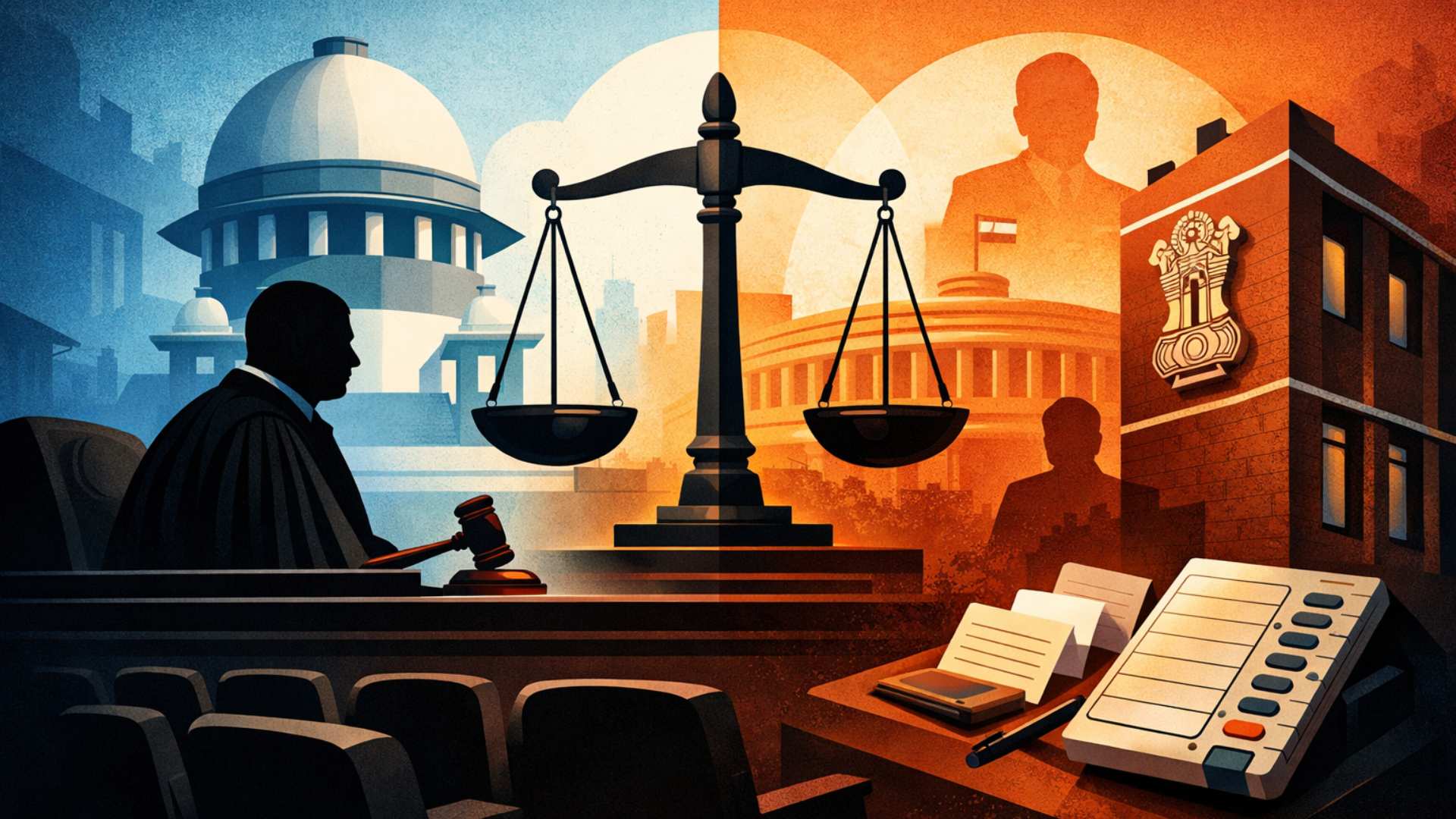
The independence of the Election Commission is a cornerstone of Indian democracy, directly tied to free and fair elections. The Chief Election Commissioner and Other Election Commissioners (Appointment, Conditions of Service and Term of Office) Act, 2023 replaced the Chief Justice of India with a Union Cabinet Minister on the appointment panel — a change now under Supreme Court challenge. Notably, two successive Chief Justices (CJI Sanjiv Khanna in 2024, CJI Surya Kant in 2025) have recused from hearing this very case, raising urgent questions about judicial recusal doctrine, institutional conflict of interest, and the absence of a codified recusal framework in India.
Recusal means a judge voluntarily stepping back from hearing a case because they have — or appear to have — a personal interest in its outcome.
The core idea is simple: a judge should not decide a matter where they stand to gain or lose something, or where a reasonable person would doubt their impartiality. It flows from the Latin maxim nemo judex in causa sua — no one shall be a judge in their own cause.
A simple example: If a case involves a company in which the judge holds shares, they recuse themselves — even if they genuinely believe they can decide fairly. The appearance of bias is enough.
What triggers recusal?
- Financial interest in the outcome
- Personal relationship with a party
- Prior involvement in the case (as a lawyer, for instance)
- Institutional stake — like in the CEC case, where the judge's future office is affected by the verdict
Key distinction: Recusal in India is entirely self-initiated. No party can force a judge to recuse, and no law prescribes when they must. It rests purely on the judge's own conscience — which is precisely why the absence of a codified standard is a problem.
It differs from disqualification, which is a formal, externally imposed bar. Recusal is voluntary; disqualification is mandatory.
In the context of the article, the conflict wasn't about money or personal relationships — it was structural. Every sitting Supreme Court judge is a potential future Chief Justice, and the case directly concerned how the Chief Justice's role in election commissioner appointments would be defined. That institutional stake is what prompted the recusals.
Background and Context
The 2023 Act and the Legal Challenge
- Prior to this Act, the Supreme Court's 2023 interim arrangement (in Anoop Baranwal v. Union of India) had placed the CJI on the selection panel for appointing Election Commissioners.
- The 2023 Act replaced the CJI with a Union Cabinet Minister, effectively reducing judicial presence in the appointment process.
- This was challenged in Dr. Jaya Thakur v. Union of India (2024), currently pending before the Supreme Court.
The Recusal Trigger
- Every sitting Supreme Court judge is a potential future CJI under the seniority convention.
- Since the CJI's position is directly at stake in the appointment mechanism, judges in the line of succession face an apparent conflict of interest.
Key Legal Concepts
1. Nemo Judex in Causa Sua A foundational maxim of natural justice — "no one shall be a judge in their own cause." It forms the constitutional basis for recusal in India.
2. Recusal Voluntary withdrawal of a judge from hearing a case where bias — actual or perceived — may exist. In India, it is an act of individual judicial conscience; no statute codifies it.
3. Standard of Bias — Evolution in India
| Case | Year | Standard Established |
|---|---|---|
| Manak Lal v. Dr. Prem Chand | 1957 | Strict disqualification for pecuniary interest |
| Ranjit Thakur v. Union of India | 1987 | Real likelihood / reasonable apprehension of bias |
| NJAC case (SCAORA v. UoI) | 2015 | Doctrine of necessity overrides institutional conflict |
4. Doctrine of Necessity When every available judge faces the same disqualifying conflict, the conflict must yield to institutional obligation — the court must still hear the case. Invoked by Justice J.S. Khehar in the NJAC case.
5. Comparison: India vs USA
| Parameter | India | USA |
|---|---|---|
| Codified standard | None | Section 455, Title 28, US Code |
| Who decides recusal | Judge's own conscience | Self-enforced, but objective standard exists |
| Review mechanism | None | None at apex level |
| Binding code of conduct | None for Supreme Court | Judicial Code of Conduct (partially applicable) |
The NJAC Precedent — The Critical Contrast
In the NJAC case (2015), recusal was sought against Justice J.S. Khehar on the ground that he would become CJI and have a stake in whether the Collegium or NJAC governed future appointments. He refused, on two grounds:
- The conflict infected every judge equally — recusal of one changes nothing.
- The doctrine of necessity: no alternative forum of equivalent jurisdiction exists.
Justice Kurian Joseph added that a judge choosing to recuse has a constitutional duty of transparency — giving reasons is part of the judicial oath under the Third Schedule.
The structural logic of NJAC applies with equal or greater force to the CEC law challenge. The CJI's recusal, therefore, is a departure from a principle the Supreme Court itself established a decade ago.
Issues and Challenges with the Current Recusal
1. The Conflict Infects the Entire Court Since every sitting judge is a potential future CJI, the conflict of interest CJI Surya Kant cited applies to all 34 judges simultaneously. Selective recusal does not resolve the structural problem — it merely relocates it.
2. Pre-assigning Disqualification to Other Judges The oral direction to constitute a bench excluding judges in the line of succession is problematic. Recusal is an act of individual judicial conscience — it cannot be pre-determined by a predecessor for judges who have not themselves considered the question.
3. The Contingency Problem Seniority succession is not perfectly predictable. A judge constituted on the "safe" bench could later become CJI due to resignation, health, or death of those ahead of them. The prophylactic rule cannot account for the accidents of judicial mortality.
4. Master of the Roster Paradox CJI Surya Kant recused himself on grounds of conflict of interest, yet retained authority as Master of the Roster to decide which judges would hear the case. This is analogous to the controversy around Lok Sabha Speaker Om Birla, who recused from the no-confidence motion but retained authority over who would preside — the very conflict that justified recusal in the first place.
5. No Institutional Framework India has no statute governing judicial recusal, no binding code of conduct enforceable against Supreme Court judges, and no mechanism to review a recusal decision once made.
Broader Implications
- For Election Commission independence: The unresolved legal challenge leaves the legitimacy of the 2023 appointment mechanism in limbo, affecting public confidence in electoral processes.
- For judicial credibility: Successive recusals by CJIs from the same case, without clear principled reasoning, risks the appearance of institutional evasion.
- For constitutional governance: The absence of codified recusal norms at the apex level is an institutional gap — particularly significant when cases directly concern judicial appointments and election administration.
- For separation of powers: The case sits at the intersection of all three branches — executive control over appointments, legislative validity of the Act, and judicial review — making it constitutionally significant.
Quote for Answers
"If I were to accede to the prayer for my recusal, I would be initiating a wrong practice, and laying down a wrong precedent." — Justice J.S. Khehar, NJAC case (2015)
Way Forward
- India should consider codifying recusal standards through a Judicial Standards and Accountability Act, providing an objective test (similar to the US model) while preserving judicial discretion.
- The doctrine of necessity must be applied more consistently at the apex level — especially in cases where structural conflict affects all judges equally.
- Transparency in recusal — stating reasons on record rather than only orally — should be treated as a constitutional obligation, as Justice Kurian Joseph observed.
- An independent review mechanism for recusal decisions, perhaps through a judicial ethics committee, would strengthen institutional legitimacy.
Conclusion
The recusal of two successive Chief Justices from the CEC appointment law challenge is not merely a procedural episode — it reveals a deeper structural deficit in India's apex judicial framework. When the conflict of interest is systemic rather than individual, the doctrine of necessity demands that the institution confront it openly rather than route around it. India's constitutional democracy is well served by judges of conscience; it would be better served by rules that make conscience accountable. The urgency for a codified recusal framework — one that balances judicial independence with institutional obligation — has never been clearer.
