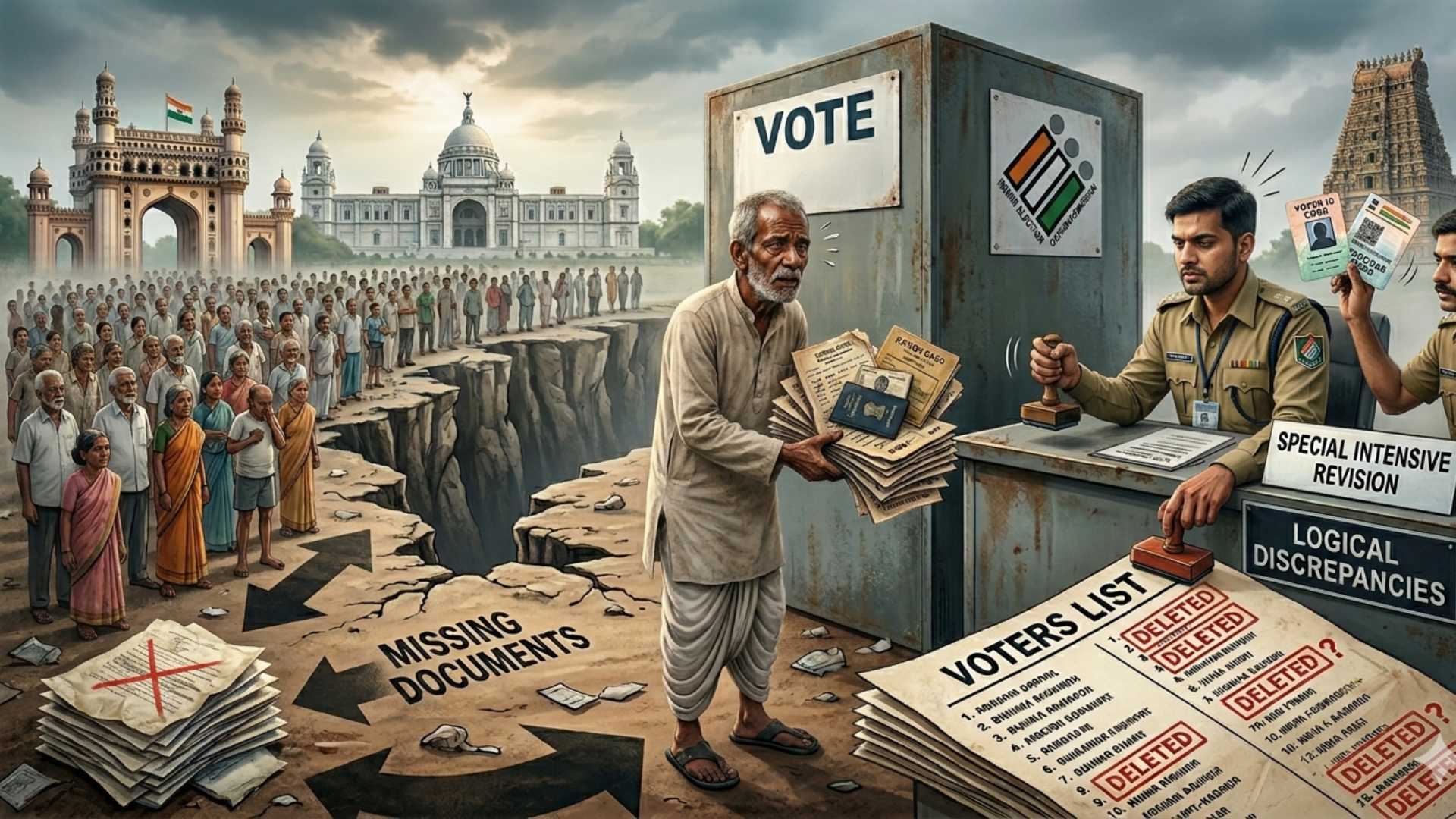
Electoral Roll Purges and Their Constitutional Implications

Introduction
- India is the world’s largest democracy with over 96 crore registered voters (ECI, 2024), making electoral integrity critical.
- However, recent electoral roll revisions have allegedly led to mass deletions (e.g., ~91 lakh voters in West Bengal)
“Universal adult franchise is the foundation of democratic legitimacy.” — NCERT, Indian Constitution at Work
Background / Context
-
The Election Commission of India (ECI) conducted a Special Intensive Revision (SIR) of electoral rolls in multiple states.
-
A new category termed “logical discrepancy” was used to delete voters.
-
Reports indicate:
- Large-scale deletion of genuine voters
- Many were unable to vote in elections
👉 Raises concerns about:
- Electoral integrity
- Constitutional rights
- Institutional accountability
Constitutional & Legal Framework
Key Constitutional Provisions
| Provision | Significance |
|---|---|
| Article 324 | Powers of ECI to conduct elections |
| Article 326 | Universal Adult Suffrage (18+ citizens eligible) |
| Citizenship Laws | Determined by Union Government |
Statutory Framework
| Law | Key Provision |
|---|---|
| Representation of the People Act, 1950 (Section 21) | Electoral roll revision |
| Registration of Electors Rules, 1960 (Rule 25) | Types of revision (summary vs intensive) |
| Rule 8 | Citizens provide info “to best of their ability” |
Key Issue 1: Citizenship as Basis of Voting Rights
-
Article 326:
- Every citizen (18+) has the right to be registered as a voter.
👉 Problem:
- No clear official list of documents for proving citizenship issued by Union Home Ministry.
👉 Instead:
-
ECI prescribed its own document list
-
Rejected commonly used documents:
- Aadhaar
- Ration card
- Voter ID
📌 Result:
- Citizens struggled to produce documents
- Mass deletions occurred
Key Issue 2: Jurisdictional Overreach
Question
👉 Can ECI decide citizenship proof documents?
Legal Position
- Citizenship → Union Home Ministry domain
- ECI → Verification authority only
👉 Concern:
- ECI allegedly exceeded its mandate under Article 324
Key Issue 3: Violation of Electoral Law
Summary vs Intensive Revision
| Type | When Allowed | Nature |
|---|---|---|
| Summary Revision | Before elections | Limited update |
| Intensive Revision | Non-election period | Fresh, detailed revision |
👉 Law (Section 21 + Rule 25):
- Only summary revision allowed before elections
👉 Issue:
- SIR (intensive revision) conducted just before elections
📌 Conclusion:
- Deviation from statutory provisions
Key Issue 4: Procedural Violations
1. “Logical Discrepancy” Category
- Not recognised under election law
- Arbitrary classification
2. Violation of Rule 8
-
Citizens must provide info:
- “to the best of their ability”
👉 ECI allegedly demanded:
- Documents difficult to obtain, especially for rural citizens
3. Lack of Natural Justice
-
Deletions reportedly done:
- Without proper hearing
-
Violates:
- Principles of natural justice
Case Evidence / Data
| State | Voters Removed |
|---|---|
| Bihar | ~64 lakh |
| West Bengal | ~91 lakh |
👉 Indicates:
- Scale of exclusion
- Possible systemic issue
Implications for Democracy
1. Electoral Disenfranchisement
- Genuine citizens excluded from voting
2. Undermining Universal Adult Franchise
- Violates Article 326
3. Institutional Credibility
- Trust in ECI affected
4. Federal Concerns
- Elections in multiple states impacted simultaneously
Judicial Dimension
-
Supreme Court of India:
-
Suggested tribunals for grievance redressal
-
Did not decisively address:
- Document authority issue
-
👉 Concern:
- Lack of strong judicial intervention
Analytical Perspective
Balance of Powers Issue
- ECI (Article 324) vs Home Ministry (Citizenship)
Administrative vs Democratic Efficiency
- Speed of revision vs fairness
Inclusion vs Verification
- Preventing illegal voters vs protecting genuine voters
Reform Suggestions
1. Clear Citizenship Documentation Policy
-
Union Home Ministry must:
- Publish uniform document list
2. Legal Clarity on ECI Powers
- Define limits under Article 324
3. Follow Statutory Procedure
- Avoid intensive revision before elections
4. Strengthen Due Process
-
Mandatory:
- Notice
- Hearing before deletion
5. Technological Integration
-
Use:
- Aadhaar (with safeguards)
- Digital verification systems
Value Addition (Quote)
- “Free and fair elections are part of the basic structure of the Constitution.” — Supreme Court (Indira Gandhi case principle)
Conclusion
The recent electoral roll revisions highlight a critical tension between administrative control and democratic inclusion. While ensuring clean electoral rolls is essential, procedural deviations, jurisdictional overreach, and mass exclusions risk undermining universal suffrage. Strengthening legal clarity, institutional accountability, and citizen-centric processes is vital to preserve the credibility of India’s electoral democracy.
Attribution
Original content sources and authors


Syllabus classification
How this article maps to GS papers
Main syllabus
GS2Indian ConstitutionQuick Q&A
What is the Special Intensive Revision (SIR) of electoral rolls, and how does it differ from summary revision?
However, it differs significantly from summary revision:
- Summary revision: Conducted before elections; limited in scope; focuses on minor corrections, additions, and deletions
- Intensive revision: Conducted when no elections are imminent; involves complete re-verification of voters
According to Section 21 of the Representation of the People Act, 1950 and Rule 25 of the Registration of Electors Rules, 1960, summary revision is the legally prescribed method before elections, while intensive revision is meant for non-election periods due to its time-consuming nature.
Issue in context: The recent use of SIR close to elections in States like West Bengal and Bihar represents a deviation from established legal norms. The large-scale deletion of voters under categories like “logical discrepancy” raises concerns about procedural irregularities and potential disenfranchisement.
Conclusion: While SIR aims to enhance electoral integrity, its timing and execution must align with legal provisions to avoid undermining democratic participation.
Why is citizenship considered the foundational criterion for inclusion in electoral rolls in India?
Importance of this principle:
- Democratic legitimacy: Voting rights are reserved for citizens to ensure that governance reflects the will of the nation’s people
- Political accountability: Only citizens can hold elected representatives accountable
- Legal clarity: Citizenship provides a clear and objective criterion for voter eligibility
Challenges in implementation: The absence of a clearly notified list of acceptable documents by the Union Home Ministry has created ambiguity. This has led to situations where commonly used documents like Aadhaar or ration cards were not accepted during SIR, causing confusion and exclusion.
Implications: If citizenship verification processes are unclear or overly stringent, it can result in the exclusion of genuine voters, undermining the principle of universal adult suffrage.
Conclusion: While citizenship is essential for electoral inclusion, its verification must be transparent, accessible, and consistent with constitutional values to ensure inclusivity and fairness.
How does the division of powers between the Election Commission and the Union Home Ministry affect voter registration processes?
Functional roles:
- Union Home Ministry: Defines and administers citizenship laws and documentation
- ECI: Verifies voter eligibility based on prescribed criteria and documents
Issue in context: During the SIR exercise, the ECI prescribed its own list of documents for proving citizenship, excluding commonly accepted documents. This raises questions about whether the ECI overstepped its mandate by effectively determining citizenship criteria.
Implications: Such overlap can lead to legal ambiguity, administrative confusion, and potential disenfranchisement. It also raises constitutional concerns regarding the separation of powers and institutional accountability.
Example: In the absence of clear guidelines from the Home Ministry, voters struggled to produce the required documents, leading to mass deletions in States like West Bengal.
Conclusion: स्पष्ट delineation of responsibilities and coordination between institutions is essential to ensure that voter registration processes are both lawful and inclusive.
What are the reasons behind large-scale voter deletions during the SIR exercise?
Key reasons include:
- Stringent documentation requirements: Many voters were unable to produce the specified documents
- Exclusion of common IDs: Aadhaar, ration cards, and voter ID cards were not accepted
- Hasty implementation: Conducting SIR close to elections left insufficient time for corrections
- Lack of awareness: Rural and unlettered populations were disproportionately affected
Case example: In West Bengal, around 91 lakh voters were reportedly removed, while Bihar saw deletions of approximately 64 lakh voters. Many of these individuals were allegedly genuine citizens who could not meet documentation requirements.
Consequences: Such large-scale deletions risk disenfranchising eligible voters, undermining electoral integrity, and eroding public trust in democratic institutions.
Conclusion: The issue highlights the need for a more inclusive, transparent, and legally sound approach to electoral roll revision.
Critically analyse the implications of the SIR exercise on free and fair elections in India.
Positive aspects:
- Improved accuracy: Removal of duplicate or ineligible voters can enhance electoral integrity
- Updated database: Helps maintain a clean and reliable voter list
Concerns and challenges:
- Disenfranchisement: Genuine voters may be excluded due to documentation barriers
- Violation of natural justice: Reports suggest deletions occurred without proper hearings
- Legal deviations: Conducting intensive revision close to elections contradicts statutory provisions
Critical perspective: The introduction of undefined categories like “logical discrepancy” and the lack of procedural safeguards undermine transparency and accountability. It also raises concerns about potential misuse for political purposes.
Conclusion: While electoral roll purification is necessary, it must be conducted in a manner that upholds constitutional principles, ensures due process, and protects the voting rights of all eligible citizens.
As a policymaker, how would you address the challenges arising from electoral roll revisions like the SIR exercise?
Second, the process should adhere strictly to legal provisions. Intensive revisions should not be conducted close to elections, and adequate time must be provided for verification, objections, and corrections. Strengthening the role of Booth Level Officers (BLOs) in conducting door-to-door verification can improve accuracy while ensuring accessibility.
Third, safeguards for natural justice must be institutionalised. Voters facing deletion should be given prior notice, an opportunity to be heard, and access to grievance redressal mechanisms.
Example: Lessons can be drawn from Aadhaar enrolment drives, where outreach programmes and simplified processes improved coverage.
Conclusion: By combining legal clarity, administrative efficiency, and citizen-centric approaches, policymakers can ensure that electoral roll revisions strengthen democracy rather than weaken it.
Practice questions
1 question for mains preparation