
Introduction
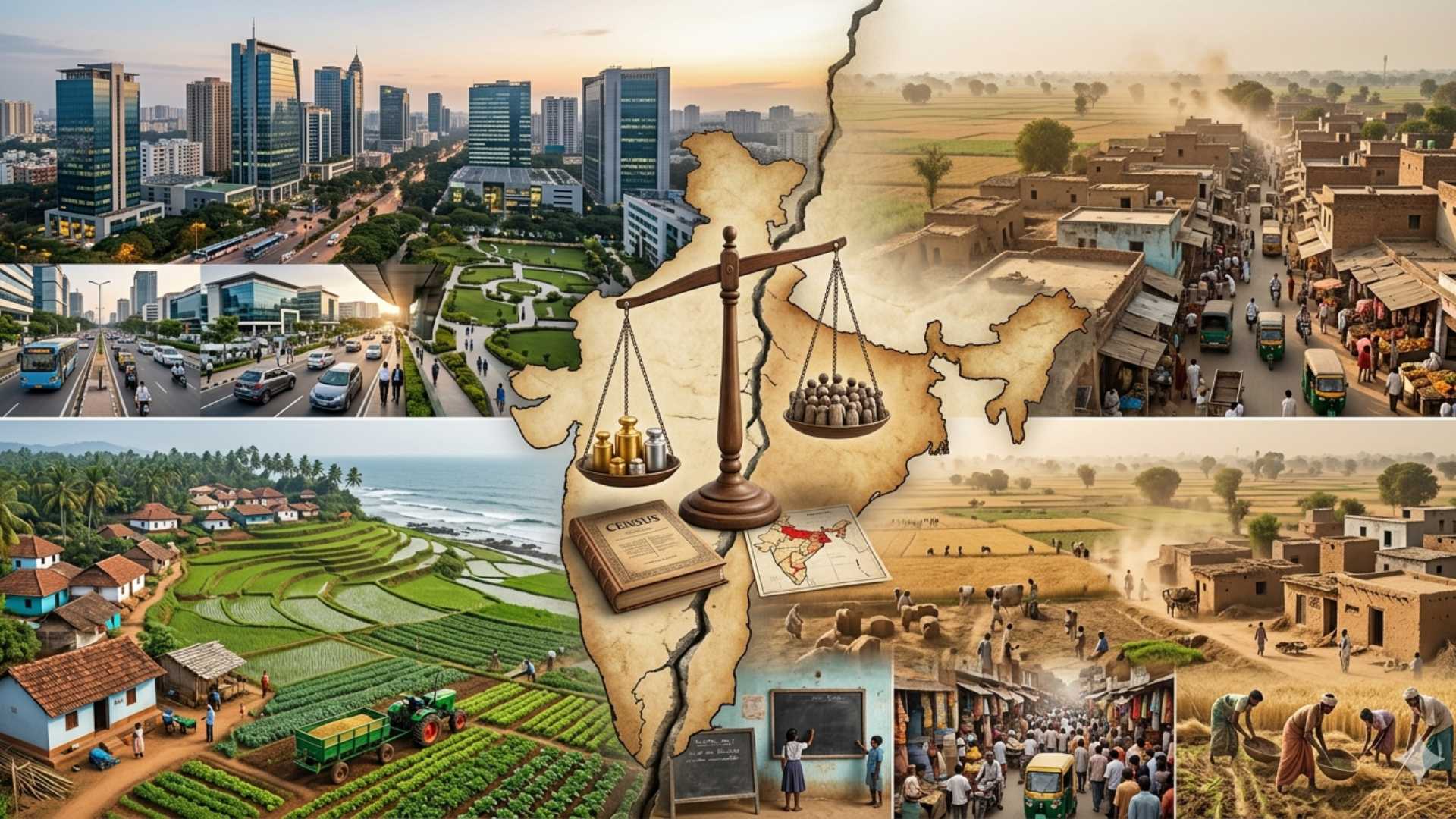
India's federal compact faces its gravest structural stress since Independence — an internal asymmetry where economic prosperity and political power are dangerously decoupled, and the approaching delimitation threatens to widen this fault-line irreversibly.
"When a productive minority is forced to subsidise a relatively poor and deprived majority that holds the reins of dominant political power, conflict is not just a possibility — it is a probability." — Article, The Hindu
On Federalism & Regional Inequality
"India is not a nation of one language, one culture, one religion. It is a civilisation of many nations held together by a federal compact — and that compact must be fair to all." — B.R. Ambedkar
| Dimension | Peninsular States | Great Indian Plain |
|---|---|---|
| Per Capita Income | At least 2–3x higher | Baseline |
| Human Development | Upper-middle-income country level | Sub-Saharan Africa comparable |
| Fertility Rate | At or below replacement level | Above replacement level |
| Post-Delimitation Trend | Seat loss | Seat gain |
Background: Two Indias in One Sovereign Space
Economist Rathin Roy's framework of the "Great Indian Plain" versus "Peninsular States" captures a divergence that has calcified over decades rather than converging as development theory predicted.
| Dimension | Peninsular States | Great Indian Plain |
|---|---|---|
| Per Capita Income | At least 2–3x higher | Significantly lower |
| Human Development | Comparable to upper-middle-income countries | Comparable to sub-Saharan Africa |
| Fertility Rate | Replacement level or below | Above replacement level |
| Literacy | High; some districts below UP average (exception) | Variable; improving |
| Tamil Nadu vs Bihar (per capita) | 3x Bihar's per capita income | Baseline |
| Tamil Nadu vs Bihar (agricultural wage) | Less than 2x Bihar's wage | Baseline |
This last data point is critical — per capita income is 3x but agricultural wages are less than 2x — revealing that southern prosperity is concentrated among elites, not distributed to labour.
The Delimitation Crisis: Political Representation vs. Economic Contribution
Background on Delimitation
- Parliamentary constituencies are delimited based on population — last frozen after the 1971 Census to avoid penalising states that successfully reduced fertility rates
- The freeze was extended until 2026 (25th Amendment + 84th Amendment, 2001)
- Post-2026, the next Census will trigger fresh delimitation — redistributing seats based on current population
The Core Asymmetry
| State | Population Growth | Likely Seat Gain/Loss Post-Delimitation |
|---|---|---|
| UP, Bihar, MP, Rajasthan | High — above national average | Significant seat gains |
| Tamil Nadu, Kerala, Andhra Pradesh, Telangana | Low — below replacement | Significant seat losses |
The consequence: States that invested in education, women's empowerment, and family planning — achieving demographic transition — will be politically punished for their success. States that did not will be politically rewarded for their demographic weight.
"When a productive minority is forced to subsidise a relatively poor and deprived majority that holds the reins of dominant political power, conflict is not just a possibility — it is a probability."
Historical Parallel: A Warning from History
The article draws a stark comparison — India risks walking the path of the USSR and Yugoslavia:
| Country | Dynamic | Outcome |
|---|---|---|
| USA, Canada, Australia | Prosperous regions = most populous regions | Natural alignment; stable federalism |
| USSR | Productive minority subsidising politically dominant majority | Collapse; fragmentation |
| Yugoslavia | Similar asymmetry + ethnic overlay | Violent dissolution |
| India (risk scenario) | Productive peninsular minority; demographically dominant but poorer north | Federal stress; political marginalisation |
In most healthy federations, economic prosperity and political power align. India's emerging trajectory inverts this — creating structural incentives for regional conflict.
The Proposed Solution: Digressive Proportionality
Professor Santosh Mehrotra (January 2026) has proposed digressive proportionality as the fairest framework for delimitation:
Principle: Larger states get more seats — but fewer seats per person. Smaller states get fewer seats — but more representation per person.
Effect:
- Prevents total domination by large northern states
- Ensures southern states retain meaningful voice despite lower population
- Balances state equality with population size
- Precedent: Used in the European Parliament for member state representation
This is the most analytically sophisticated solution currently on the table — and UPSC-relevant as it directly engages constitutional, federal, and democratic principles simultaneously.
The South's Internal Crisis: Middle-Income Trap
The article makes a crucial argument — the South cannot frame its challenge purely as a grievance against the Centre. It faces a self-inflicted middle-income trap:
1. Inequality Within Prosperity
- Tamil Nadu's per capita income is 3x Bihar — but agricultural wages are less than 2x
- Wealth concentrated in 3–4 urban districts in Karnataka and Telangana
- Benefits of growth captured by a narrow elite — not distributed to labour or rural populations
2. Social Stagnation Despite Economic Growth
- Casteism, patriarchy, and misogyny persist across both north and south
- Dharmapuri district (Tamil Nadu) has literacy rates lower than dozens of UP districts
- Rule of law flouted in Bengaluru and Chennai despite high incomes
- Economic wealth has not translated into social transformation — Kerala is the notable exception
3. Institutional Weakness
- Southern states are "punching below their weight" due to weak institutions
- Failure to convert economic capital into human capital investment at scale
- Internal migration from north creating "internal outsiders" — migrants vote in home states, adding no political weight to the south
"True progress is not measured by the number of unicorns in a capital city, but by the daily wage of an agricultural labourer and the literacy rate of its poorest district."
Fiscal Federalism Dimension
The north-south divide is also a fiscal federalism problem:
- Southern states are net contributors to the Union tax pool — they pay more in taxes than they receive in devolution and grants
- Northern states are net recipients — receiving more than they contribute
- Finance Commission devolution formulas balance equity (need) vs. efficiency (performance) — but southern states argue the equity weightage consistently disadvantages them
- Tax devolution criteria (income distance, demographic performance, forest cover, area) are contested — southern states argue demographic performance should be rewarded, not penalised
This fiscal asymmetry compounds the political asymmetry of delimitation — the south contributes disproportionately to national revenue while receiving diminishing political representation.
Analytical Dimensions
1. Federalism Under Stress
India's federalism was designed for a diverse, unequal nation — but not for a sustained inverse correlation between economic contribution and political power. As this gap widens post-delimitation, pressures for fiscal autonomy, language rights, and administrative decentralisation will intensify in southern states.
2. The Language Politics Overlay
The three-language formula, Hindi imposition concerns, and NEP language debates are not separate from the delimitation crisis — they are part of the same cultural-political-economic complex that southern states experience as centralising pressure from a demographically dominant north.
3. Migration and Social Fabric
Large-scale migration from Bihar and UP to southern states is already reshaping labour markets, urban demographics, and social dynamics. But as the article notes, these migrants remain politically rooted in their home states — they do not organically integrate into the south's political economy, creating social tension without political compensation.
4. The Kerala Exception
Kerala uniquely demonstrates that economic development can translate into social equity — high literacy, low inequality, strong public health, gender parity. Its model — built on land reform, education investment, and strong local governance — offers a template that other southern states have not replicated.
Three Theoretical Scenarios and Their Limits
| Scenario | Description | Why It Is Failing |
|---|---|---|
| Northern catch-up | North develops economically before delimitation rebalances seats | 300% per capita gap — will take generations |
| Population movement | Large-scale migration "equalises" demographics | Migrants vote in home states; creates social friction, not political equity |
| Southern pull | Southern prosperity pulls entire country up | South itself trapped in middle-income cycle; weak institutions limit growth |
All three convergence mechanisms are failing simultaneously — making institutional and constitutional reform the only viable path.
Conclusion
India's north-south divide is not a grievance to be managed — it is a structural fault-line to be addressed before delimitation converts it into a constitutional crisis. The asymmetry between economic contribution and political representation, if left unresolved, risks transforming cooperative federalism into coercive federalism — where the productive minority is perpetually outvoted by the politically dominant majority. The solution requires action on multiple fronts simultaneously: digressive proportionality in delimitation to protect southern representation; reform of Finance Commission criteria to reward demographic and development performance; and a radical commitment within southern states themselves to convert economic prosperity into genuine social transformation. India's unity has always rested on the principle that diversity is a strength — but only if the federal compact ensures that no region's success is used as a justification for its political marginalisation.