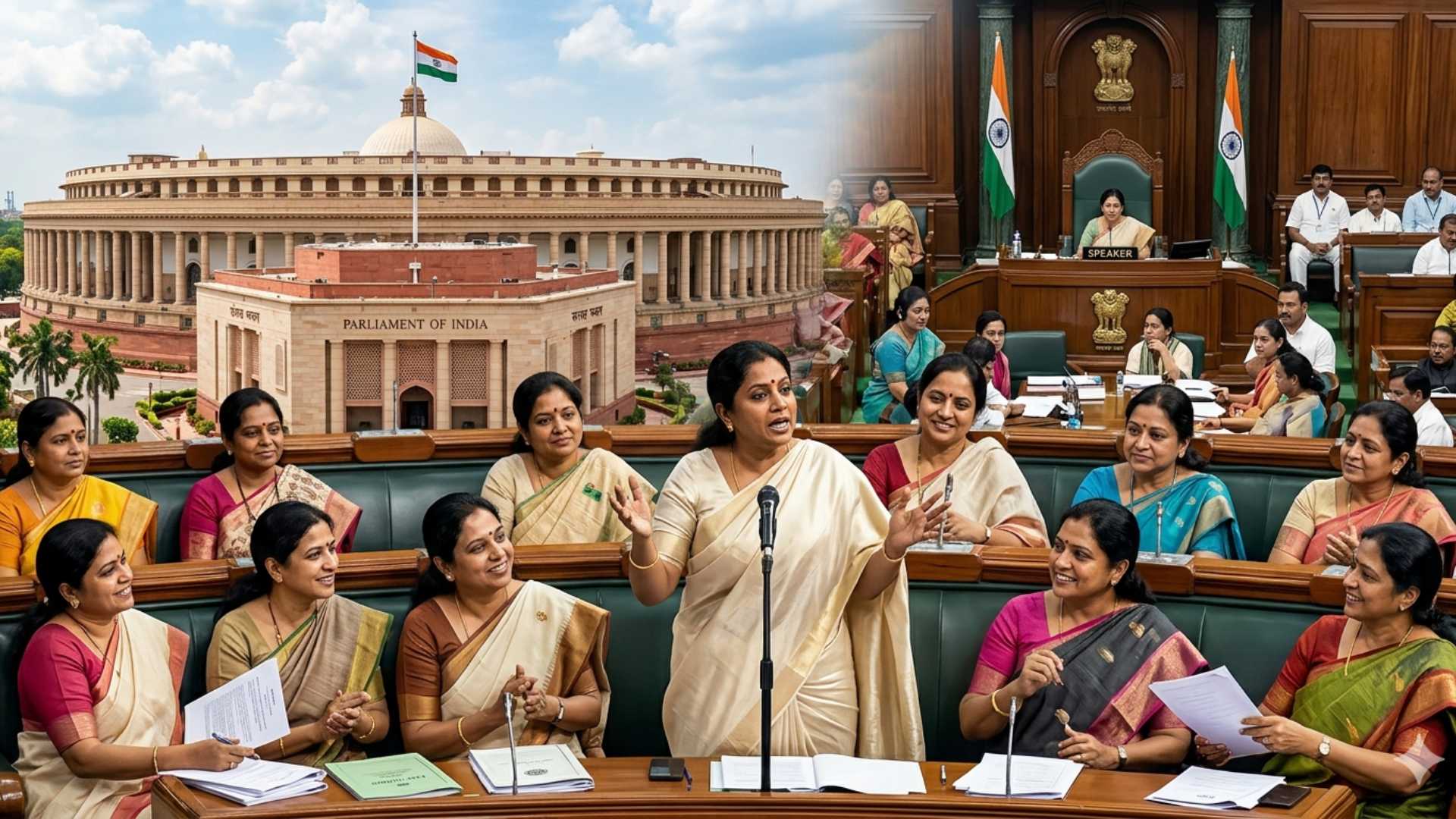
Centre Proposes Changes to Lok Sabha Seat Distribution

Amendments could change Lok Sabha representation, impacting southern states as 2029 elections approach.
G
Gopi
4 mins read
Proposed Delimitation May Shift Parliamentary Power Across States

The Constitution (131st Amendment) Bill, 2026 proposes expanding the Lok Sabha to 850 seats and operationalising women's reservation — but its population-proportional seat reallocation based on 2011 Census data would shift federal power dramatically toward Hindi-heartland states, reducing southern and demographically stabilised states' share of parliamentary representation.

"The Bills being introduced in the name of implementing women's reservation amount to a death warrant for federal India." — John Brittas, CPI(M) MP

State/RegionCurrent Seats (Share)Projected Seats (Share)Change
Hindi Heartland207 (38.1%)366 (43.1%)+5%
Southern States132 (24.3%)176 (20.7%)−3.6%
Uttar Pradesh80 (14.73%)138 (16.24%)+58 seats
Kerala20 (3.68%)23 (2.70%)−0.98% share
Tamil Nadu39 (7.18%)50 (5.88%)−1.3% share
Bihar40 (7.37%)72 (8.47%)+32 seats

Background & Context

Under the existing constitutional scheme, Lok Sabha seats are distributed between states on the basis of the 1971 Census and within states on the basis of the 2001 Census. Article 82 provides that this arrangement continues "until the relevant figures for the first census taken after the year 2026 have been published." The 42nd Amendment (1976) froze inter-state seat distribution to protect states that had controlled population growth. The 84th Amendment (2001) — negotiated under PM Vajpayee — extended this freeze through 2026 as a political consensus. The 131st Amendment now proposes to remove this safeguard entirely.


Key Constitutional Changes

1. Expansion of Lok Sabha Ceiling raised from 550 to 850 seats — 815 for states, 35 for UTs — with 33% reserved for women.

2. Population Definition Delegated Existing constitutional anchor (1971/2001 Census) replaced with open-ended formulation: population = Census "as Parliament may by law determine" — changeable by simple majority.

3. Freeze Proviso Deleted Articles 81 and 82 freeze provisions — protecting population-stabilised states since 1976 — deleted entirely. Delimitation Commission mandated to readjust seats based on "latest census figures" — currently 2011.


Core Federal Tension

Demographic Penalty for Development

States that invested in public health, female literacy, and family planning achieved lower fertility rates — and now face reduced parliamentary representation as a consequence. This creates a structurally perverse incentive: demographic responsibility = political marginalisation.

StateFertility AchievementParliamentary Consequence
Kerala, Tamil Nadu, KarnatakaAmong lowest TFR in IndiaShare of seats shrinks
UP, BiharHigher TFRShare of seats grows significantly

Assurances vs. Legal Reality

Cabinet ministers assured that existing inter-state seat proportions would be maintained. However, Article 81(2)(a) — retained unchanged — mandates population-proportionality "so far as practicable." This is a proportionality requirement, not a proportion-preservation guarantee. The assurances have no constitutional backing in the Bill's text.


Procedural Concerns

  • Bills introduced with barely 36 hours notice before Parliament reconvened.
  • No multi-party consultations despite repeated Opposition demands.
  • No referral to parliamentary standing committee.
  • Timed ahead of 2029 Lok Sabha elections — raising questions of political motivation over constitutional necessity.
  • TN, Kerala, Karnataka, Telangana, Punjab had demanded 25-year freeze extension — demand entirely overlooked.

Women's Reservation: The Constitutional Shortcut

Women's reservation (106th Amendment, 2023) can be operationalised within the existing 543-seat Lok Sabha through rotational constituency designation — the approach pressed by the Opposition post-passage. Bundling it with delimitation is a political choice, not a constitutional necessity — using a widely supported reform as cover for a contested federal restructuring.


Implications

DimensionImpact
Federal balancePower shift toward BJP-dominant Hindi-heartland states
Fiscal federalismReduced political representation compounds Finance Commission disparities
Constitutional safeguardsSimple majority can now alter fundamental federal parameters
Democratic incentivesDevelopment → lower fertility → fewer seats = perverse governance signal
Women's reservationFurther delayed; tied to contested delimitation process

Conclusion

The 131st Amendment Bill presents itself as a women's empowerment measure but operates as a federal restructuring instrument. The deletion of the population freeze, the delegation of Census definition to simple majority legislation, and the projected seat distribution collectively represent the most consequential reshaping of India's parliamentary democracy since the Emergency era amendments. Federal principles demand that such legislation receive not parliamentary velocity but constitutional deliberation — with affected states accorded genuine voice. Representation without federal equity is democracy incomplete.

Quick Q&A

Everything you need to know

Delimitation refers to the process of redrawing the boundaries of electoral constituencies and reallocating seats in legislative bodies based on population changes. In India, this exercise ensures that representation in the Lok Sabha remains proportionate to demographic shifts.

Under the current constitutional framework, Articles 81 and 82 mandate that seat allocation among States is based on the 1971 Census, with a freeze imposed to encourage population control measures. This freeze, extended until after the first Census post-2026, ensured that States which successfully controlled population growth were not penalized with reduced representation.

The proposed Constitution (131st Amendment) Bill seeks to remove this safeguard by allowing immediate readjustment of seats based on the latest available Census (currently 2011). It also proposes increasing the total strength of the Lok Sabha to 850 seats, including 33% reservation for women.

Implication: This fundamentally shifts India’s representational balance, moving from a policy-driven freeze to a purely population-based model, which could significantly alter the federal political landscape.

The proposed delimitation has sparked controversy primarily because it is perceived as undermining the principle of cooperative federalism. States that have effectively implemented population control measures, particularly in southern India, fear a reduction in their political representation.

Key concerns include:

  • Disincentivising population control: States like Tamil Nadu and Kerala may lose seats despite better governance outcomes.
  • Regional imbalance: Hindi heartland States could see their share rise significantly (e.g., from 38.1% to 43.1%).
  • Lack of consultation: Opposition parties argue that the Bills were introduced without adequate federal dialogue or committee scrutiny.


Critics argue that this shift could distort the political equilibrium by concentrating power in more populous States, thereby marginalizing others. This raises concerns about the erosion of the federal compact, where States are expected to have equitable participation in national decision-making.

Thus, the controversy lies not just in seat redistribution, but in its broader implications for democratic fairness and Centre-State relations.

The linkage between women’s reservation and delimitation is a central point of political contention. The government argues that delimitation is necessary to operationalize the 33% reservation for women in the Lok Sabha and State Assemblies, as envisioned in the 106th Constitutional Amendment (Nari Shakti Vandan Adhiniyam).

However, critics view this as a strategic coupling of two distinct issues. They argue that women’s reservation could be implemented within the existing seat structure, without altering inter-State representation. By linking the two, the government is accused of using a widely supported reform as a political cover for controversial seat redistribution.

Political implications:

  • Creates a dilemma for opposition parties, who support women’s reservation but oppose delimitation.
  • Shifts public discourse away from federal concerns to gender representation.
  • Raises questions about legislative intent and transparency.


This linkage complicates the debate by intertwining gender justice with federal equity, making it difficult to evaluate each reform on its own merits.

The primary driver of the proposed redistribution is the significant demographic shift across States since 1971. Northern States such as Uttar Pradesh and Bihar have experienced higher population growth, while southern States have achieved demographic stabilization.

Demographic rationale:

  • Representation should reflect current population realities.
  • The 1971-based allocation is seen as outdated.


However, the political dimension is equally significant. Increased seats in populous States could translate into greater influence in national politics. For instance, Uttar Pradesh may gain 58 additional seats, enhancing its already dominant position in the Lok Sabha.

Concerns:
  • Potential political centralization in certain regions.
  • Marginalization of smaller or demographically stable States.


Thus, while the proposal is grounded in demographic logic, it also carries profound political consequences that could reshape electoral dynamics and governance priorities.

The impact of the proposed delimitation can be clearly seen through State-level seat projections. For instance, Uttar Pradesh, currently holding 80 seats, is projected to gain 58 additional seats, increasing its share from 14.73% to 16.24% of the Lok Sabha.

In contrast, Kerala would gain only 3 seats (from 20 to 23), but its overall share would decline from 3.68% to 2.7%. Similarly, Tamil Nadu would increase from 39 to 50 seats, yet its proportional share would fall significantly.

Other examples include:

  • Bihar: Increase from 40 to 72 seats
  • Maharashtra: Increase from 48 to 78 seats


These examples highlight a critical point: absolute gains do not necessarily translate into proportional advantage. States with slower population growth may gain seats numerically but lose influence in percentage terms.

This uneven impact underscores the broader concern that delimitation could alter the balance of political power across regions.

Removing the freeze on Lok Sabha seat allocation presents both opportunities and challenges.

Potential benefits:

  • Democratic fairness: Aligns representation with current population distribution.
  • Improved governance: Larger representation from populous States may enhance policy responsiveness.
  • Dynamic system: Reflects evolving demographic realities.


However, significant drawbacks exist:
  • Federal imbalance: States with effective population control may be penalized.
  • Political dominance: Increased concentration of power in a few large States.
  • Social equity concerns: Regional disparities may widen.


Moreover, the abrupt removal of the freeze without consensus risks undermining the spirit of cooperative federalism. The earlier freeze was a carefully negotiated political compromise, balancing demographic logic with national unity.

Conclusion: While the reform may enhance representational accuracy, it must be implemented with safeguards to ensure that it does not destabilize India’s federal structure.

As a policymaker, balancing demographic representation with federal equity would be crucial. A multi-pronged approach would be necessary to address the concerns of southern States.

Policy measures could include:

  • Phased implementation: Gradually introduce delimitation changes to avoid sudden political shifts.
  • Incentive mechanisms: Reward States for population control through fiscal transfers or special grants.
  • Upper House strengthening: Enhance the role of the Rajya Sabha to protect State interests.


Additionally, women’s reservation could be implemented independently of delimitation by reserving seats within the existing structure, thereby avoiding unnecessary linkage.

Consultative approach: تشکیل of an all-party committee or Inter-State Council discussions would ensure broader consensus and legitimacy.

Conclusion: A balanced solution must uphold both democratic principles and the federal spirit, ensuring that no region feels disadvantaged in the process.

Attribution

Original content sources and authors

Sign in to track your reading progress

Comments (0)

Please sign in to comment

No comments yet. Be the first to comment!