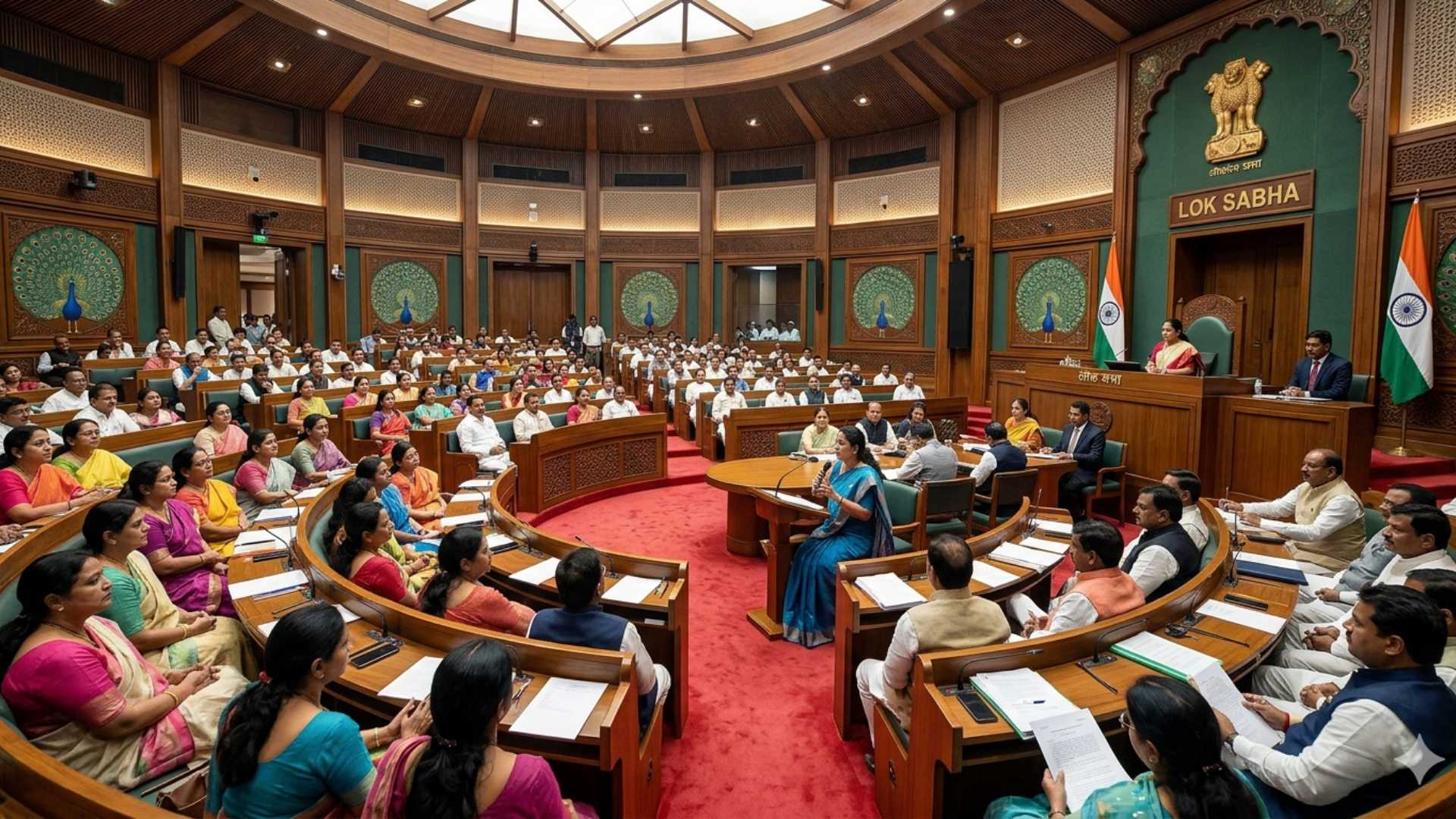
Delimitation vs. Women’s Reservation: The Real Issue at Hand

Examining the political implications of delimitation and women's reservation in the upcoming elections and legislative process.
G
Gopi
5 mins read
Rushed reforms or political strategy?

Introduction

India's 543-seat Lok Sabha has only ~13% women members — far below the global average of 26.5% (IPU, 2024) and well behind Rwanda (61%), Iceland (47%), and Sweden (46%). The Nari Shakti Vandan Adhiniyam, 2023 (Constitution 106th Amendment Act) sought to address this historic underrepresentation by mandating 33% reservation for women in Parliament and State Assemblies — but linked it to a post-Census delimitation, deferring actual implementation. Now, a proposed special session aims to fast-track both women's reservation (from 2029) and a new delimitation formula — raising deep constitutional and federal concerns.

"Reservation without a timeline is a promise without sincerity." — Mallikarjun Kharge, Leader of Opposition, Rajya Sabha (2023)


Key Statistics at a Glance

IndicatorData
Women in Lok Sabha (2024)~13.6%
Global average (IPU, 2024)26.5%
Elected women in local bodies (post-73rd/74th Amendment)~15 lakh (>40%)
Last Census conducted2011
Census due year2021 (delayed by 5 years)
Constitutional Amendment106th Amendment Act, 2023 (Article 334-A)
Reservation quantum1/3rd of total seats

Background & Context

The 106th Constitutional Amendment (2023)

  • Passed unanimously in a special session (September 2023)
  • Introduced Article 334-A: mandates 33% reservation for women in Lok Sabha and State Assemblies
  • Contains reservation within reservation — SC/ST seats will also have women's sub-quota
  • Critical condition: implementation deferred until after the next Census and subsequent delimitation

Why the delay matters: The Census was due in 2021 but has been postponed five years — a delay that has already deprived over 10 crore persons of entitlements under the National Food Security Act, 2013. Digital Census operations have only recently begun; senior officials confirm population data will be available by 2027.

The 73rd and 74th Amendment precedent (1992–93): Rajiv Gandhi's landmark panchayat/nagarpalika reservation Bills underwent nearly five years of debate before enactment. Today, 40%+ of elected local body representatives are women — demonstrating what patient, consensus-driven reform achieves.


Current Controversy: The Special Session

What is proposed:

  • Amendment to Article 334-A to make women's reservation operative from 2029 (without waiting for delimitation)
  • A new delimitation formula — details not yet officially shared with MPs

Why it is controversial:

IssueConcern
TimingScheduled during peak election campaign (Tamil Nadu & West Bengal)
TransparencyNo official proposal shared with MPs prior to session
Due processOpposition's three written requests for a post-election all-party meeting denied
OBC sub-quotaNo provision for women from OBCs, despite being included in education/employment reservations
Delimitation formulaUndisclosed; raises fears of penalising southern/smaller states

The Delimitation Problem: A Federal Flashpoint

Delimitation — the redrawing of constituency boundaries — is not merely arithmetic; it is deeply political.

Core federal concern: States like Tamil Nadu, Kerala, Andhra Pradesh, and Telangana have achieved low Total Fertility Rates (TFRs near replacement level) through decades of investment in health and education. A straight population-based delimitation would reduce their relative representation in Parliament — punishing good governance.

  • Absolute vs. relative disadvantage: Even a "proportionate" increase in Lok Sabha seats can magnify the absolute gap between large and small states, reducing the influence of southern and smaller states.
  • Constitutional safeguard at stake: The spirit of federalism under Articles 1, 2, and the basic structure doctrine demands political equity, not just numerical proportionality.

"Delimitation based solely on population without equity corrections would be an assault on cooperative federalism."

Relevant precedent: The 42nd Amendment (1976) froze delimitation until 2001; the 84th Amendment (2002) extended the freeze until after the 2001 Census to protect southern states.


The Caste Census Dimension

  • PM announced a caste census as part of Census 2027 — a U-turn from prior government affidavits in the Supreme Court rejecting the idea
  • Bihar and Telangana completed comprehensive caste surveys within 6 months, disproving claims that caste enumeration would delay the Census
  • Critics argue the special session's timing is designed to delay and derail the caste census by accelerating delimitation before OBC data is available — which would weaken the case for OBC sub-quota in women's reservation

Constitutional & Democratic Process Concerns

  1. Parliamentary propriety: Far-reaching constitutional amendments require adequate deliberation — not rushed special sessions during election season
  2. Anti-defection and consensus norms: Unanimous passage of the 2023 Act was achieved through good faith; bypassing all-party consultations undermines that
  3. Separation of election and legislation: Using special sessions to gain electoral narrative control conflates the legislative function with electoral strategy
  4. Basic structure concerns: Delimitation that fundamentally alters the federal balance between states could invite judicial scrutiny under the Kesavananda Bharati doctrine

Way Forward

  • Convene an all-party meeting after the last phase of elections to present the government's proposals transparently
  • Introduce amendments in the Monsoon Session (July) after public debate
  • Ensure delimitation formula incorporates equity corrections for states with low TFR and smaller populations
  • Provide OBC sub-quota for women within the 33% reservation
  • Complete and publish Census 2027 (including caste data) before finalising any delimitation

Conclusion

Women's reservation in Parliament is a settled constitutional commitment — the debate has moved beyond whether to how and when. The real contest today is over delimitation: who draws the lines, on what basis, and with whose consent. A federal democracy cannot afford to treat its constitutional architecture as an electoral prop. The urgency of reform is real, but so is the constitutional imperative of deliberative, inclusive, and transparent governance. Rushing delimitation through a special session — without sharing proposals, without consensus, and without completing the Census — risks doing more damage to India's democratic fabric than any delayed implementation ever could.

Quick Q&A

Everything you need to know

Nari Shakti Vandan Adhiniyam, 2023: This landmark constitutional amendment introduces Article 334-A, mandating one-third reservation for women in the Lok Sabha and State Legislative Assemblies. It also incorporates the principle of ‘reservation within reservation’, ensuring that one-third of seats reserved for Scheduled Castes (SCs) and Scheduled Tribes (STs) are allocated to women from these communities.

Key features include:

  • Conditional Implementation: The reservation will come into effect only after the completion of the next Census and subsequent delimitation exercise.
  • Time-bound Provision: The reservation is envisaged for a fixed period, similar to other political reservations.
  • Extension to States: It applies uniformly across Parliament and State legislatures.

Transformational potential: The Act builds upon the success of the 73rd and 74th Constitutional Amendments, which enabled over 40% representation of women in local bodies. This has led to greater focus on social welfare, health, and education at grassroots levels. Extending similar representation to higher legislatures can reshape policy priorities.

Limitations and concerns: The delayed implementation due to Census and delimitation conditions has raised questions about political intent. Additionally, the absence of explicit OBC reservation within women’s quota has sparked debates on inclusivity. Thus, while the Act is progressive, its real impact depends on timely and equitable execution.

Importance of Democratic Process in Lawmaking: The timing and procedure of introducing constitutional amendments are crucial because they reflect the health of parliamentary democracy. Rushed legislation, especially during politically sensitive periods like elections, raises concerns about transparency, inclusivity, and deliberation.

Key concerns include:

  • Lack of Consultation: Bypassing all-party meetings or parliamentary committees undermines consensus-building.
  • Electoral Advantage: Introducing major reforms during elections may be perceived as a strategy to gain political mileage.
  • Reduced Debate: Special sessions with limited agenda clarity restrict meaningful discussion.

Historical contrast: The 73rd and 74th Amendments were passed after nearly five years of extensive debate and consultation, ensuring broad political consensus. This strengthened their legitimacy and acceptance.

Implications: Democratic legitimacy is not just about outcomes but also processes. Procedural fairness enhances trust in institutions, while perceived haste or unilateralism can weaken it. Therefore, major constitutional changes must be deliberative, transparent, and inclusive to uphold democratic values.

Interlinkage of Census, Delimitation, and Representation: The Census provides updated population data, which forms the basis for delimitation—the redrawing of electoral constituencies. This process ensures that representation in legislatures reflects demographic realities.

Mechanism:

  • Census: Enumerates population, including socio-economic and demographic details.
  • Delimitation Commission: Uses Census data to redraw constituency boundaries.
  • Reservation Allocation: Seats for SCs, STs, and now women are allocated based on population proportions.

Implications of delays: The postponement of the 2021 Census has disrupted this cycle. Without updated data, delimitation—and consequently women’s reservation—cannot be implemented. This creates a policy bottleneck.

Case example: The freeze on delimitation since 1976 (extended till 2026) was intended to encourage population control. However, it has led to disparities where states with successful family planning may lose relative representation in future exercises.

Conclusion: While linking reservation to delimitation ensures fairness, delays in Census operations can delay democratic reforms. Thus, timely and transparent data collection is essential for equitable representation.

Delimitation Debate: Delimitation is essential for ensuring equal representation, but it also raises complex political and federal concerns. The proposed exercise, especially if linked with increasing Lok Sabha seats, has sparked debates about fairness and constitutional balance.

Key challenges:

  • Regional Imbalance: States with higher population growth (often in the north) may gain more seats, while southern states may lose relative influence despite better population control.
  • Federal Tensions: Perceived inequities can strain Centre-State relations.
  • Political Manipulation: Concerns about gerrymandering or politically motivated boundary changes.

Equity vs Arithmetic: A purely population-based approach may ignore historical efforts in family planning. For instance, Kerala and Tamil Nadu could be disadvantaged compared to states like Uttar Pradesh or Bihar.

Way forward: A balanced approach must combine demographic representation with political equity. Mechanisms such as weighted representation or safeguards for smaller states could be explored.

Conclusion: Delimitation is not merely a technical exercise but a deeply political one. It must be conducted transparently and consensually to avoid undermining the federal structure.

Delay in Census and Its Implications: The decadal Census, due in 2021, has been significantly delayed, reportedly due to logistical challenges such as the COVID-19 pandemic. However, prolonged postponement has raised concerns about governance deficits.

Key impacts include:

  • Welfare Exclusion: Over 10 crore people may have been excluded from benefits under the National Food Security Act (NFSA), 2013 due to outdated population data.
  • Policy Distortion: योजनाएँ like PM Garib Kalyan Anna Yojana rely on accurate population estimates.
  • Delayed Reforms: Women’s reservation and delimitation are stalled.

Case example: States like Bihar and Telangana conducted caste surveys within months, demonstrating that large-scale data collection is feasible with political will.

Governance implications: Accurate data is the backbone of evidence-based policymaking. Delays weaken targeting efficiency and increase exclusion errors.

Conclusion: The Census is not just a statistical exercise but a governance tool. Its delay has cascading effects on welfare, representation, and policy planning, making timely execution imperative.

Grassroots Democracy through Constitutional Amendments: The 73rd and 74th Constitutional Amendments (1992-93) institutionalized Panchayati Raj Institutions (PRIs) and Urban Local Bodies (ULBs), marking a major step towards decentralized governance.

Key achievements:

  • Women’s Representation: One-third reservation for women (now increased to over 40% in many states).
  • Inclusive Governance: Participation of marginalized groups in decision-making.
  • Local Development: Greater focus on issues like sanitation, education, and health.

Case studies: In states like Rajasthan and Bihar, women पंचायत leaders have led initiatives in water conservation, school enrollment, and public health awareness. This demonstrates how representation translates into tangible outcomes.

Lessons for present: The success of these amendments underscores the importance of deliberation, consensus, and gradual implementation. The Nari Shakti Vandan Adhiniyam builds upon this legacy.

Conclusion: Inclusive governance is strengthened when representation is broadened. The 73rd and 74th Amendments serve as a model for how constitutional reforms can drive social transformation.

Attribution

Original content sources and authors

Sign in to track your reading progress

Comments (0)

Please sign in to comment

No comments yet. Be the first to comment!