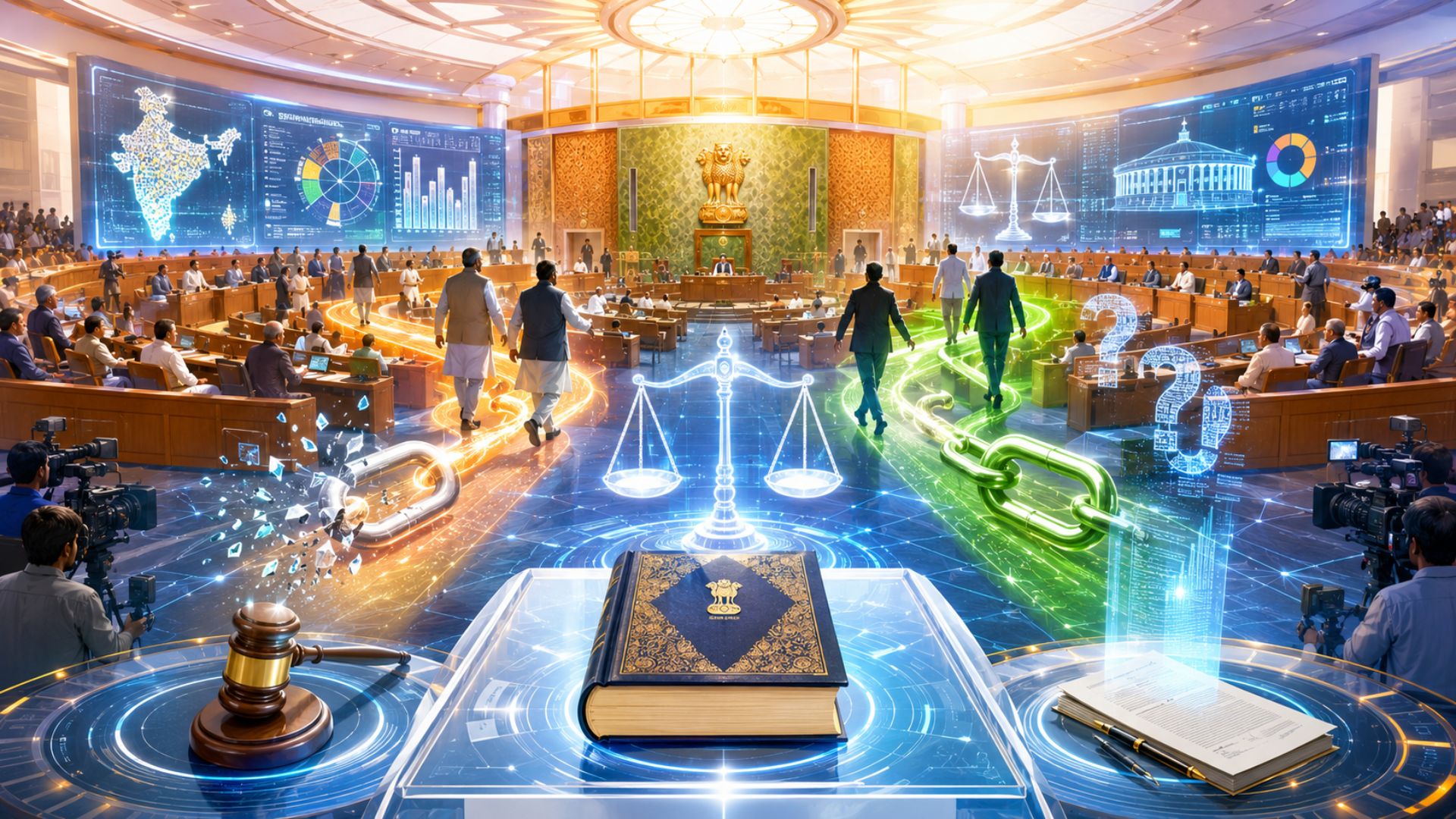
The Anti-Defection Law and the Merger Exception: A Constitutional Crisis in the Rajya Sabha
When seven of AAP's ten Rajya Sabha MPs announced their merger with the BJP on April 24, 2026, invoking the 10th Schedule's merger exception, they triggered a constitutional question that goes far beyond partisan politics: can a legislature party's numerical majority override the identity and will of the original political party? The answer will define the future of India's anti-defection framework.
The Constitutional Architecture: How We Got Here
The anti-defection law has evolved through deliberate legislative choices:
- The Constitution (1950) originally provided for MP disqualification only on limited grounds under Article 103, decided by the President on the Election Commission's advice
- The 52nd Constitutional Amendment Act, 1985 introduced the 10th Schedule, adding disqualification for defection — to be decided by the Speaker or Chairman
- The Schedule originally carved out two exceptions:
- Paragraph 3 — the "split" exception: recognised a faction of one-third members as legitimate
- Paragraph 4 — the "merger" exception: immunity where the original political party merges with another
- The 91st Constitutional Amendment Act, 2003 — acting on the Dinesh Goswami Committee (1990) and 170th Law Commission Report (1999) recommendations — deleted Paragraph 3 entirely
The deletion of the split exception was not procedural housekeeping. It was a conscious constitutional signal: internal legislature party dissent cannot override the primacy of the political party as the fundamental unit of democratic accountability.
The Merger Exception: What Paragraph 4 Actually Says
The present AAP controversy turns entirely on the interpretation of Paragraph 4:
- It grants immunity from disqualification where the "original political party" merges with another
- Paragraph 4(2) introduces a deeming fiction — treating consent of two-thirds of legislature party members as constituting a merger
The critical constitutional question: does two-thirds numerical strength within the legislature party alone constitute a valid merger, or must it reflect a decision of the political party organisation itself?
A plain reading of Paragraph 4 places emphasis squarely on the merger of the political party — not merely a numerical alignment within its legislative wing. Reading Paragraph 4(2) in isolation would allow the legislature party to dictate the fate of the political party — effectively inverting the constitutional design the 10th Schedule was built to protect.
This reading is reinforced by the abolition of Paragraph 3. If even a one-third split was deemed constitutionally impermissible, it strains logic to argue that a two-thirds faction can now appropriate the entire identity of the political party through a merger claim.
Precedent and Scale: Why This Case Matters More
Similar numerical assertions have been made at the state level — most notably the Eknath Shinde-led Shiv Sena faction in the Maharashtra Assembly. But the AAP episode is qualitatively different:
- It unfolds at the national level in the Rajya Sabha — the House of States
- It involves 7 of 10 sitting MPs — well above the two-thirds threshold
- AAP has approached the Chairman of the Rajya Sabha under Paragraph 6 of the 10th Schedule to challenge the merger claim
The Rajya Sabha Chairman's ruling — and ultimately the Supreme Court's adjudication — will set binding precedent for how merger claims are evaluated across India's parliamentary system.
The Deeper Democratic Stakes
"The essential distinction between democracy and dictatorship lies in the presence of an opposition." — Javed Akhtar, lyricist and former Rajya Sabha MP
The 10th Schedule was never merely about regulating individual conduct. Its foundational purpose was to preserve the integrity of the party system and protect the institution of opposition in parliamentary democracy. A permissive interpretation of the merger exception — one that allows legislative majorities to claim party identity without organisational sanction — would make the anti-defection law a tool for engineered political consolidation rather than democratic discipline.
Way Forward
- Supreme Court adjudication is now inevitable and necessary — the absence of settled judicial clarity on Paragraph 4 creates a constitutional vacuum that political actors will continue to exploit
- The Court must establish whether a valid merger requires organisational decision-making by the political party, not merely a head count in the legislature
- Parliament should consider further amendment to explicitly require that any merger claim be accompanied by a formal resolution of the political party's organisational body — closing the interpretive gap Paragraph 4(2) currently leaves open
- The Election Commission's role in recognising or rejecting merged factions must be clearly delineated vis-à-vis the Speaker/Chairman's jurisdiction under the 10th Schedule
- Timelines for deciding disqualification petitions must be constitutionally mandated — prolonged uncertainty, as seen repeatedly, itself becomes a political instrument
Conclusion
The AAP merger episode is a stress test of India's anti-defection architecture. The 10th Schedule was designed to ensure that elected representatives remain accountable to the political mandate that brought them to power — not to the highest numerical bidder within their legislative group. If the merger exception is interpreted to permit legislature party majorities to override the political party's organisational identity, the anti-defection law will have been hollowed out from within. Constitutional adjudication must restore what the framers of the 91st Amendment made clear: the political party — not its legislative faction — is the irreducible unit of India's parliamentary democracy.
Attribution
Original content sources and authors
Syllabus classification
How this article maps to GS papers
Main syllabus
GS2Indian ConstitutionQuick Q&A
What is the constitutional purpose of the anti-defection law under the Tenth Schedule, and how has it evolved over time?
Originally, the Constitution under Article 103 provided only limited grounds for disqualification of Members of Parliament, with the President acting on the advice of the Election Commission. The Tenth Schedule added defection as a specific ground for disqualification, with the Speaker or Chairman empowered to decide such cases. Importantly, the law initially included two exceptions: the ‘split’ exception under Paragraph 3 and the ‘merger’ exception under Paragraph 4. The split provision protected legislators if one-third of the members of a legislature party formed a separate faction.
However, the split exception was deleted by the 91st Constitutional Amendment Act, 2003 following recommendations of the Dinesh Goswami Committee and the Law Commission. Parliament believed that the split provision had become a loophole encouraging opportunistic defections rather than ideological dissent. Its removal marked a constitutional shift toward strengthening the authority and continuity of political parties as institutions of democratic representation.
The evolution of the anti-defection law reflects two competing concerns: ensuring political stability while preserving democratic debate and dissent. Critics argue that strict anti-defection provisions reduce legislative independence and transform legislators into agents of party leadership. Supporters, however, maintain that the law is necessary to prevent corruption, horse-trading, and collapse of governments.
The recent AAP Rajya Sabha controversy has once again brought attention to the unresolved constitutional questions surrounding the merger exception. It highlights the continuing tension between legislative autonomy and party identity, making the anti-defection law one of the most debated aspects of India’s parliamentary democracy.
Why is the interpretation of the ‘merger exception’ under Paragraph 4 of the Tenth Schedule constitutionally significant?
A plain reading of Paragraph 4 suggests that immunity from disqualification is available only when the ‘original political party’ merges with another political party. This indicates that the political organization—not merely its legislative wing—is central to the constitutional design. If legislators alone are allowed to determine the merger without authorization from the political party, it would effectively permit a legislature party to appropriate the identity and mandate of the parent political organization.
This issue becomes more important in light of the deletion of the ‘split’ provision. Parliament deliberately abolished the split exception in 2003 to prevent factions within legislature parties from claiming legitimacy independently. Allowing a legislature party to engineer a merger solely through numerical strength could undermine the intent behind this constitutional amendment. In effect, it may revive the logic of the split doctrine indirectly, despite Parliament’s conscious decision to remove it.
The broader democratic significance lies in the protection of opposition parties and the integrity of electoral mandates. Voters elect representatives not merely as individuals but as members of specific political parties with distinct ideologies and manifestos. If large-scale defections through merger claims become easier, opposition parties could be systematically weakened, affecting democratic competition and accountability.
Therefore, the Supreme Court’s eventual interpretation of Paragraph 4 will have long-term implications for parliamentary democracy, coalition politics, and constitutional morality. The decision will shape whether India’s anti-defection framework prioritizes numerical majorities within legislatures or the institutional continuity of political parties as the foundation of representative democracy.
How did the deletion of the ‘split’ provision under the Tenth Schedule alter the constitutional relationship between legislature parties and political parties?
Over time, however, the split provision became widely associated with political opportunism and instability. Legislators frequently used it to justify defections motivated by power-sharing arrangements rather than ideological disagreements. The Dinesh Goswami Committee and the Law Commission observed that the provision weakened party discipline and encouraged unethical political practices. Consequently, the 91st Constitutional Amendment Act, 2003 removed Paragraph 3 altogether.
The constitutional implication of this deletion was significant. It signaled Parliament’s intention to strengthen the authority and continuity of political parties rather than allowing temporary legislative factions to claim legitimacy. After the amendment, legislators could no longer justify defections merely by citing internal disagreement or factional strength. Instead, the anti-defection framework increasingly emphasized loyalty to the political party under whose symbol and manifesto representatives were elected.
This shift also reinforced the importance of collective political accountability. In parliamentary democracy, voters generally cast their votes based on party ideology, leadership, and policy commitments rather than individual legislators alone. Therefore, strengthening party identity was seen as essential for preserving the integrity of electoral mandates.
The current debate around the merger exception directly relates to this constitutional evolution. If a legislature party can independently decide to merge with another political party solely through a two-thirds majority, it may effectively dilute the constitutional intent behind abolishing the split provision. Thus, the deletion of Paragraph 3 remains central to understanding contemporary debates about defections, mergers, and the role of political parties in India’s democratic framework.
Critically analyze the strengths and limitations of the anti-defection law in preserving parliamentary democracy in India.
One major strength of the law is that it protects the integrity of electoral mandates. Voters generally elect candidates based on party affiliation, ideology, and leadership. By discouraging opportunistic defections, the law helps maintain stability in legislatures and prevents unethical political bargaining. It has been particularly important in coalition politics, where even small shifts in legislative support can destabilize governments.
However, the law also has significant limitations. Critics argue that it undermines legislative independence by forcing legislators to strictly follow party directives. This weakens deliberative democracy and reduces Parliament and State Assemblies into arenas of party control rather than forums for independent debate. Members often fear disqualification even when expressing legitimate dissent within the party.
Another major concern relates to procedural delays and partisan decisions. Since the Speaker or Chairman decides disqualification petitions, accusations of political bias frequently arise. Delayed decisions can allow defecting legislators to continue in office and influence government formation. Several Supreme Court judgments, including Kihoto Hollohan vs. Zachillhu (1992), have attempted to balance parliamentary privilege with judicial review, but concerns remain.
The merger exception itself has become controversial. As seen in the recent AAP episode and earlier Shiv Sena developments in Maharashtra, legislators may use numerical strength to justify political realignments. This raises questions about whether the law truly safeguards party systems or merely incentivizes larger-scale defections.
Therefore, while the anti-defection law has contributed to political stability, reforms are necessary to balance party discipline with democratic deliberation. Suggestions include independent tribunals for disqualification cases, clearer definitions of mergers, and limiting disqualification only to votes affecting government stability. Such reforms can strengthen both accountability and democratic debate within India’s parliamentary system.
How do the recent AAP Rajya Sabha developments and the Shiv Sena split illustrate the constitutional challenges surrounding the anti-defection law?
In the Shiv Sena case, the Eknath Shinde-led faction argued that it represented the majority of the legislature party and therefore possessed legitimacy under the anti-defection framework. This created a complex constitutional dispute involving the Speaker’s powers, recognition of party leadership, and the role of the Election Commission in deciding the “real” political party. The controversy demonstrated how internal party disputes can evolve into constitutional crises affecting governance and democratic stability.
The AAP Rajya Sabha developments carry similar implications but at the national level. Seven out of ten MPs reportedly invoked the merger exception under Paragraph 4 after announcing alignment with another political party. The constitutional question is whether such a merger can be based solely on legislative numbers or whether it requires an organizational decision by the original political party itself. This issue directly concerns the balance between legislative autonomy and party continuity.
These examples reveal several systemic challenges. First, the anti-defection law lacks precise clarity regarding the relationship between political parties and legislature parties. Second, procedural delays in deciding disqualification petitions often create uncertainty and political instability. Third, political actors increasingly use constitutional ambiguities strategically to justify defections or factional claims.
The broader democratic concern is that repeated large-scale defections may weaken opposition parties and reduce the effectiveness of parliamentary democracy. Opposition plays a crucial role in ensuring accountability, debate, and checks on executive power. As Javed Akhtar observed in the Rajya Sabha, the existence of an effective opposition distinguishes democracy from authoritarianism.
Therefore, these cases underscore the urgent need for judicial clarity. The Supreme Court’s interpretation of the merger exception will likely shape the future of party systems, coalition politics, and democratic accountability in India.
Suppose two-thirds of MPs belonging to a national political party decide to join another party without the approval of the original party organization. How should constitutional authorities address such a situation under the Tenth Schedule?
Under Paragraph 4 of the Tenth Schedule, immunity from disqualification applies in cases where the “original political party” merges with another political party. Therefore, authorities such as the Chairman or Speaker must examine whether the political organization itself—through its authorized structures and decision-making bodies—approved the merger. A mere legislative majority should not automatically override the institutional identity of the political party.
The Chairman or Speaker, acting under Paragraph 6, would need to consider several factors:
- Whether the party constitution permits such a merger process
- Whether organizational leadership approved the merger
- Whether the legislators acted collectively or independently
- Whether the action reflects genuine merger or opportunistic defection
At the same time, constitutional authorities must ensure procedural fairness and avoid partisan decision-making. Since Speakers and Chairpersons are often associated with political parties, allegations of bias commonly arise. Therefore, any decision should be transparent, reasoned, and open to judicial review by constitutional courts.
The Supreme Court may ultimately be required to provide authoritative interpretation. The Court would likely examine the intent behind the deletion of the split provision in 2003 and the constitutional emphasis on preserving party identity. It may also consider the larger democratic implications of allowing legislature parties to effectively appropriate political organizations.
This hypothetical scenario highlights the broader constitutional challenge of balancing party discipline, legislative autonomy, and democratic accountability. The outcome of such disputes will significantly influence the future of India’s parliamentary democracy, coalition politics, and the role of opposition parties within the constitutional framework.
Practice questions
1 question for mains preparation