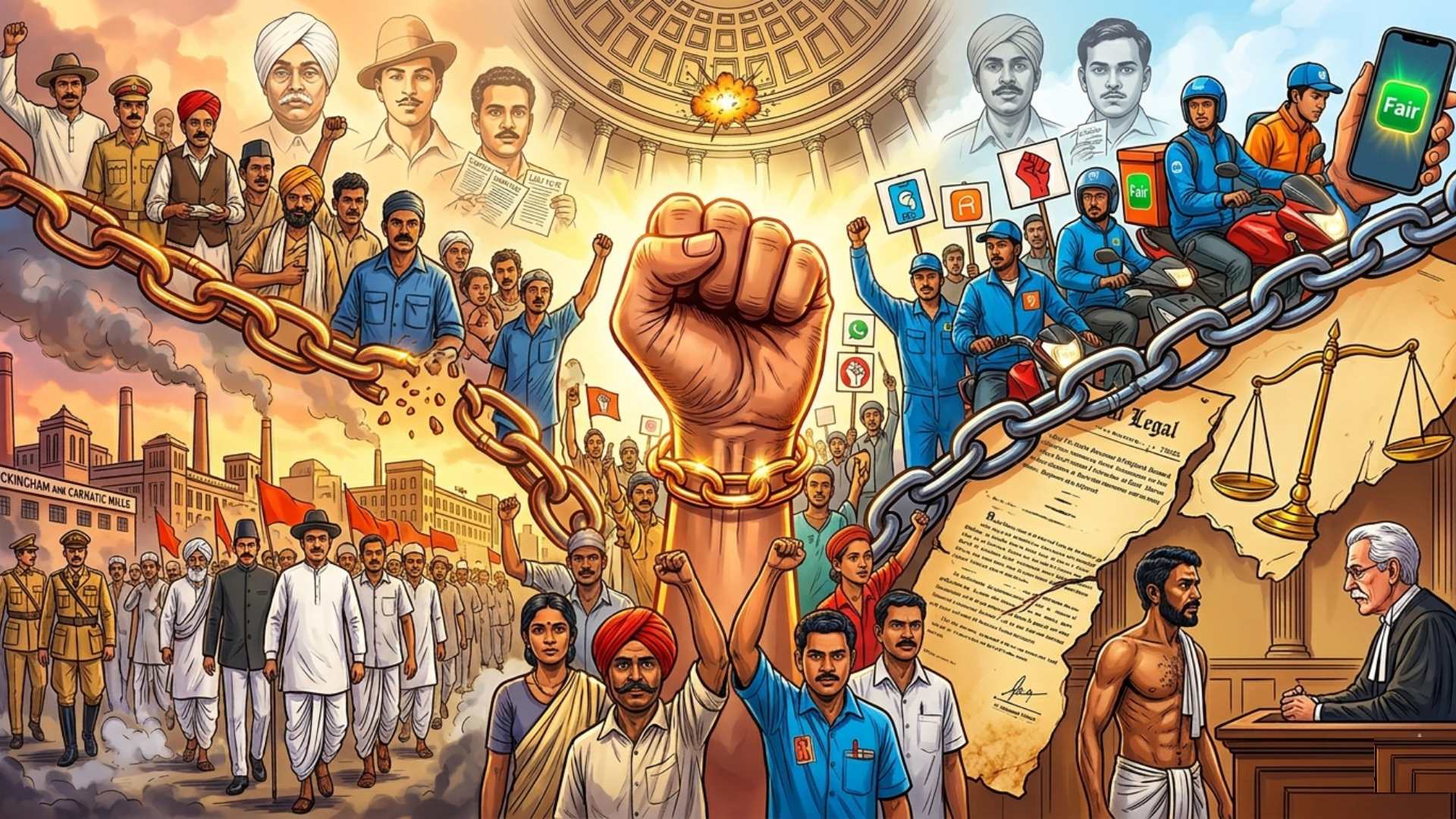
Trade Union Movement in India: From Colonial Conspiracy to Constitutional Right

Introduction
1. The Origin of a Movement
"A union was not a right — it was a conspiracy. And the first act of Indian labour was to prove otherwise."
In 1918, Bahman Pestonji Wadia founded the Madras Labour Union — India's first trade union with regular membership — to address what he called the "mal-treatment of workers" by European officers. Under British common law at the time, organising workers was legally treated as a conspiracy to restrain trade.
2. The Legal Battle
"Even if my clothes are removed in execution of a decree, I will continue to work for the trade union by wearing my loincloth." — Vengal Chakkarai Chettiar, 1921
The 1921 Buckingham and Carnatic Mills judgment awarded £2,000 against unionists for leading a strike — exposing that hundreds of trade unions existed across India with zero legal recognition. N.M. Joshi's resolution in the Central Legislative Assembly that same month launched five years of sustained pressure that produced the Trade Union Act of 1926.
3. The Unfinished Promise
"It takes a loud voice to make the deaf hear." — Bhagat Singh & Batukeshwar Dutt's pamphlet, April 8, 1929
A century later, the Industrial Relations Code 2020 — which came into force on November 21, 2025 — reprints the 1926 Act's protective words almost verbatim. Yet gig workers, casual labourers, and platform workers remain structurally excluded. The letter survives. The spirit remains contested.
Key Data
| Dimension | Data Point |
|---|---|
| Madras Labour Union founded | 1918 — India's first registered trade union |
| Trade Union Act passed | 1926 — after 5 years of legal and political pressure |
| Girni Kamgar Union membership (1928) | 70,000+ members; 203 strikes involving 5 lakh workers |
| Trade union growth post-independence | 625% increase between 1951–1979 |
| Labour codes consolidated | 4 codes replacing 29 existing laws (2020) |
| Industrial Relations Code in force | November 21, 2025 |
| Platform workers (NITI Aayog estimate) | 7.7 million in 2020 → projected 23.5 million by 2030 |
| Platforms recognising trade unions (2024) | Zero — out of 11 major platforms assessed by Fairwork India Report |
Historical Progression: Letter vs Spirit
① Colonial Phase (1918–1947)
The 1926 Act delivered two landmark protections:
- Section 17 — union members immune from criminal conspiracy charges (IPC Section 120B) for legitimate union activities
- Section 18 — no civil suit maintainable against a registered union for acts in furtherance of a trade dispute
Yet the colonial state immediately undermined these gains through parallel instruments: the Meerut Conspiracy Case (1929) charged unionists under sedition provisions the Act never touched; the Trade Disputes Bill banned sympathetic strikes and criminalised linking workers' grievances to nationalist politics — what Motilal Nehru called the "Slavery of India Bill"; the Public Safety Bill made executive intention — not action — the basis for prosecution.
The assassination of the spirit began almost immediately after the letter was written.
② Post-Independence Phase (1947–1991)
- Article 19(1)(c) guaranteed every citizen the right to form associations or unions
- Trade unions absorbed into the constitutional settlement
- Ideological fire of early movement gradually cooled into wage bargaining
- 625% growth in registered unions between 1951–1979
③ Liberalisation and the Gig Age (1991–Present)
- 1991 New Economic Policy introduced labour flexibility as the price of growth
- 2020: Four labour codes consolidated 29 laws during a pandemic Monsoon Session amid Opposition protests
- Industrial Relations Code 2020 came into force November 21, 2025
- The words 'gig' and 'platform' do not appear once in the entire Code
Analytical Sections
① What the Industrial Relations Code 2020 Preserves — and Undermines
Preserved (letter):
- Sections 16 and 17 — successors to the 1926 immunity provisions — retained in nearly identical language
Undermined (spirit):
| Provision | Problem |
|---|---|
| 51% muster roll support for negotiating union recognition | Impossible in high-turnover, casual, fixed-term contract sectors — precisely where protection is most needed |
| 60 days' notice before strike | Four times the 15-day requirement of the 1929 Trade Disputes Act — the very bill Motilal Nehru called the "Slavery of India Bill" |
| Strikes banned during conciliation + 7 days after + during Tribunal proceedings + 60 days after | Employers can keep workers in procedural suspension indefinitely |
| Complete silence on gig/platform workers | 7.7 million workers legally classified as "independent contractors" — precarity real, freedom notional |
② The Gig Worker Paradox
NITI Aayog projects 23.5 million platform workers by 2030. Yet a law that will govern Indian industrial relations for decades contains no mention of them. Four states have passed social security laws for platform workers — but welfare benefits are designed, as the Fairwork India Report notes, to make the struggle for collective bargaining seem unnecessary.
Despite this, workers continue to organise. In March 2024, platform worker unions forced Zomato to reverse a policy segregating delivery fleets by food type — a policy that endangered religious minority and lower-caste riders by making their identities visible.
The Telangana Gig and Platform Workers Union, Indian Federation of App-Based Transport Workers, and All-India Gig Workers Union continue to organise — sometimes over WhatsApp — and occasionally win.
③ The Recurring Pattern: A Century of the Same Contradiction
| Era | Gain | Simultaneous Undermining |
|---|---|---|
| 1926 | Trade Union Act — legal recognition | Meerut Case, Trade Disputes Bill, Public Safety Bill |
| 1947 | Article 19(1)(c) — constitutional right | Gradual depoliticisation of unions post-independence |
| 2025 | Industrial Relations Code — immunity provisions retained | 51% threshold, 60-day notice, complete gig worker exclusion |
Attribution
Original content sources and authors

Syllabus classification
How this article maps to GS papers
Main syllabus
GS2Indian ConstitutionQuick Q&A
What were the key features and significance of the Trade Union Act, 1926 in the evolution of labour rights in India?
These provisions enabled workers to organise collectively without fear of legal retaliation. The Act also allowed for the registration of trade unions, thereby granting them a formal legal identity. This was crucial in legitimising collective bargaining and strengthening the labour movement. As a result, trade union membership grew rapidly, with organisations like the Girni Kamgar Union amassing tens of thousands of members.
However, while the Act strengthened the legal framework, its effectiveness was limited by the colonial state’s simultaneous use of repressive laws such as sedition provisions and restrictive bills like the Trade Disputes Act. Thus, the Act’s significance lies not only in its protections but also in highlighting the gap between legal rights (letter of the law) and actual enforcement (spirit of the law), a theme that continues to shape labour relations in India.
Why did the colonial government both legalise and suppress trade union activities simultaneously?
On the other hand, the colonial state feared the growing alignment between labour movements and the nationalist struggle. Events such as the 1908 Bombay strike in support of Lokmanya Tilak demonstrated the political power of organised workers. To counter this, the government introduced restrictive measures like the Trade Disputes Act, which banned sympathetic strikes and imposed procedural barriers, and used laws like sedition to target labour leaders, as seen in the Meerut Conspiracy Case.
This dual strategy reflects a broader colonial objective: to allow limited economic concessions while preventing political mobilisation that could challenge imperial authority. The result was a system where unions were legally recognised but practically constrained, revealing a tension between reform and repression. This dynamic remains relevant in contemporary labour policy debates, where the balance between regulation and worker rights continues to be contested.
How does the Industrial Relations Code, 2020 reflect continuity and change from the Trade Union Act, 1926?
However, significant changes have been introduced that alter the practical functioning of trade unions. For instance, the requirement that a negotiating union must have 51% worker support makes recognition difficult in sectors characterised by informal or contractual labour. Additionally, the Code mandates a 60-day notice period for strikes, along with multiple restrictions during conciliation and tribunal proceedings, effectively limiting workers’ ability to undertake timely industrial action.
Another major gap is the exclusion of gig and platform workers, who form a rapidly growing segment of the workforce. Despite their economic significance, they are classified as independent contractors and lack collective bargaining rights. Thus, while the IRC preserves the letter of historical protections, it arguably weakens their spirit by introducing procedural and structural constraints, raising questions about the future of labour rights in India.
What factors led to the weakening of the labour movement in post-independence India?
A major turning point came with the New Economic Policy of 1991, which prioritised liberalisation, privatisation, and globalisation. Labour reforms increasingly focused on flexibility and ease of doing business, often at the expense of worker protections. This led to the rise of informal and contractual employment, making it harder for unions to organise workers effectively.
Additionally, the fragmentation of the workforce, coupled with declining union density and political co-option of trade unions, weakened collective action. The emergence of the gig economy has further complicated the scenario, as workers lack formal recognition and legal protections. Together, these factors have transformed the labour movement from a powerful political force into a more fragmented and constrained entity.
Provide a contemporary example of labour resistance in India and analyse its significance.
This example highlights the evolving nature of labour organisation in the gig economy. Unlike traditional unions, platform worker groups operate in a decentralised and informal manner, often without legal recognition. Despite these challenges, they have demonstrated the ability to influence corporate decision-making through coordinated action.
The significance of this case lies in its implications for labour rights in emerging sectors. It underscores the need for legal frameworks to adapt to new forms of work and recognise the rights of gig workers. It also shows that, despite institutional constraints, collective action remains a powerful tool for addressing worker grievances, reaffirming the enduring relevance of trade union principles.
Critically analyse the statement: ‘The letter of labour laws in India has often failed to match their spirit.’
In contemporary India, a similar pattern can be observed in the Industrial Relations Code, 2020. While the Code retains key protections from earlier laws, it introduces procedural barriers—such as high thresholds for union recognition and stringent strike regulations—that limit their practical utility. Moreover, the exclusion of gig workers from the legal framework highlights a disconnect between the law and the realities of the modern workforce.
This mismatch has significant implications for social justice and economic equity. It undermines workers’ trust in legal institutions and weakens collective bargaining mechanisms. Addressing this issue requires not only legal reforms but also effective enforcement, institutional capacity building, and a commitment to aligning policy with the evolving nature of work. Only then can the spirit of labour laws be realised in practice.
As a policymaker, how would you design a labour framework for gig and platform workers in India?
Second, the framework should promote collective bargaining by allowing platform workers to form unions or associations. Drawing from the Trade Union Act’s principles, legal recognition of such bodies can empower workers to negotiate with platform companies. Additionally, digital tools can be leveraged to facilitate organisation and communication among dispersed workers.
Third, the government should establish a portable social security system, funded through contributions from platforms, workers, and the state. Initiatives by some Indian states to provide welfare benefits to gig workers can serve as a starting point. Finally, regulatory mechanisms must ensure transparency in algorithms and fair working conditions. Such a framework would align with constitutional values while addressing the realities of the modern labour market, ensuring both economic growth and worker welfare.
Practice questions
1 question for mains preparation