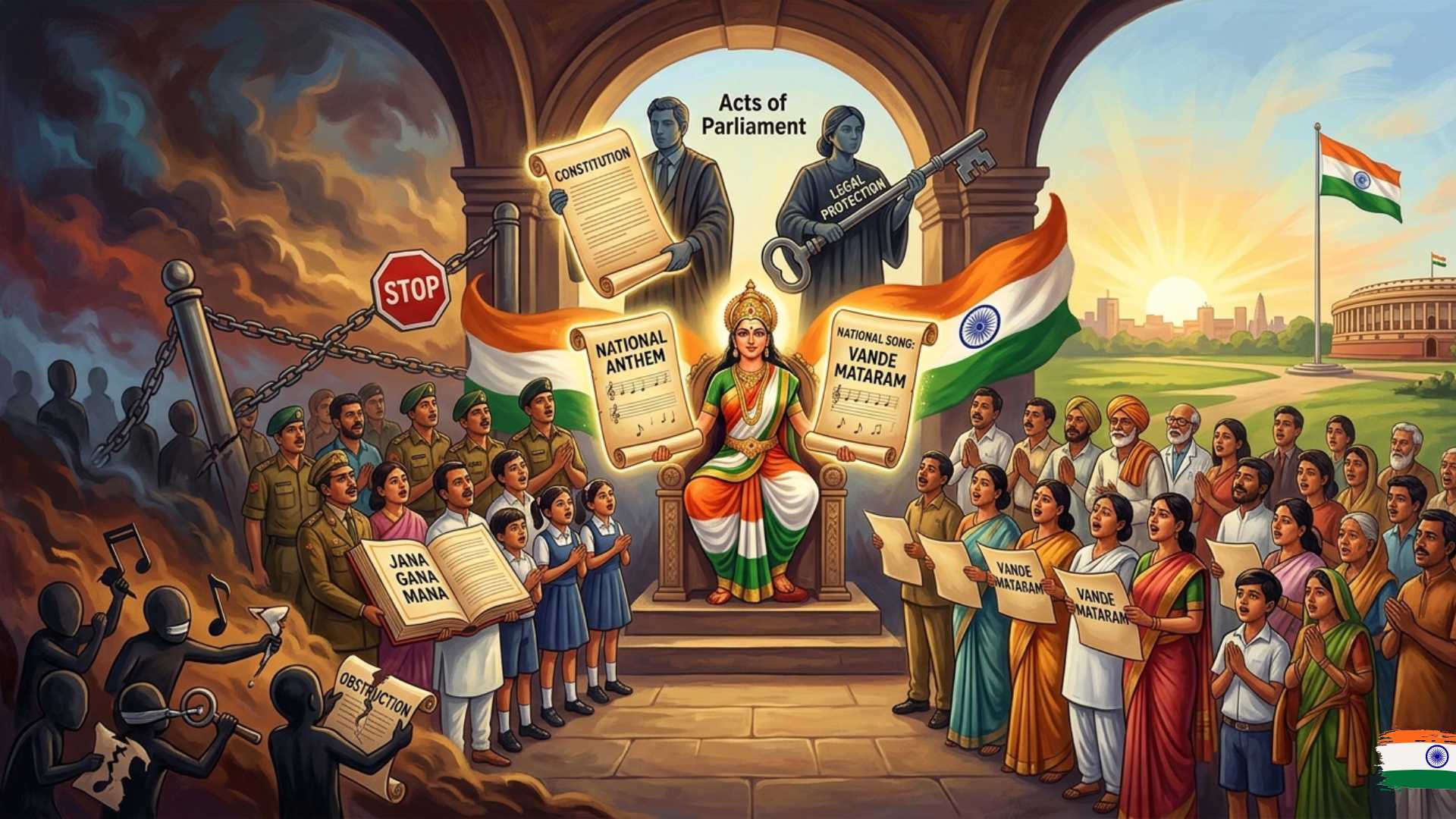
Amendment to Criminalize Insulting Vande Mataram

Introduction
"Patriotism cannot be legislated into existence — but the law can define the boundaries within which national symbols command public respect."
The Union Cabinet (May 5, 2026) approved an amendment to The Prevention of Insults to National Honour Act, 1971 to make insult or obstruction of Vande Mataram a punishable offence — extending to the National Song the same statutory protection currently available to the National Anthem, National Flag, and Constitution.
The move raises foundational questions about the tension between compelled expression and fundamental freedoms under Part III of the Constitution.
| National Symbol | Legal Instrument | Protection |
|---|---|---|
| National Anthem — Jana Gana Mana | Prevention of Insults to National Honour Act, 1971 (S.3) | Up to 3 years imprisonment / fine |
| National Flag | Same Act | Up to 3 years imprisonment / fine |
| Constitution of India | Same Act | Up to 3 years imprisonment / fine |
| National Song — Vande Mataram | Proposed Amendment (2026) | Up to 3 years imprisonment / fine |
Background & Context
Vande Mataram — Historical Journey
→ Written by Bankim Chandra Chattopadhyay; published in the novel Anandamath (early 1880s)
→ 1937 — Indian National Congress adopted its first two stanzas for use at national movement gatherings; remaining stanzas excluded given concerns about religious imagery
→ Constitution of India — accorded Vande Mataram the status of National Song (distinct from National Anthem)
→ February 2026 — MHA issued advisory instructions to states mandating all six stanzas at official events; directed Vande Mataram be given precedence over National Anthem when both are played
→ May 2026 — Cabinet approved statutory backing through amendment to the 1971 Act
Distinction: National Anthem vs. National Song
| Feature | National Anthem | National Song |
|---|---|---|
| Song | Jana Gana Mana | Vande Mataram |
| Author | Rabindranath Tagore | Bankim Chandra Chattopadhyay |
| Constitutional Status | Formally designated | National Song status |
| Existing Legal Protection | Yes (1971 Act, S.3) | Proposed (2026 Amendment) |
Key Concepts & Implications
1. Compelled Expression vs. Article 19
The Supreme Court in Bijoe Emmanuel v. State of Kerala (1986) held that no one can be compelled to sing the National Anthem — standing respectfully was sufficient. Extending criminal liability to Vande Mataram raises the same question: does mandated participation in national expression violate the right to freedom of conscience under Articles 19 and 25?
2. Advisory to Statutory — A Significant Shift
The MHA's February 2026 guidelines were explicitly advisory — without statutory force. The Cabinet amendment converts a cultural instruction into a criminal liability. This shift from soft norm to hard law represents a meaningful escalation in the state's role in regulating expressions of national identity.
3. The Six-Stanza Question
The 1937 INC decision to adopt only the first two stanzas reflected a deliberate political accommodation. The MHA's insistence on all six stanzas — and the proposed criminalisation of obstruction — reinserts a settled historical compromise into active legal and political contestation.
Conclusion
The proposed amendment to the 1971 Act reflects a broader governance pattern: converting cultural and symbolic contestations into legal obligations backed by criminal sanction.
-
While protecting national symbols from deliberate insult is a legitimate state interest — as the existing 1971 Act already recognises — the extension of criminal liability to the National Song raises proportionality concerns.
-
A mature democracy distinguishes between protecting symbols from contempt and compelling citizens to perform allegiance.
The former is law; the latter approaches the domain of conscience — which, under India's Constitution, the state has historically been cautious to enter.
- How courts interpret this amendment against Articles 19 and 25 will define its ultimate constitutional standing.
Attribution
Original content sources and authors


Syllabus classification
How this article maps to GS papers
Main syllabus
GS2Indian ConstitutionQuick Q&A
What is the proposed amendment to the Prevention of Insults to National Honour Act, 1971, and how does it change the legal status of Vande Mataram?
Change in Legal Status: Until now, Vande Mataram held a symbolic and cultural status as the National Song but lacked statutory enforcement. The proposed amendment elevates its position from a largely moral and advisory domain to a legally enforceable one. This marks a shift from normative respect to legal obligation.
Broader Implications: This change reflects the State’s attempt to institutionalize respect for national symbols. However, it also raises important questions regarding the balance between national sentiment and individual freedoms, particularly under Article 19(1)(a) (freedom of speech and expression). The amendment thus has both symbolic and constitutional significance.
Why is the inclusion of Vande Mataram under the 1971 Act considered significant in the context of Indian polity and society?
Political and Social Context: The timing of the amendment, following significant political developments, suggests a possible attempt to reinforce nationalist narratives. It may also aim to standardize practices across states, especially since earlier guidelines by the Ministry of Home Affairs were merely advisory and lacked enforceability.
Constitutional Debate: The move is significant because it intersects with debates on constitutional morality, pluralism, and freedom of expression. While promoting respect for national symbols is important, critics argue that coercive enforcement may alienate certain sections of society. Thus, the amendment’s significance lies not only in legal terms but also in its broader socio-political implications.
How does the existing legal framework regulate respect for national symbols, and how will this amendment fit into it?
Role of Guidelines: In addition to statutory provisions, the Ministry of Home Affairs has issued advisory guidelines regarding the singing and playing of Vande Mataram, including its precedence over the National Anthem in certain contexts. However, these guidelines lack legal enforceability and rely on voluntary compliance.
Integration of Amendment: The proposed amendment will bring Vande Mataram under the same legal framework as other national symbols, ensuring uniformity in enforcement. It will transform advisory norms into binding legal obligations, thereby strengthening the institutional framework for protecting national honour. However, its implementation will require careful balancing with fundamental rights.
What are the historical and cultural reasons behind the prominence of Vande Mataram in India’s national discourse?
Adoption and Evolution: In 1937, the Indian National Congress adopted the first two stanzas of the song for official use, recognizing concerns about its religious imagery. Post-independence, it was accorded the status of the National Song, distinct from the National Anthem but equally significant in cultural terms.
Cultural Significance: The song embodies the idea of the nation as a mother, which resonates deeply in Indian cultural ethos. However, its interpretation has also been contested, particularly by communities that view certain verses as religiously exclusive. These historical and cultural factors explain both its prominence and the debates surrounding it.
Critically analyze the implications of criminalizing insults to the National Song in a democratic society.
Concerns and Criticism: However, such measures raise concerns about freedom of expression under Article 19(1)(a). The Supreme Court, in cases like Bijoe Emmanuel v. State of Kerala (1986), has upheld the right of individuals to refrain from participating in national symbols on grounds of conscience. Extending criminal liability to the National Song may lead to potential misuse and suppression of dissent.
Balancing Approach: A लोकतांत्रिक society must balance patriotism with pluralism. While respect for national symbols is essential, it should ideally be cultivated through awareness and education rather than coercion. The amendment’s success will depend on its implementation and judicial interpretation.
Can you provide examples or judicial precedents that highlight the tension between national honour laws and fundamental rights?
Other Instances: There have been controversies over mandatory playing of the National Anthem in cinema halls, where the Supreme Court initially mandated it but later modified its order to make it optional. These cases illustrate the evolving judicial stance on balancing national respect and individual liberty.
Relevance to Current Amendment: These precedents suggest that any attempt to criminalize conduct related to national symbols must be carefully scrutinized. The judiciary is likely to play a crucial role in interpreting the scope and limits of the amended law, ensuring that it aligns with constitutional values.
As a civil servant, how would you handle a situation where a group refuses to sing Vande Mataram citing personal or religious reasons?
Balancing Law and Rights: While the amended law mandates respect for the National Song, it must be implemented in harmony with fundamental rights. Engaging in dialogue with the concerned group, explaining the importance of national symbols, and ensuring that no coercion or confrontation occurs would be a prudent approach.
Administrative Approach: A balanced response would involve sensitization rather than penalization, unless there is clear evidence of intentional insult or disruption. This approach upholds constitutional values while maintaining public order and social harmony, which are key responsibilities of a civil servant.
Practice questions
2 questions for mains preparation