
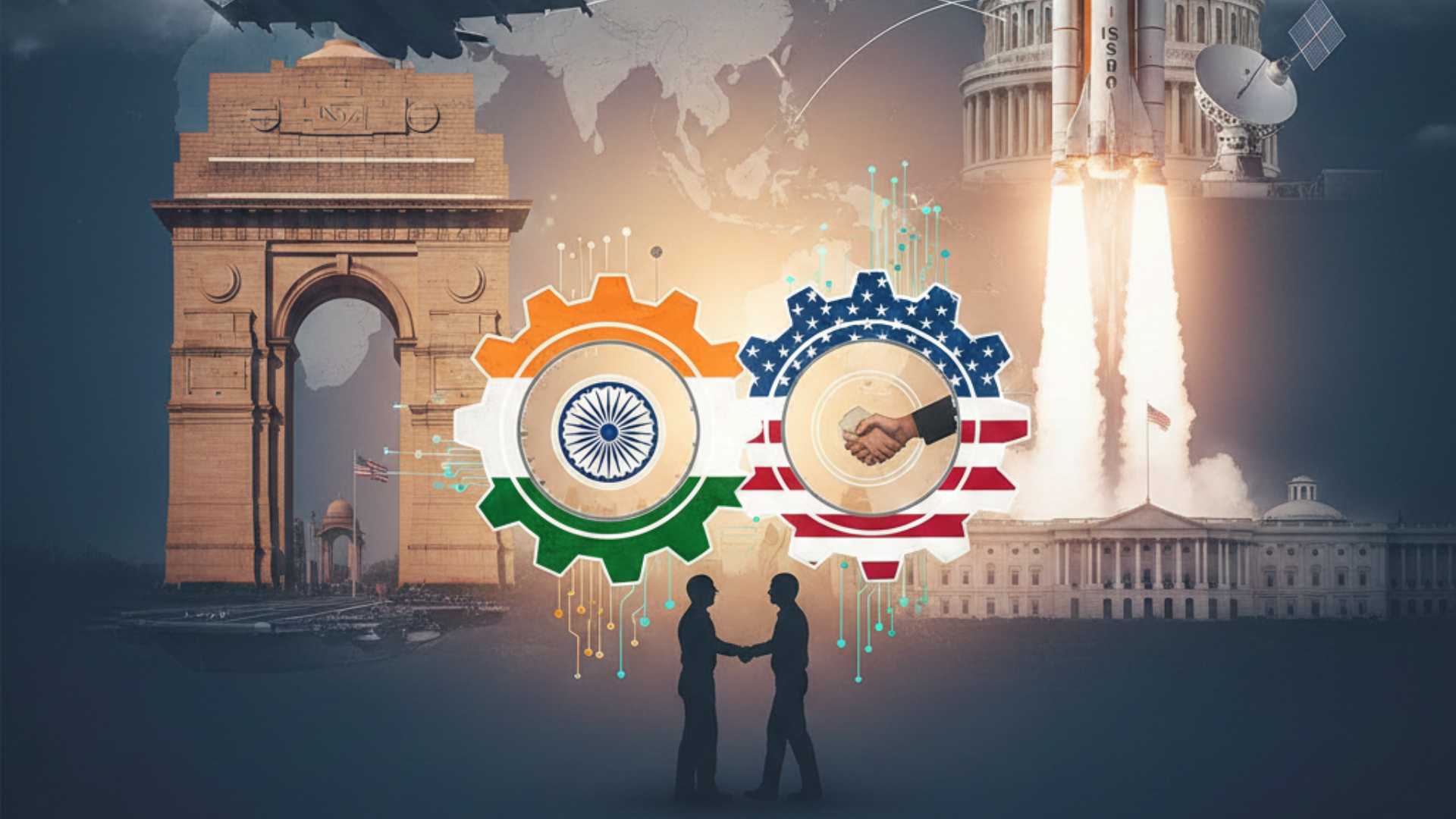
1. Political Strains and the Shifting Context of India–U.S. Relations
India–United States relations in 2025 present a paradoxical picture: visible political strain alongside quiet strategic continuity. The postponement of the Quad Leaders’ Summit, which India was to host, and declining political optics point to diplomatic unease at the leadership level.
This strain is reinforced by worsening trade relations, particularly U.S. tariffs on Indian goods and India’s purchase of Russian crude oil. India’s exports to the U.S. fell sharply in 2025, signalling tangible economic consequences of geopolitical disagreements.
At the same time, U.S. warming ties with Pakistan and perceptions of a possible U.S.–China “G-2” style rapprochement have contributed to India’s diplomatic recalibration. These developments underscore India’s concerns about strategic marginalisation within great power politics.
If such political frictions persist without careful management, they risk weakening public trust and slowing momentum in broader cooperation, even when long-term strategic interests remain aligned.
Institutionalised diplomacy becomes critical when political signalling weakens; ignoring this balance risks allowing short-term tensions to undermine long-term strategic convergence.
2. Economic Frictions and Transactional Diplomacy
Economic disagreements form a major axis of current bilateral tension. U.S. tariffs on Indian exports and penalties linked to India’s energy imports from Russia have introduced a transactional dimension to the relationship.
In contrast, China and Pakistan have faced relatively lower tariff pressures, with Pakistan offering port access and critical mineral supplies to U.S. firms. These moves reflect Washington’s balance-of-interest pragmatism, where economic and strategic incentives are closely intertwined.
Such asymmetries challenge India’s expectations of strategic partnership and highlight the limits of values-based cooperation in the absence of aligned economic priorities. They also test India’s commitment to strategic autonomy.
Unchecked, persistent economic frictions can spill over into political distrust, complicating cooperation even in areas of shared security interest.
Economic instruments increasingly shape geopolitical behaviour; if trade disputes harden, they can erode strategic goodwill despite shared regional objectives.
3. Institutional Continuity within the Quad Framework
Despite political headwinds, institutional cooperation within the Quad has intensified. The Quad Foreign Ministers’ Meeting (July 2025) in Washington expanded cooperation in maritime security, transnational threats, critical technologies, economic resilience, and humanitarian assistance.
Operational relevance was further reinforced by the Quad Counterterrorism Working Group’s third meeting in December 2025, demonstrating continuity beyond summit-level engagements. These mechanisms ensure steady collaboration irrespective of leadership-level pauses.
The Quad Ports of the Future Conference (November 2025, Mumbai) highlighted infrastructure and connectivity as emerging pillars of Quad cooperation, linking security with economic and developmental outcomes across the Indo-Pacific.
This sustained engagement underscores that the Quad functions increasingly as an operational platform rather than a symbolic grouping.
Institutional depth allows multilateral frameworks to survive political pauses; neglecting these mechanisms risks reducing strategic groupings to episodic diplomacy.
4. Defence Cooperation as the Backbone of Bilateral Resilience
Defence cooperation remains the most stable pillar of India–U.S. relations. Since the 2008 civil nuclear deal, successive agreements have built interoperability, logistics support, and intelligence sharing.
Key foundational agreements include:
- Logistics Exchange Memorandum of Agreement (LEMOA, 2016)
- Communications Compatibility and Security Agreement (COMCASA, 2018)
- Basic Exchange and Cooperation Agreement (BECA, 2020)
- India–U.S. Defence Acceleration Ecosystem (INDUS-X, 2023)
- Security of Supply Arrangement (SOSA, 2024)
In October 2025, a landmark 10-year Defence Framework Agreement was signed, institutionalising coordination, information-sharing, and technology collaboration to enhance Indo-Pacific deterrence.
Regular military exercises—Yudh Abhyas, Tiger Claw, and Malabar—continue to build trust and operational familiarity, reinforcing defence as a stabilising force.
Defence institutionalisation creates strategic ballast; weakening this pillar would expose the partnership to political volatility.
5. Technology, Space, and Infrastructure Cooperation
Technology cooperation complements defence ties and broadens the partnership’s developmental relevance. The NASA–ISRO Synthetic Aperture Radar (NISAR) satellite, launched in July 2025, supports disaster resilience, agriculture, and infrastructure planning.
Industrial collaboration has also deepened. In November 2025, Hindustan Aeronautics Limited signed a billion-dollar deal with General Electric for fighter jet engines, strengthening India’s defence manufacturing ecosystem.
Infrastructure cooperation, particularly through Quad initiatives, links security with regional development by promoting resilient and secure ports across the Indo-Pacific.
These initiatives align strategic interests with tangible governance outcomes, enhancing the partnership’s legitimacy beyond security elites.
Technology and infrastructure cooperation translate strategy into development; neglecting them risks narrowing the partnership’s societal impact.
6. Way Forward: Deepening Institutional Understanding
The India–U.S. relationship increasingly operates on a dual-track model: fluctuating political engagement alongside steady institutional cooperation. This structure has shielded core collaborations from short-term political shocks.
However, analysts caution that unresolved trade disputes and regulatory barriers could constrain future momentum. Building deeper institutional understanding—across defence, technology, and economic governance—is therefore essential.
Expanding cooperation into broader sectors and strengthening bureaucratic linkages can sustain trust during political lows and reinforce long-term strategic alignment.
Institutional familiarity sustains partnerships through uncertainty; without it, strategic ties risk erosion during inevitable political cycles.
Conclusion
India–U.S. relations in 2025 demonstrate that institutions, not summits alone, anchor strategic partnerships. Sustained investment in institutional frameworks will determine whether the partnership remains resilient and relevant amid an evolving geopolitical landscape.