Introduction
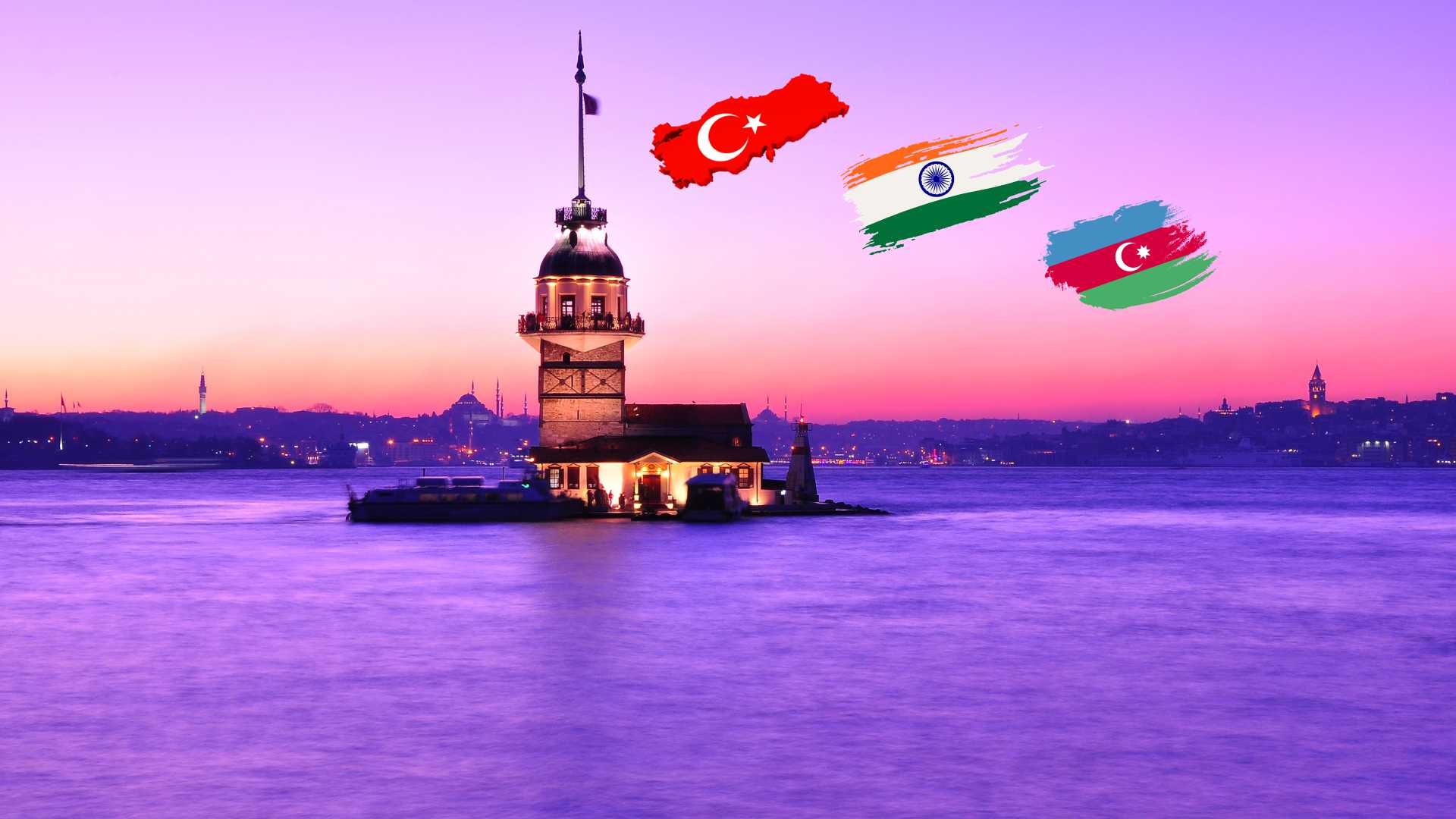
India's foreign policy has historically been guided by the doctrine of strategic autonomy — maintaining independent positions across competing global alignments. However, the May 2025 India-Pakistan conflict (Operation Sindoor) and its diplomatic fallout tested this doctrine sharply, as New Delhi froze ties with Türkiye, Azerbaijan, and Malaysia over their perceived support for Pakistan. India's recent decision to resume Foreign Office Consultations with both Baku and Ankara marks a significant recalibration — signalling that strategic interests must ultimately override reactive diplomacy. In a multipolar world where India engages simultaneously with the US, Russia, Iran, Israel, and Gulf states, the ability to manage complex, layered relationships without slipping into binary alignments defines the maturity of a rising power.
"Nations have no permanent friends or allies, they only have permanent interests." — Lord Palmerston
Background — Operation Sindoor and Diplomatic Fallout
| Event | Date | Significance |
|---|---|---|
| Pahalgam terror attack | April 2025 | Trigger for Indian military response |
| Operation Sindoor | May 7–10, 2025 | 96-hour Indian strikes on terror sites in Pakistan |
| Türkiye, Azerbaijan, Malaysia statements | May 2025 | Questioned India's military action; perceived pro-Pakistan tilt |
| MEA excludes envoys from briefings | May–July 2025 | Diplomatic signal of displeasure |
| Army Deputy Chief statement | July 2025 | Named Türkiye as one of three adversaries faced during conflict |
| US-Israel strikes on Iran | June 2025 | MEA directed evacuees via Armenia/Turkmenistan — pointedly avoiding Türkiye and Azerbaijan |
| Foreign Office Consultations resumed | Recent | Sibi George (MEA Secretary West) to Baku; Turkish Deputy FM invited to Delhi |
Why Türkiye and Azerbaijan Matter to India
Despite the friction, both countries carry strategic weight that makes prolonged estrangement costly:
Türkiye:
- NATO member and G20 economy — significant in multilateral forums India engages with
- Controls the Turkish Straits — critical for global shipping and energy routes
- Growing defence and technology exporter — its Bayraktar drones were used by Pakistan, but Türkiye also has tech India could engage with
- Historical civilisational and trade connections; Indian diaspora and tourism presence
- Ankara's position on Kashmir, while unfavourable, is not unique among Islamic bloc nations
Azerbaijan:
- Controls the South Caucasus energy corridor — Baku-Tbilisi-Ceyhan pipeline, critical for Caspian energy flows
- Key node in the International North-South Transport Corridor (INSTC) that India is developing through Iran to reach Central Asia and Europe
- Believed to have provided technological/drone support to Pakistan during the conflict
- Strategic location between Russia, Iran, and Türkiye — relevant to India's Eurasian connectivity ambitions
The Trilateral Dynamics
| Grouping | Members | Basis |
|---|---|---|
| Emerging alignment | India, Armenia, Greece | Shared rivals; anti-Türkiye/Azerbaijan/Pakistan axis |
| Existing trilateral | Pakistan, Azerbaijan, Türkiye | Strong civilisational, military, and diplomatic solidarity |
Foreign policy commentary had suggested India was building a counter-trilateral with Armenia and Greece. However, hardening into such an alignment would contradict India's foundational principle of strategic autonomy and risk being hyphenated with Pakistan — the very outcome India has historically worked to avoid in multilateral forums including the OIC, UN, and SAARC contexts.
The Problem with Reactive Diplomacy
The Türkiye-Azerbaijan episode reveals a recurring pattern in recent Indian foreign policy:
- Government displeasure → MEA demarches → amplification by influential social media accounts → public calls for boycotts → measurable drop in trade and tourism → eventual diplomatic damage requiring repair
- This escalation cycle has affected ties not just with adversaries but with close partners and neighbours — a concerning trend for a country seeking to expand its diplomatic footprint
- Tourism and trade boycotts, while emotionally satisfying domestically, are blunt instruments that disproportionately harm ordinary citizens and businesses on both sides
- Excluding envoys from military briefings signals displeasure but also reduces India's ability to shape narratives among those countries' governments
India's Strategic Autonomy Doctrine — NCERT Foundation
Class XII Political Science (Contemporary World Politics, Ch. 4) covers India's foreign policy principles:
- Panchsheel — peaceful coexistence; non-interference
- Non-alignment — independence from power blocs
- Strategic autonomy — freedom to pursue national interest without binding alliance commitments
The current reset with Türkiye and Azerbaijan is consistent with this doctrine — relationships must be managed on the basis of long-term national interest, not short-term emotional reactions to diplomatic statements.
Way Forward
- Maintain firm red lines on Kashmir and terrorism while keeping diplomatic channels open — these are not contradictory positions
- Develop issue-specific engagement frameworks — disagree on Kashmir, cooperate on INSTC, engage on trade
- Avoid public boycott amplification as a foreign policy tool — it constrains government flexibility and embitters bilateral atmospheres
- Leverage the Türkiye-Pakistan relationship diplomatically — engage Ankara on counter-terrorism frameworks where shared interests exist
- Protect India's role in the INSTC by ensuring Azerbaijan remains a functional corridor partner regardless of political friction
- Resist the temptation to form rigid counter-alliances — the India-Armenia-Greece framing limits India's options unnecessarily
Conclusion
India's re-engagement with Türkiye and Azerbaijan is less a retreat than a return to form — the pragmatic, interest-driven diplomacy that has historically served India well. Operation Sindoor demonstrated India's willingness to act decisively on national security. The diplomatic reset demonstrates its willingness to think strategically once the immediate crisis passes. In a world of accelerating conflicts and shifting alignments, India's greatest foreign policy asset remains its refusal to be permanently assigned to any camp. That asset is worth protecting — even when, perhaps especially when, the domestic political temperature runs hot.