
1. Context: Greenland and Emerging Arctic Geopolitics
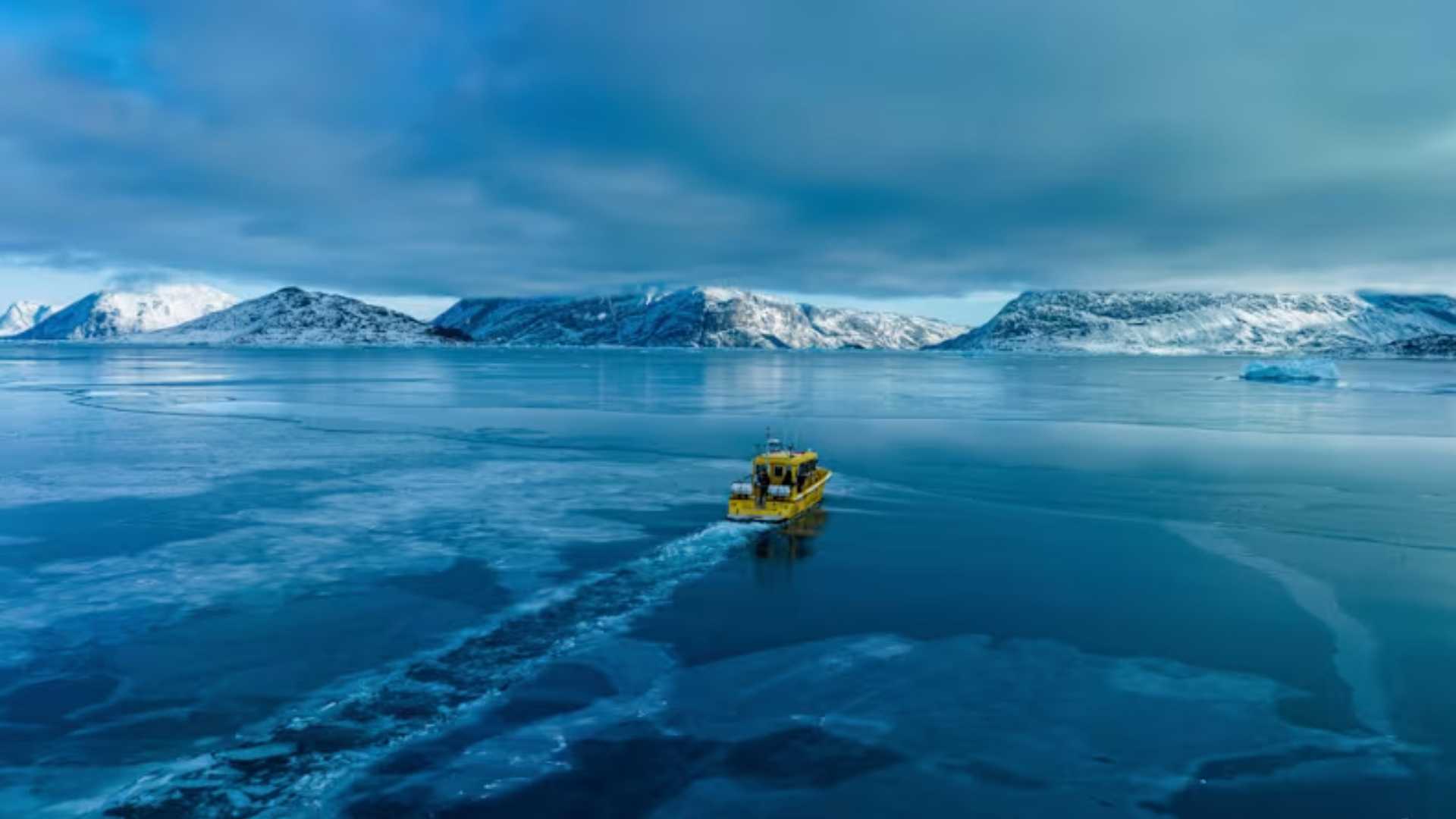
Greenland occupies a critical strategic position in the Arctic, located between North America and Europe and proximate to key maritime routes and military corridors. As climate change reduces ice cover, the Arctic’s geopolitical salience has increased due to emerging shipping lanes, access to seabed resources, and strategic depth for military operations.
The article situates Greenland within intensifying great power competition, particularly between the United States and China. Former US President Donald Trump’s repeated assertions about Chinese threats reflect broader anxieties over strategic encirclement and loss of influence in traditionally Western-dominated regions.
However, expert assessments cited in the article suggest that such claims exaggerate China’s current footprint. This gap between perception and reality is central to understanding Arctic geopolitics and its implications for global security governance.
If Arctic geopolitics is framed primarily through exaggerated threat perceptions, governance risks becoming reactionary rather than evidence-based, leading to unnecessary securitisation and diplomatic friction.
2. Issue: China’s Actual Presence and Capabilities in the Arctic
China’s physical and military presence in the Arctic remains limited. Contrary to claims of widespread deployment, experts emphasise that Greenland is not populated by Chinese naval assets or permanent military installations.
China operates a small number of icebreakers equipped with advanced technologies such as deep-sea mini-submarines and observation satellites. While officially designated for scientific research, these assets possess dual-use potential, raising cautious concern among security analysts.
Importantly, the article highlights that China’s capacity to project power in the Arctic is largely mediated through cooperation with Russia, especially after the 2022 Ukraine invasion, which intensified Sino-Russian coordination.
Overstating China’s independent Arctic capabilities may distort policy responses, whereas underestimating dual-use risks could weaken long-term strategic preparedness.
3. Institutions and Strategic Actors Shaping the Arctic
NATO emerges as a key institutional actor due to Greenland’s association with Denmark, a NATO member. US concerns about Greenland are therefore closely tied to alliance politics and collective security calculations.
Research institutions such as the Norwegian Institute for Defence Studies and the Mercator Institute for China Studies provide critical analytical counterweights to political rhetoric, underscoring the role of epistemic communities in security governance.
Russia’s role is pivotal, as China’s Arctic access and operational learning depend significantly on joint patrols, exercises, and logistical cooperation with Moscow, including joint bomber patrols near Alaska in 2024.
Ignoring institutional checks and expert assessments risks allowing political narratives to override strategic realism, undermining cooperative security mechanisms.
4. Implications: Militarisation, Governance, and Security Dilemmas
The Arctic illustrates a classic security dilemma, where limited actions by one actor are interpreted as aggressive by others, triggering disproportionate responses. Trump’s threats exemplify how perception-driven policy can escalate tensions.
Scientific diplomacy becomes fragile when research infrastructure is viewed through a military lens. This blurring of civilian and military domains complicates Arctic governance and trust-building.
Impacts:
- Heightened risk of Arctic militarisation
- Erosion of scientific cooperation
- Increased strain within NATO and transatlantic relations
If governance frameworks fail to manage perception gaps, the Arctic may shift from a low-tension zone to a contested security theatre.
5. Way Forward: Evidence-Based Arctic Governance
The article implicitly argues for calibrated, evidence-based approaches to Arctic security. Policy responses must distinguish between potential risks and present realities to avoid strategic overreach.
Strengthening multilateral Arctic governance mechanisms and relying on expert assessments can help balance security concerns with cooperation. Transparency in scientific activities and confidence-building measures are essential to prevent escalation.
Therefore, Arctic governance should prioritise proportionality, institutional coordination, and long-term stability over short-term political signalling.
Failure to adopt such an approach may entrench mistrust, weaken global commons governance, and accelerate great power rivalry in fragile regions.
Conclusion
The Greenland debate reflects broader challenges in managing emerging geopolitical spaces amid great power competition. Long-term stability in the Arctic depends on aligning security perceptions with empirical realities, strengthening institutions, and preserving cooperative governance frameworks in a rapidly changing strategic environment.