
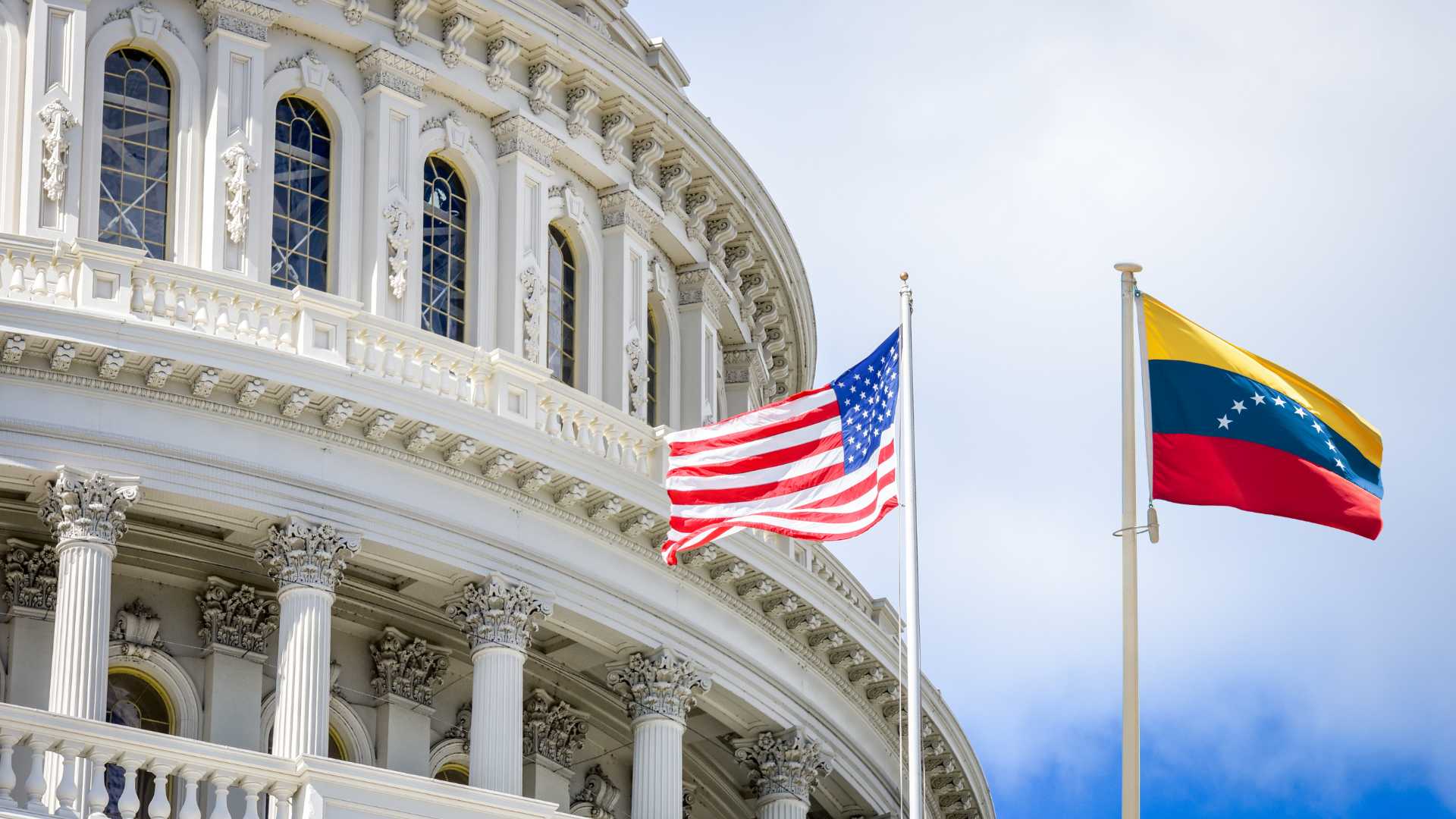
1. Context: U.S. Intervention in Venezuela and the New Pattern of Power Projection
The U.S. military intervention in Venezuela and the abduction of sitting President Nicolás Maduro mark a significant departure from earlier forms of American overseas interventions. Unlike past regime-change operations justified through ideological or humanitarian narratives, the current episode reflects a more openly transactional exercise of power.
The simultaneous engagement of Washington with Venezuela’s opposition leader María Corina Machado and with Delcy Rodríguez, a senior figure of the Bolivarian regime, underscores a contradiction at the heart of contemporary U.S. statecraft. Publicly, the U.S. endorses democratic opposition; operationally, it negotiates with the very apparatus it claims to have dismantled.
This dual-track engagement matters for governance and international relations because it normalises coercive intervention while hollowing out the meaning of sovereignty. If unexamined, it risks setting precedents where legality and legitimacy are subordinated to short-term strategic gains.
The logic reflects a shift from ideological interventionism to interest-based control, where stability for extraction is prioritised over political transformation; ignoring this risks misreading future great-power behaviour.
2. The “Donroe Doctrine”: From Regime Change to Regime Management
The Venezuela operation illustrates what can be described as a modern extension of the Monroe Doctrine, termed here as “regime management” rather than regime change. The U.S. has sought to neutralise a leader while retaining the governing structure, provided it aligns with American economic interests.
This contrasts with earlier U.S. interventions in Iraq and Afghanistan, where dismantling state institutions and rebuilding them along preferred ideological lines proved costly and destabilising. Learning from these outcomes, Washington now appears focused on preserving administrative continuity.
For governance, this approach reduces immediate instability but entrenches external influence over domestic policy choices. Over time, it weakens institutional autonomy and democratic accountability.
The governing rationale is risk minimisation: managing compliant elites is seen as cheaper than rebuilding states; overlooking this enables subtle but durable external control.
3. Neo-Colonialism and International Law Implications
Kwame Nkrumah’s concept of neo-colonialism is directly relevant to Venezuela’s present condition. The country retains formal sovereignty, yet its economic and policy decisions are increasingly shaped by external pressure, sanctions, and negotiated permissions.
The U.S. intervention and subsequent negotiations violate core principles of international law, including non-intervention and sovereign equality. The blockade, seizures of oil shipments, and conditional access to revenues effectively constrain Venezuela’s independent policymaking.
For the global order, such practices weaken the credibility of international norms. If left unchallenged, they encourage power-based interpretations of law, particularly in regions considered spheres of influence.
"The essence of neo-colonialism is that the State which is subject to it is, in theory, independent..." — Kwame Nkrumah, Neo-Colonialism: The Last Stage of Imperialism
The logic is coercive compliance: legality yields to leverage; ignoring this erodes the rule-based international system.
4. Economic Sanctions, Oil Dependency, and Strategic Capitulation
Venezuela’s economy has been under extensive U.S. sanctions since the late 2010s, targeting its oil sector—the backbone of state revenue. These measures triggered hyperinflation, economic contraction, and welfare decline.
Key economic indicators from the article:
- Oil production collapsed below 4,00,000 barrels/day, later recovering to 9,00,000 barrels/day.
- Limited oil sales under licences reportedly generated around $500 million in initial transactions.
To survive, the Venezuelan state adopted pragmatic reforms, including the 2020 Anti-Blockade Law, allowing greater private participation in oil extraction. While this restored some economic stability, it also diluted sovereign control over resources.
For development, this reflects the dilemma of sanctioned states: survival often requires policy concessions that undermine long-term autonomy.
The reasoning is constrained choice: economic collapse forces compromise; ignoring this context leads to simplistic judgments of “capitulation”.
5. Limits of Multipolarity: China, Russia, and Strategic Non-Intervention
Despite deep economic ties with China and political alignment with Russia, Venezuela received no direct strategic protection when confronted by U.S. force. Chinese tankers were denied access, and Russian support remained rhetorical.
This exposes the limits of the emerging multipolar order. Great powers may offer economic engagement but are reluctant to confront U.S. dominance within its declared sphere of influence.
For international relations, this signals that multipolarity does not automatically translate into collective security for smaller states. Overreliance on external patrons can therefore be strategically risky.
The logic highlights power asymmetry: multipolar rhetoric does not equal multipolar protection; ignoring this leads to misplaced strategic expectations.
6. Political Balancing within Venezuela’s State Apparatus
Delcy Rodríguez’s role reflects an internal consensus within the Bolivarian state to prioritise institutional survival. Managing relations with the military, party ideologues, and external actors requires careful balancing.
The opposition, weakened institutionally and lacking control over state mechanisms, has limited leverage despite international backing. This reinforces the U.S. preference for negotiating with existing power centres rather than fragmented alternatives.
For governance, this dynamic preserves short-term stability but constrains democratic renewal and political pluralism.
The governing logic is continuity over legitimacy: functioning authority is favoured over contested change; ignoring this explains opposition marginalisation.
7. Broader Lessons for the Global South
Venezuela’s experience offers a cautionary lesson for developing countries heavily dependent on a single resource and external markets. Economic diversification matters, but it may not suffice against hegemonic intervention.
The episode also underscores the need for collective action among Global South countries rather than reliance on great-power rivalry for protection. Without coordination, asymmetrical power relations persist.
For policy, this strengthens the case for regional solidarity, diversified trade partnerships, and resilience-building in strategic sectors.
The logic is structural vulnerability: isolated states face coercion alone; ignoring this perpetuates dependency cycles.
Conclusion
The Venezuela episode reflects a shift in global power politics towards pragmatic, interest-driven intervention that preserves formal sovereignty while constraining real autonomy. For governance and international relations, it highlights the erosion of international law, the limits of multipolarity, and the vulnerabilities of resource-dependent states. Long-term stability will depend on institutional resilience, economic diversification, and coordinated Global South responses rather than faith in external patrons.

