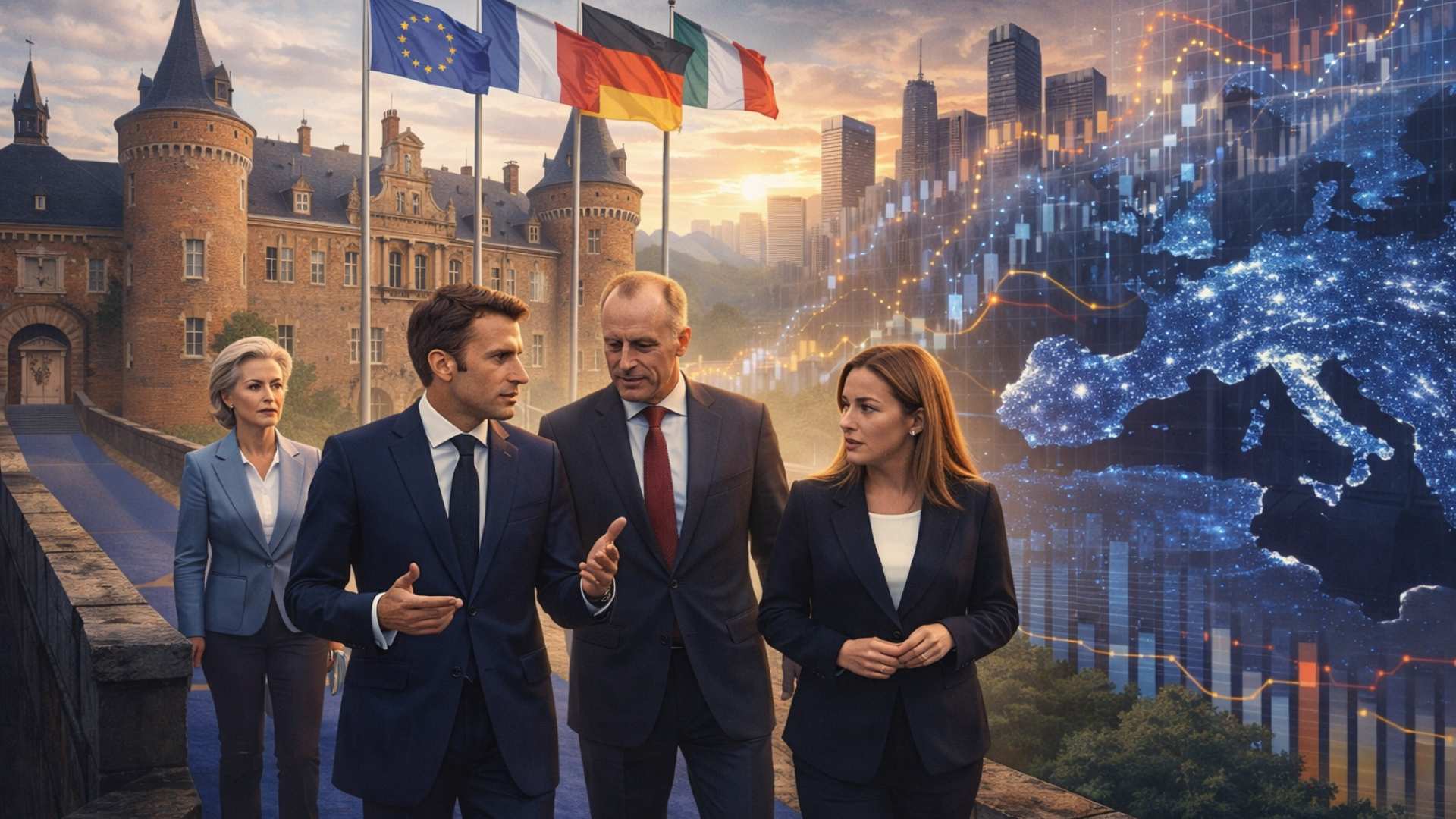
EU Leaders Unite for Economic Restructuring Amid Global Pressures

EU addresses trade wars, market dominance, and hybrid threats to ensure competitive autonomy and financial integration.
S
Surya
3 mins read
EU leaders unite to boost competitiveness amid global pressures
Not Started

European Union Economic Restructuring Plan 2024

1. Context: Strategic Imperatives for EU Economic Restructuring

The European Union (EU) is undertaking a comprehensive economic restructuring to enhance competitiveness amid geopolitical and economic pressures from the United States, China, and hybrid threats associated with Russia. EU leaders agreed on an action plan with a strict timeline, aimed at coordinating energy grid upgrades, deepening financial integration, and relaxing merger regulations to enable European firms to scale globally.

The plan reflects the EU’s response to global economic shifts and internal pressures to create “European champions” capable of competing internationally. European Commission President Ursula von der Leyen described the urgency as capable of moving “mountains,” emphasizing the strategic imperative for unified economic action.

Failing to restructure risks leaving the EU vulnerable to external coercion, trade disadvantages, and diminished industrial competitiveness, affecting long-term economic sovereignty.

Key Points:

  • 27-nation bloc seeking coordinated restructuring
  • Focus areas: energy, finance, industrial consolidation
  • Formal presentation: March 2024

2. Policy and Strategic Divergence within the EU

EU leaders exhibit differing visions regarding economic governance. The French-led camp, spearheaded by President Emmanuel Macron, advocates strategic autonomy, reducing reliance on Washington, prioritising European producers, and strengthening defense-related industrial capacity. This approach aligns with increased military spending in response to Russian aggression in Ukraine.

Conversely, leaders such as German Chancellor Friedrich Merz and Italian Prime Minister Giorgia Meloni promote deregulation, liberal trade, and mixed sourcing from foreign and European firms. This wing emphasises the need to reduce hyperregulation, attract investment, and maintain competitive engagement with global markets.

Internal divergence requires negotiation and compromise; without consensus, EU reforms risk delays, weakening the bloc’s ability to implement unified industrial and trade policies.

Strategic Perspectives:

  • Macron/France: Strategic autonomy, European industrial protection
  • Merz/Meloni: Deregulation, open trade, mixed sourcing

3. Economic Measures Proposed

The EU’s action plan outlines several structural and fiscal measures:

  • Industrial Competitiveness: Support cleantech, chemicals, steel, automotive, and defense sectors under threat from global competition
  • Financial Integration: Streamline capital movement, reduce barriers to investment, and consider instruments like Eurobonds to challenge dollar hegemony
  • Infrastructure Investments: Upgrade energy grids and other critical infrastructure
  • Trade Expansion: Forge new trade agreements, including recent EU-Mercosur deal

Former leaders Mario Draghi and Enrico Letta stressed urgent economic integration and reduction of internal barriers to capital and finance movement, promoting faster and more agile EU-wide operations.

Implementing these measures strengthens the EU’s global economic position, reduces reliance on external powers, and enhances resilience to geopolitical shocks.

Policy Measures:

  • Capital and finance liberalisation within EU
  • Regulatory simplification
  • Strategic support for key industrial sectors
  • Expansion of trade networks

4. Citizen Expectations and Political Legitimacy

EU citizens are increasingly demanding stronger, unified leadership to address military threats, economic pressures, and climate challenges, as reflected in Eurobarometer polls. Leaders leverage this public demand to accelerate reforms, enhance policy legitimacy, and mobilize political capital for cross-national initiatives.

Ignoring citizen expectations risks eroding political legitimacy and slowing the pace of structural reforms, undermining the EU’s capacity to act cohesively on the global stage.

Implications:

  • Stronger public backing for integrated EU policies
  • Greater accountability for economic and strategic decisions
  • Alignment of national and EU-level initiatives

5. Way Forward: Strengthening the EU’s Global Position

The EU’s 2024 action plan must focus on rapid implementation, cross-country coordination, and clear accountability mechanisms. Key forward-looking steps include:

  • Establishing “European champions” to compete globally
  • Deepening financial and regulatory integration to reduce internal barriers
  • Expanding strategic autonomy while balancing trade openness
  • Accelerating energy, infrastructure, and industrial upgrades

Effective execution will enable the EU to maintain sovereignty, competitiveness, and resilience in a multipolar global economy.

"We need European champions." — Ursula von der Leyen, European Commission President

Quick Q&A

Everything you need to know

Overview:
The 2024 European Union (EU) economic restructuring plan is a comprehensive strategy aimed at enhancing the bloc’s global competitiveness. It was proposed in response to mounting pressures from international actors such as the United States, China, and Russia. The plan envisions a coordinated approach to upgrade energy grids, deepen financial integration, loosen merger regulations, and foster the growth of pan-European corporations.
Purpose: The goal is to create a more robust, agile, and competitive European economy capable of addressing geopolitical threats, technological competition, and trade imbalances. By establishing “European champions” in critical industries, the EU seeks to safeguard strategic sectors including cleantech, chemicals, steel, automobiles, and defense.
Example: European Commission President Ursula von der Leyen emphasized the urgency of the plan, stating that strong and decisive action can transform the EU’s economic landscape, while French President Emmanuel Macron and German Chancellor Friedrich Merz highlighted the need for unity and speed in implementing reforms. The plan also proposes measures to facilitate trade deals like the EU-Mercosur agreement, reflecting a global economic strategy.

Geopolitical pressures:
The EU faces increasing economic and strategic pressure from the U.S., China, and Russia. U.S. tariffs and coercive measures, China’s restrictions on critical minerals, and hybrid threats linked to Russia have exposed vulnerabilities in Europe’s economic and technological base.
Internal economic imperatives: Many EU leaders believe that hyperregulation and fragmented financial systems hinder investment, capital movement, and corporate growth. The restructuring aims to streamline regulations, improve infrastructure, and integrate financial markets to facilitate cross-border investments and scale up European firms.
Strategic autonomy: France has emphasized reducing dependency on external powers, advocating for European-led supply chains and defense investments. Leaders recognize that without decisive restructuring, the EU risks losing competitiveness and strategic influence in a rapidly changing global economy.

Mechanisms of implementation:
The EU’s strategy relies on several coordinated measures:

  • Energy infrastructure: Upgrading grids and transitioning to more sustainable energy sources to improve industrial efficiency.
  • Financial integration: Simplifying financial regulations and removing barriers to capital flow to allow European companies to scale and invest across borders.
  • Deregulation and mergers: Loosening merger regulations to encourage the creation of multinational European corporations that can compete globally.
  • Strategic sectors: Focusing on cleantech, chemicals, steel, automotive, and defense to ensure industrial resilience.
Leadership coordination: Key EU leaders, including Macron, Merz, and Meloni, are advocating for both regulatory reforms and proactive trade strategies. By combining infrastructure investment, regulatory simplification, and corporate scaling, the EU intends to create a unified economic front capable of meeting global competition.

Challenges:

  • Divergent national priorities: EU member states have differing economic philosophies and priorities, leading to potential delays in consensus-based decision-making.
  • Regulatory resistance: Efforts to deregulate or harmonize financial rules may encounter opposition from stakeholders accustomed to established national systems.
  • Global economic uncertainties: Trade tensions, supply chain disruptions, and geopolitical conflicts could undermine the plan’s effectiveness.
Case in point: The split between France’s push for strategic autonomy and Merz/Meloni’s advocacy for deregulation highlights ideological divisions. Coordinating between protectionist measures and open-market policies will require careful negotiation and compromise to avoid fragmenting the bloc or creating internal economic imbalances.

Examples of measures:

  • Energy grid upgrades: Investments to modernize infrastructure and enhance cross-border energy distribution.
  • Financial integration: Simplification of banking regulations, promotion of Eurobonds, and unified capital markets to support pan-European corporations.
  • Trade facilitation: Loosening merger regulations and promoting strategic trade agreements like the EU-Mercosur deal to strengthen global competitiveness.
  • Sectoral support: Encouraging development in cleantech, chemicals, steel, automotive, and defense to create European industrial champions.
Illustration: Macron’s advocacy for Eurobonds as a tool to challenge the dollar hegemony shows how financial integration and innovative instruments are central to the EU’s competitiveness strategy.

Potential benefits:

  • Reduced dependency on external powers such as the U.S. and China, enhancing resilience against geopolitical shocks.
  • Promotion of homegrown industries and technological innovation, strengthening Europe’s industrial base.
  • Improved coordination in defense and energy policies, contributing to collective security and climate objectives.
Potential drawbacks:
  • Risk of protectionism, which could reduce trade efficiency and provoke retaliatory measures from external partners.
  • High implementation costs associated with infrastructure investments and industrial scaling.
  • Possible tensions between member states over resource allocation and economic priorities, leading to slower decision-making.
Evaluation: While strategic autonomy can enhance long-term resilience and competitiveness, balancing openness with protectionism, and ensuring cohesion among diverse member states, remains a critical challenge for policymakers.

Case Study:
The EU’s plan illustrates a proactive response to multiple external pressures: U.S. tariffs, China’s restrictions on critical minerals, and Russian hybrid threats. Leaders recognized that without decisive economic integration and reform, European firms would struggle to compete globally.
Integration measures: By promoting financial harmonization, deregulating mergers, and investing in strategic sectors, the plan seeks to create a unified European market with stronger industrial champions capable of scaling internationally.
Outcome and implications: This approach demonstrates the EU’s attempt to transform crises into opportunities by leveraging internal cohesion, citizen demand for stronger leadership, and strategic investments. The plan also highlights the importance of combining regulatory reforms, infrastructure development, and trade strategy to maintain global competitiveness while addressing geopolitical vulnerabilities.

Attribution

Original content sources and authors

Sign in to track your reading progress

Comments (0)

Please sign in to comment

No comments yet. Be the first to comment!