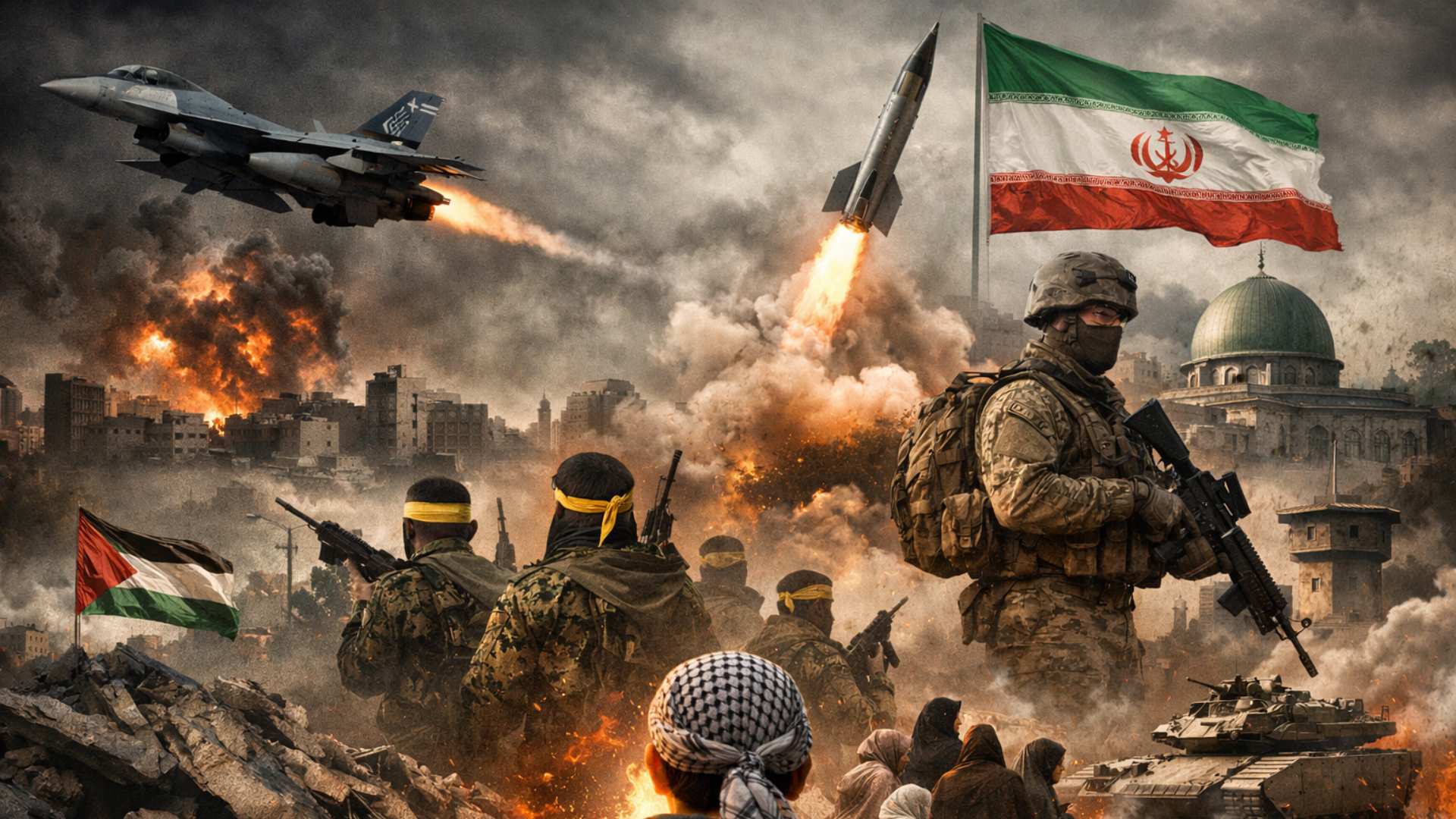
Israel's Militarism: The Reality Behind the Apartheid Allegations

Gideon Levy discusses the complexities of Israel's military strategies and their implications for peace in the West Asia region
S
Surya
3 mins read
War without endgame deepens endless conflict

Introduction

West Asia (Middle East) remains one of the most volatile regions globally, accounting for a significant share of geopolitical conflicts and energy security concerns. The ongoing Israel–Iran tensions, conflicts in Gaza and Lebanon, and the unresolved Palestinian issue have displaced over 6–7 million people in recent years. For India, the region is critical due to ~60% of crude oil imports and a large diaspora presence. The current crisis reflects deeper structural issues beyond immediate military confrontations.


1. Background and Context

  • Long-standing hostility between Israel and Iran rooted in ideological, strategic, and security concerns.

  • Iran’s “Axis of Resistance” includes Hezbollah (Lebanon), Hamas (Gaza), and Houthis (Yemen).

  • Israel has engaged in multi-front conflicts:

    • Gaza (Hamas)
    • Lebanon (Hezbollah)
    • Iran (direct confrontation)
  • The Palestinian question (100+ years old) remains unresolved, acting as a core instability driver.


2. Key Concepts

(a) Decapitation Strategy

  • Targeted assassination of political/military leaders.
  • Aims to disrupt command structures.

Critical Insight:

  • Often leads to more radical successors rather than stability.

(b) Militarism in State Policy

  • Preference for military solutions over diplomacy.
  • Shapes public opinion and national identity.

Quote:

“For Israel, the military option is not the last option, but the first option.” – Gideon Levy


(c) Proxy Warfare

  • Iran’s indirect strategy through non-state actors.
RegionProxy ActorObjective
LebanonHezbollahNorthern pressure on Israel
GazaHamasSouthern front
YemenHouthisStrategic disruption

3. Analysis of the Ongoing Conflict

(a) Absence of Clear Endgame

  • No clarity on:

    • Regime change in Iran
    • Post-Hamas governance in Gaza
  • Similar to past interventions (e.g., Iraq, Libya).

Implication: → Prolonged instability and power vacuums.


(b) Effectiveness of Military Strategy

  • Repeated wars in Lebanon and Gaza have:

    • Failed to eliminate Hezbollah/Hamas
    • Increased regional hostility
StrategyIntended OutcomeActual Outcome
AssassinationsLeadership collapseRadicalisation
Military offensivesSecurityCyclical violence
Occupation/buffer zonesStabilityResistance growth

(c) Humanitarian and Economic Costs

  • Massive displacement:

    • Gaza: ~2 million
    • Iran: ~3 million
    • Lebanon: ~1 million
  • Impact:

    • Collapsing economies
    • Education disruption
    • Long-term trauma

4. Palestinian Question: Core Issue

Key Observations

  • Palestinians remain stateless and right-deprived.
  • Increasing settlement expansion in the West Bank (~700,000 settlers).
  • Two-State Solution increasingly seen as unviable.

Critical Concern:

  • Risk of:

    • Forced displacement
    • Permanent occupation
    • Human rights violations

5. Diplomacy vs Militarism

Why Diplomacy is Weak

  • Political incentives favor military action:

    • National unity
    • Electoral gains
  • Highly militarised public mindset

  • Collapse of past agreements:

    • Example: U.S. withdrawal from Iran Nuclear Deal (JCPOA, 2015)

Potential Diplomatic Pathways

  • Revival of US–Iran nuclear negotiations
  • Regional security frameworks
  • Inclusion of Palestinian issue in peace processes

6. Implications for Global and Indian Interests

Global

  • Threat to energy security
  • Risk of regional war escalation
  • Strengthening of arms industry

India

  • Energy dependency on West Asia

  • Safety of Indian diaspora (~9 million in the region)

  • Strategic balancing between:

    • Israel (defence partner)
    • Iran (connectivity, Chabahar Port)

7. Key Challenges

  • Lack of political will for peace
  • Radicalisation on all sides
  • Weak international intervention
  • Erosion of international law norms

8. Way Forward

  • Prioritise diplomatic engagement over military escalation
  • Revive multilateral agreements (JCPOA-type frameworks)
  • Address Palestinian statehood seriously
  • Promote regional cooperation mechanisms

Scholarly Insight:

Sustainable peace in West Asia is impossible without addressing the Palestinian question.


Conclusion

The ongoing conflicts in West Asia highlight the limits of military power in resolving deeply rooted political issues. Without a clear endgame and meaningful diplomacy, cycles of violence will persist. A durable solution requires addressing core grievances—especially the Palestinian issue—while balancing security concerns with humanitarian and legal obligations.


Quick Q&A

Everything you need to know

Israel’s contemporary military strategy in West Asia is characterised by a proactive, multi-front approach that prioritises pre-emptive and offensive actions over defensive restraint. This includes direct confrontation with Iran, targeted assassinations (decapitation strategy), and sustained operations against Iran-backed groups such as Hezbollah in Lebanon, Hamas in Gaza, and the Houthis in Yemen. The aim is to dismantle what is often described as a ‘ring of fire’ surrounding Israel.

Key features include:

  • Decapitation strategy: Targeting leadership figures to disrupt command structures.
  • Multi-theatre operations: Simultaneous engagement in Gaza, Lebanon, and beyond.
  • Technological superiority: Use of advanced missile defence systems and intelligence networks.
  • Pre-emptive doctrine: Viewing military action as the first, not last, option.

However, critics argue that this approach lacks a clear endgame, particularly regarding regime change in Iran or governance alternatives in Gaza. For instance, while Israel opposes Hamas, there is no consensus on a viable replacement, highlighting a strategic gap.

In essence, Israel’s strategy reflects a blend of military dominance and threat neutralisation, but it raises questions about sustainability, long-term security, and regional stability.

The absence of a clear ‘endgame’ is a critical strategic flaw because it undermines the purpose and sustainability of military interventions. In the context of the Israel-Iran conflict, while objectives such as weakening Iran or curbing its nuclear ambitions may exist, there is no clearly defined post-conflict scenario.

This creates multiple challenges:

  • Power vacuum risks: If the Iranian regime collapses, there is uncertainty about who will replace it, potentially leading to instability or radicalisation.
  • Repetition of past mistakes: Similar situations in Iraq and Libya show how regime change without planning can lead to chaos.
  • Prolonged conflict: Without an exit strategy, wars tend to escalate and involve more actors.

The article also highlights the parallel with Gaza, where Israel seeks to eliminate Hamas but lacks a viable alternative governance structure. This illustrates a broader pattern of tactical success but strategic ambiguity.

Therefore, the lack of an endgame not only prolongs conflict but also increases humanitarian costs, destabilises the region, and reduces the effectiveness of military gains.

The ‘decapitation strategy’ involves targeting and eliminating key political or military leaders to disrupt organisational functioning. Israel has frequently employed this approach against adversaries such as Iranian leaders and leaders of groups like Hezbollah and Hamas.

In the short term, this strategy may:

  • Disrupt command and control systems
  • Create temporary confusion within organisations
  • Demonstrate military and intelligence superiority

However, its long-term effectiveness is highly contested. Evidence suggests that leadership elimination often results in the emergence of more radical or hardline successors. For example, past assassinations in West Asia have not eliminated militant organisations but, in some cases, strengthened their ideological resolve.

Additionally, there are legal and ethical concerns regarding targeted killings, especially when directed at state leaders. Such actions may violate international norms and escalate conflicts further.

Thus, while decapitation may yield tactical gains, it fails to address root causes of conflict and may inadvertently perpetuate cycles of violence, making it a limited tool for achieving lasting peace.

Prolonged militarism has profound implications for both the social fabric and governance structures of Israel. Continuous engagement in conflicts fosters a security-centric worldview, where military solutions are prioritised over diplomatic alternatives.

Key societal impacts include:

  • Normalization of conflict: Frequent exposure to war conditions creates psychological adaptation but also long-term stress.
  • Rise in nationalism: High public support (over 90% in some cases) reflects a collective alignment with militaristic policies.
  • Erosion of liberal values: Increased aggression and polarisation may weaken democratic discourse.

From a governance perspective, militarism can create a vicious cycle, where political leaders rely on military actions for legitimacy and public support. This reduces incentives for diplomacy and reinforces hardline policies.

However, it is important to note that Israel also faces genuine security threats, including missile attacks and hostile non-state actors. This creates a security dilemma, where defensive measures appear offensive to others.

In conclusion, while militarism may provide short-term security, its long-term impact risks transforming Israel into a more aggressive, less democratic society, complicating prospects for peace.

The Palestinian issue remains a central and unresolved conflict that significantly influences broader geopolitical dynamics in West Asia. It serves as both a symbolic and strategic factor in regional politics.

Its role can be understood through the following dimensions:

  • Source of legitimacy: Groups like Hamas and Hezbollah justify their actions as resistance to Israeli occupation.
  • Regional mobilisation: Iran uses the Palestinian cause to build alliances and justify its opposition to Israel.
  • Humanitarian crisis: Large-scale displacement in Gaza and the West Bank fuels global concern and criticism.

For example, Iran’s support for Hezbollah in Lebanon and Hamas in Gaza is partly framed as defending Palestinian rights. Similarly, recurring violence in Gaza often triggers wider regional tensions.

The article also highlights the deteriorating situation in the West Bank, including restrictions on movement and settler violence, which exacerbates grievances.

Thus, the Palestinian issue acts as a persistent fault line. Without addressing it, achieving lasting peace in West Asia remains highly unlikely, as it continues to fuel both state and non-state conflicts.

The Israel-Lebanon conflict provides a compelling case study to evaluate the effectiveness of military force against non-state actors such as Hezbollah. Despite multiple military interventions, including invasions and establishment of buffer zones, Israel has struggled to achieve lasting security outcomes.

Key observations include:

  • Resilience of non-state actors: Hezbollah has survived and, in some respects, grown stronger politically and militarily.
  • Limited success of force: Destruction of infrastructure did not dismantle Hezbollah’s core capabilities.
  • Political complexity: Hezbollah’s integration into Lebanese politics makes it difficult to eliminate without destabilising the state.

The current scenario presents an opportunity, as Lebanon reportedly has a government willing to address Hezbollah’s disarmament. However, continued military actions risk undermining this possibility.

This case demonstrates that military solutions alone are insufficient against ideologically driven, socially embedded groups. A combination of diplomacy, political engagement, and regional cooperation is essential.

Therefore, the Israel-Lebanon experience underscores the limitations of hard power and highlights the need for comprehensive strategies in dealing with non-state actors.

Attribution

Original content sources and authors

Sign in to track your reading progress

Comments (0)

Please sign in to comment

No comments yet. Be the first to comment!