West Asia Conflict and India: Energy Security, Macroeconomic Stability, and Diaspora Concerns
1. Strategic Context: India’s Exposure to West Asia
The escalating conflict involving Iran, the United States, and Israel has highlighted India’s structural vulnerability to geopolitical instability in West Asia. The region remains central to India’s energy security, trade flows, and diaspora employment.
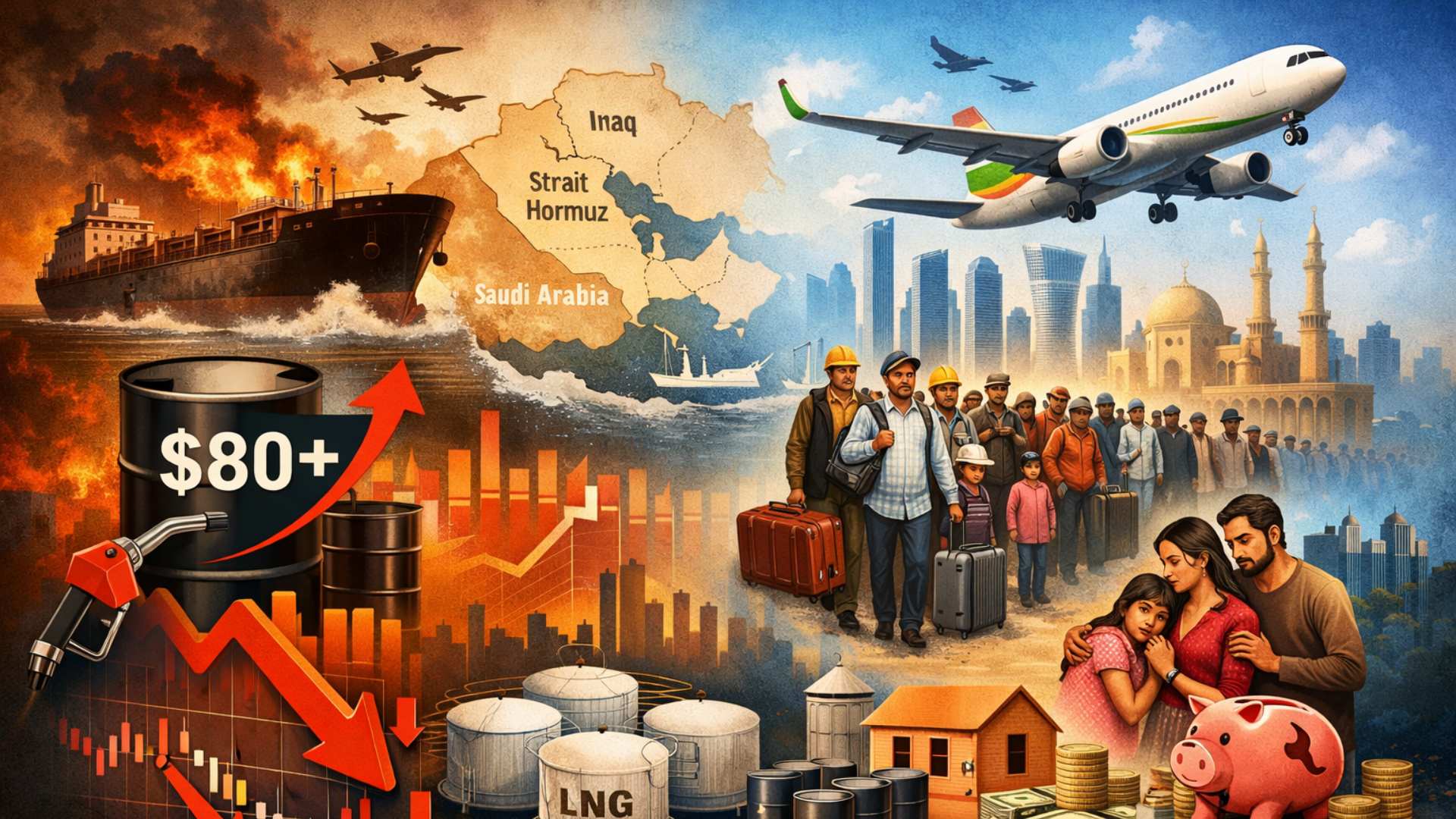
The Strait of Hormuz, which accounts for nearly one-fifth of global petroleum and LNG flows, has emerged as a potential flashpoint. Although Iran has not formally declared its closure, hundreds of shipments have already been suspended, creating uncertainty in global energy markets.
Brent crude prices rose above 77, the highest since June 2025. For India—the world’s third-largest oil consumer—such volatility has immediate macroeconomic implications.
Geopolitical instability in energy choke points directly translates into economic vulnerability for energy-importing nations like India. If not proactively managed, such shocks can disrupt growth, inflation stability, and external balances.
2. Energy Security and Import Dependence
India imports over 80% of its crude oil requirements. More than half of these imports come from Iraq, Saudi Arabia, and Kuwait, increasing dependence on the Gulf region. This dependence has intensified as geopolitical pressures reduced access to cheaper Russian oil.
India’s strategic petroleum reserves currently cover:
- About 10 days of demand (excluding oil companies’ reserves)
- An additional 60 days through commercial stocks
- Only one week of fuel stocks for certain segments
Oil imports constitute 3.1% of GDP. According to Nomura estimates, every 10% increase in oil prices worsens the current account deficit by 0.4 percentage points.
India also imports 85% of its liquefied petroleum gas (LPG) from the Gulf and does not maintain strategic gas reserves, heightening vulnerability.
Implications:
- Supply disruptions
- Price shocks
- Inflationary pressures
- Fiscal strain
- External account deterioration
“Energy security is national security.” — Daniel Yergin
High import dependence combined with limited strategic reserves amplifies exposure to external shocks. Without diversification and reserve expansion, recurrent crises may repeatedly destabilise macroeconomic stability.
3. Macroeconomic Impacts: Inflation, Current Account, and Currency
India has been running a modest current account deficit. However, rising oil prices increase the import bill, thereby widening the deficit. If global financial markets turn volatile, capital flows—already under pressure—may weaken, complicating deficit financing.
The rupee could face renewed depreciation pressures. Concurrent inflationary trends may force reconsideration of fiscal and monetary policy assumptions.
The government retains limited policy space:
-
It may reduce central excise duties on petrol and diesel to cushion inflation.
-
However, this could widen the fiscal deficit.
-
Monetary tightening to combat inflation may slow growth.
-
Transmission Channels:
- Higher crude prices → Higher import bill
- Wider current account deficit → Pressure on rupee
- Rupee depreciation → Imported inflation
- Inflation → Fiscal and monetary recalibration
Oil price shocks act as cost-push inflationary triggers and external balance stressors. If prolonged, they can generate stagflationary pressures, complicating macroeconomic management.
4. Diversification and Strategic Options
India may explore diversifying oil sourcing to countries such as Venezuela or the United States. However, these options may be more expensive and logistically complex.
In the medium term, strengthening strategic petroleum and gas reserves could mitigate future shocks. Market-based instruments and long-term supply contracts may also offer stability.
However, diversification is constrained by geopolitical alignments, logistics, and price competitiveness.
Energy diversification enhances resilience but cannot fully eliminate geopolitical risk. A calibrated mix of reserves, diversified sourcing, and demand management remains essential.
5. Indian Diaspora in West Asia: Safety and Evacuation Challenges
India has approximately nine million diaspora members in West Asia. In Bahrain, Qatar, and the UAE—now exposed to Iranian attacks—Indians account for more than one-third of the population.
A large proportion are low-skilled workers in construction and hospitality sectors, primarily from Uttar Pradesh, Bihar, West Bengal, and Telangana. Skilled workers largely come from Kerala and Tamil Nadu.
Evacuating such a large population from conflict zones would pose logistical and diplomatic challenges. Past evacuation operations (e.g., Operation Rahat, Operation Ganga) demonstrate capacity, but scale remains a concern.
Challenges:
- Large numbers concentrated in high-risk zones
- Logistical constraints
- Diplomatic coordination
- Employment disruptions
Diaspora safety is both a humanitarian and foreign policy priority. Failure to ensure protection and evacuation preparedness could have domestic political and social consequences.
6. Remittances and Socio-Economic Implications
West Asia remains the second-largest source of remittances to India after the United States. Any prolonged disruption could significantly affect remittance flows.
Remittances support:
- Household consumption
- Education and healthcare spending
- Local economies in migrant-sending states
An indefinite suspension of employment or return migration could create hardships for thousands of dependent families and strain local labour markets.
Remittances function as a stabilising external inflow and social safety net. Disruption may amplify regional inequality and increase domestic unemployment pressures.
7. Integrated Policy Response: Managing “Known Unknowns”
The uncertainty surrounding the conflict’s duration and geopolitical realignment requires India to deploy multiple policy tools simultaneously:
- Strengthen strategic oil and gas reserves
- Diversify energy sourcing
- Maintain fiscal flexibility for tax adjustments
- Prepare contingency evacuation plans
- Monitor capital flows and currency pressures
- Enhance diplomatic engagement with Gulf states
This crisis underscores the interlinkage between foreign policy (GS-II), energy security (GS-III), macroeconomic management, and diaspora welfare.
“The world is interconnected in ways we do not always see.” — Kofi Annan
Managing external shocks requires coordinated economic, diplomatic, and security responses. Fragmented policy action may worsen spillover effects.
Conclusion
The Iran–US–Israel conflict highlights India’s structural exposure to West Asia through energy dependence, external balances, and diaspora presence. While short-term tools such as tax adjustments and reserve drawdowns offer temporary relief, long-term resilience requires diversified energy sourcing, expanded strategic reserves, robust macroeconomic buffers, and proactive diplomatic engagement. In an era of geopolitical volatility, economic stability and foreign policy preparedness must operate in tandem to safeguard national interests.