
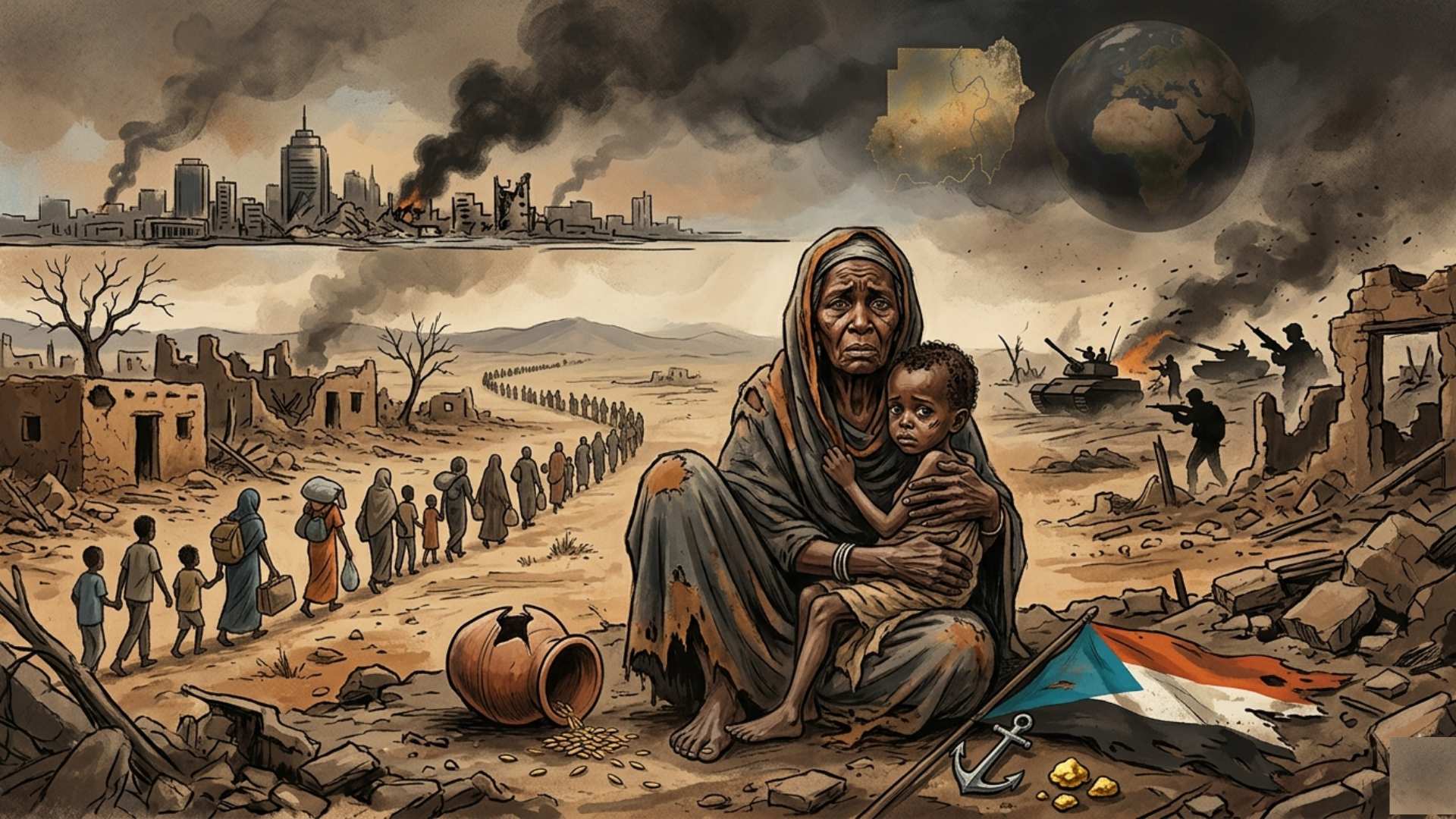
"Please don't call this the forgotten crisis. I'm referring to this as an abandoned crisis." — Denise Brown, UN Senior Official, Sudan
| Indicator | Data |
|---|---|
| War duration | April 2023 — present (3+ years) |
| People displaced | 13 million (world's largest displacement crisis) |
| Deaths confirmed | 59,000+ |
| Deaths in el-Fasher (3 days, Oct 2024) | 6,000+ |
| People needing humanitarian assistance | ~34 million (~2 in 3 Sudanese) |
| Severe acute malnutrition (expected) | 8,00,000 |
| Functional health facilities | Only 63% (fully/partially) |
| Fuel price increase (Iran war effect) | 24%+ |
Background & Context
Sudan's civil war erupted in April 2023 from a power struggle between two military factions following the 2019 popular uprising that ousted long-time dictator Omar al-Bashir.
Two principal warring parties:
- SAF (Sudan Armed Forces): Led by Gen. Abdel-Fattah Burhan — internationally recognised government, controls north, east, central Sudan including Red Sea ports, oil refineries, pipelines
- RSF (Rapid Support Forces): Led by Gen. Mohamed Hamdan Dagalo ("Hemeti") — controls Darfur + parts of Kordofan region including oil fields and gold mines
The RSF evolved from the Janjaweed militias — the same Arab militia groups responsible for the Darfur genocide of the early 2000s, making the current conflict a continuation of decades-long ethnic and political violence.
Humanitarian Dimensions
Displacement & Hunger Sudan now holds the distinction of the world's largest humanitarian crisis by displacement. Famine conditions have been confirmed in multiple regions. Severe acute malnutrition — the deadliest form — is projected to affect 800,000 people, with 34 million requiring assistance.
Health System Collapse Only 63% of health facilities remain functional. Active disease outbreaks including cholera compound the crisis. The WHO reports 2,000+ deaths from attacks on hospitals, ambulances, and medical workers — a direct violation of International Humanitarian Law (IHL).
Sexual Violence Widespread gang rapes and sexual violence have been documented — constituting potential crimes against humanity under the Rome Statute.
Geopolitical Dimensions
| Actor | Role |
|---|---|
| Egypt | Supports Sudan's military (SAF) |
| UAE | Accused by UN experts of arming RSF; denies allegation |
| Ethiopia | RSF allegedly received support from base in Ethiopia (Yale Humanitarian Research Lab) |
| USA | Ceasefire attempts failed; attention diverted to Iran conflict |
| ICC | Investigating war crimes + crimes against humanity in Darfur |
The Iran war's indirect effect — fuel price surge of 24%+ — demonstrates how geopolitical crises thousands of kilometres away cascade into humanitarian emergencies in fragile states.
Strategic stalemate: Neither SAF nor RSF can achieve decisive victory. Sudan is effectively partitioned — military-backed government in Khartoum vs. RSF-controlled administration in Darfur.
Key Concepts for UPSC
R2P (Responsibility to Protect): UN doctrine obligating international community to protect civilians from genocide, war crimes, crimes against humanity — Sudan represents a near-total failure of R2P in practice.
Genocide Determination: UN-backed experts concluded RSF's el-Fasher offensive bore "defining characteristics of genocide" — significant because genocide requires proving specific intent (dolus specialis) under international law.
Conflict Spillover Risk: International Crisis Group warns war could spread across Sudan's borders — threatening already fragile states of South Sudan, Chad, Central African Republic, and Ethiopia.
"Abandoned Crisis" vs. "Forgotten Crisis": UN officials distinguish between the two — "forgotten" implies neglect by oversight; "abandoned" implies deliberate deprioritisation by a distracted international community.
Why International Response Has Failed
- Attention diversion: Iran conflict + Middle East tensions consuming US and regional diplomatic bandwidth
- Proxy interests: UAE and Egypt's competing strategic interests prevent unified pressure
- No security council consensus: Great power divisions stall binding UN action
- Access restrictions: Aid delivery severely constrained by active combat zones
- Normalisation fatigue: Three years of sustained crisis = reduced media and policy attention
India's Relevance
India evacuated ~3,000 nationals during Operation Kaveri (April 2023) — one of the first large-scale evacuations from the conflict zone. India has maintained a cautious, non-interventionist diplomatic posture consistent with its traditional foreign policy framework. As a non-permanent UNSC member in recent cycles, India's position on Sudan reflects its broader balancing act between humanitarian concerns and non-interference doctrine.
Conclusion
Sudan's crisis is a convergence of state failure, proxy warfare, humanitarian catastrophe, and international paralysis. The "abandoned crisis" framing is analytically significant — it indicts not just warring parties but the architecture of global governance itself. The ICC investigation, R2P framework, and UN mechanisms have all proven insufficient against the combined weight of strategic distraction and competing great power interests. For UPSC purposes, Sudan is a live case study in the limits of multilateralism, the humanitarian cost of geopolitical rivalry, and the cascading effects of regional instability on civilian populations.