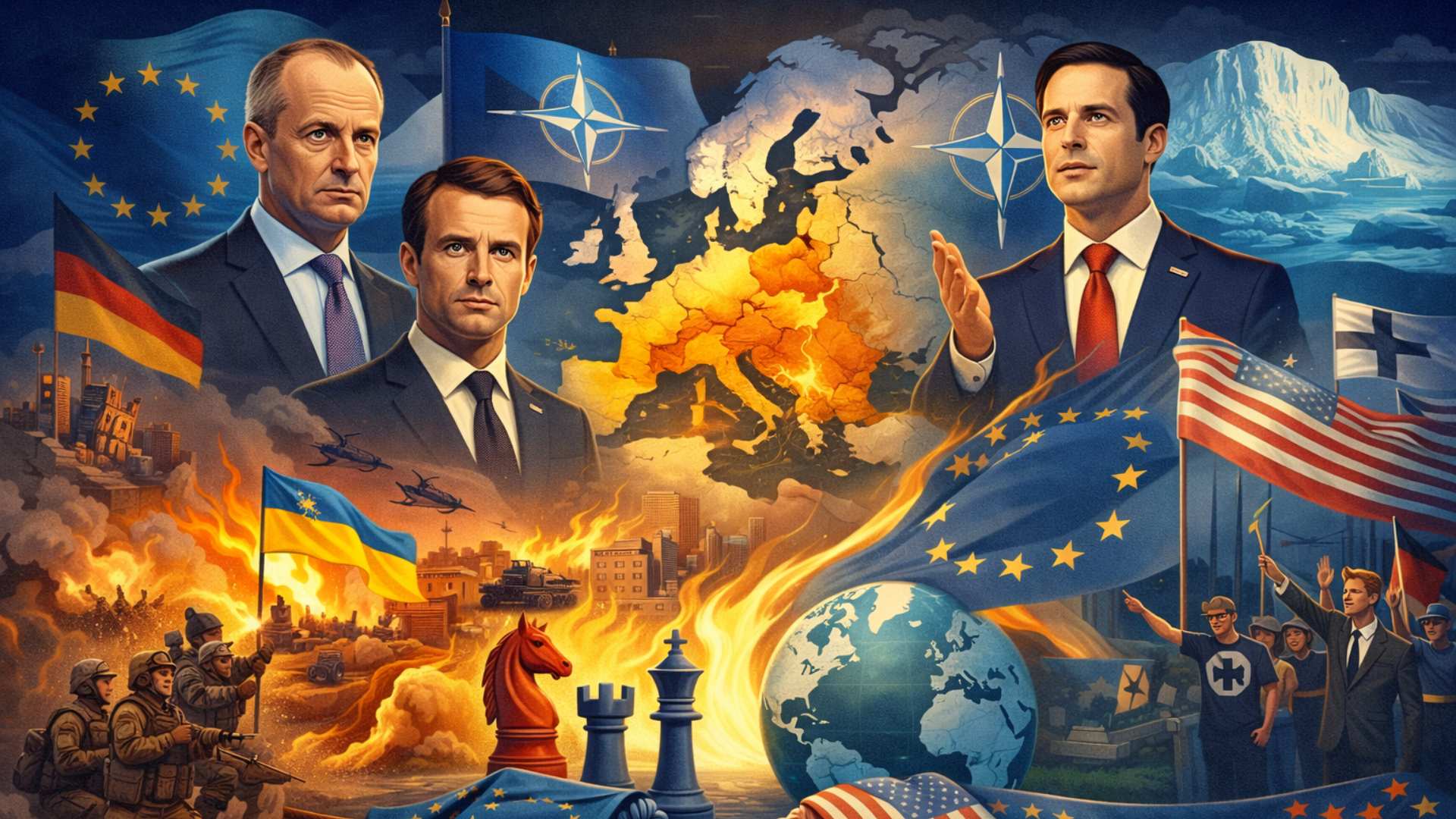
Europe, Transatlantic Strains and the Crisis of the Rules-Based Order
1. Erosion of the International Rules-Based Order
At the Munich Security Conference, Germany’s Chancellor stated that the international rules-based order “no longer exists,” signalling deep anxiety within Europe about systemic instability. This reflects growing uncertainty about the durability of post-Second World War institutions and norms that underpinned global security and economic governance.
The remarks come amid weakening transatlantic cohesion and geopolitical realignments. European leaders increasingly perceive that traditional guarantors of stability, particularly the United States, may be recalibrating their global commitments. If unaddressed, this erosion risks undermining multilateralism, collective security, and rule-based dispute resolution mechanisms.
The debate also indicates a transition from a U.S.-led unipolar moment to a more fragmented global order. Such shifts often create power vacuums, strategic ambiguity, and competitive alignments.
When shared norms weaken, uncertainty increases in global politics. If the rules-based order erodes without replacement, smaller and middle powers face greater insecurity and strategic vulnerability.
2. Strains in Transatlantic Relations
French President Emmanuel Macron called for greater European “military autonomy,” arguing that Europe must become a stronger pillar within NATO. This reflects recognition that reliance on U.S. security guarantees since the Second World War may no longer be sustainable.
While the U.S. Secretary of State expressed willingness for cooperation, his emphasis on shared civilizational identity rather than strategic interests revealed an ideological shift in American discourse. Earlier criticism of Europe’s democratic model and refugee policies by U.S. leaders has further strained trust.
Additionally, remarks about taking control of Greenland risk undermining NATO’s collective defence principle. Such rhetoric creates doubts about alliance solidarity at a time of external threats.
Key Issues:
- Growing perception of declining U.S. security commitment.
- Ideological divergence within the alliance.
- Questions over NATO’s collective defence credibility.
Alliances function on trust and shared strategic clarity. If political rhetoric undermines mutual confidence, institutional cohesion weakens, affecting deterrence and stability.
3. The Ukraine War and Europe’s Security Dilemma
Europe faces the largest land conflict since the end of the Second World War on its eastern flank. For four years, the war in Ukraine has reshaped European security calculations.
Europe’s principal response has been:
- Arming Ukraine.
- Imposing sanctions to weaken Russia economically.
However, these measures have not produced decisive battlefield outcomes. Prolonged conflict strains resources, deepens humanitarian costs, and creates long-term regional instability.
The war also exposes Europe’s dependence on U.S. military and logistical support. Without strategic autonomy, Europe’s capacity to shape outcomes in its immediate neighbourhood remains constrained.
Prolonged war without strategic resolution drains economic and political capital. If Europe cannot shape security outcomes in its vicinity, its geopolitical relevance diminishes.
4. Rise of Far-Right Movements within Europe
Resurgent far-right movements across Europe are challenging the idea of an inclusive European Union. Public resentment toward political establishments, migration policies, and economic anxieties has created fertile ground for such movements.
The American political discourse invoking “civilizational” narratives resonates with similar currents within Europe. This convergence risks shifting the focus from institutional cooperation to identity-driven politics.
If domestic fragmentation intensifies, the EU’s capacity for collective action in foreign policy, defence integration, and economic coordination could weaken significantly.
Challenges:
- Growing scepticism toward supranational institutions.
- Polarisation over migration and identity.
- Electoral volatility affecting policy continuity.
Domestic political instability directly affects external posture. If internal cohesion declines, Europe’s ability to project stability and uphold democratic norms weakens.
5. Strategic Autonomy and Engagement Beyond the West
European leaders increasingly argue that reducing reliance on the U.S. and building strategic autonomy is essential. This includes strengthening defence capabilities and enhancing independent decision-making within NATO.
Simultaneously, rebuilding a functional international order requires engagement beyond the West. Cooperation with non-Western countries can help restore multilateral balance and reduce bloc-based polarization.
In the near term, Europe must also work towards ending the Ukraine war and establishing a workable new normal with Russia to stabilise its eastern frontier.
Way Forward:
- Enhance European defence integration.
- Rebalance transatlantic partnership on more equal footing.
- Pursue diplomatic efforts to end the Ukraine conflict.
- Address socio-economic grievances fueling far-right rise.
- Deepen engagement with emerging powers.
Strategic autonomy is not disengagement but diversification. If Europe fails to recalibrate, it risks being squeezed between great-power rivalries and internal fragmentation.
Conclusion
Europe stands at a strategic crossroads marked by war on its borders, shifting U.S. commitments, and domestic political churn. Rebuilding stability requires greater strategic autonomy, renewed multilateral engagement, and internal political consolidation. How Europe navigates this transition will shape not only continental peace but also the future trajectory of the evolving global order.