
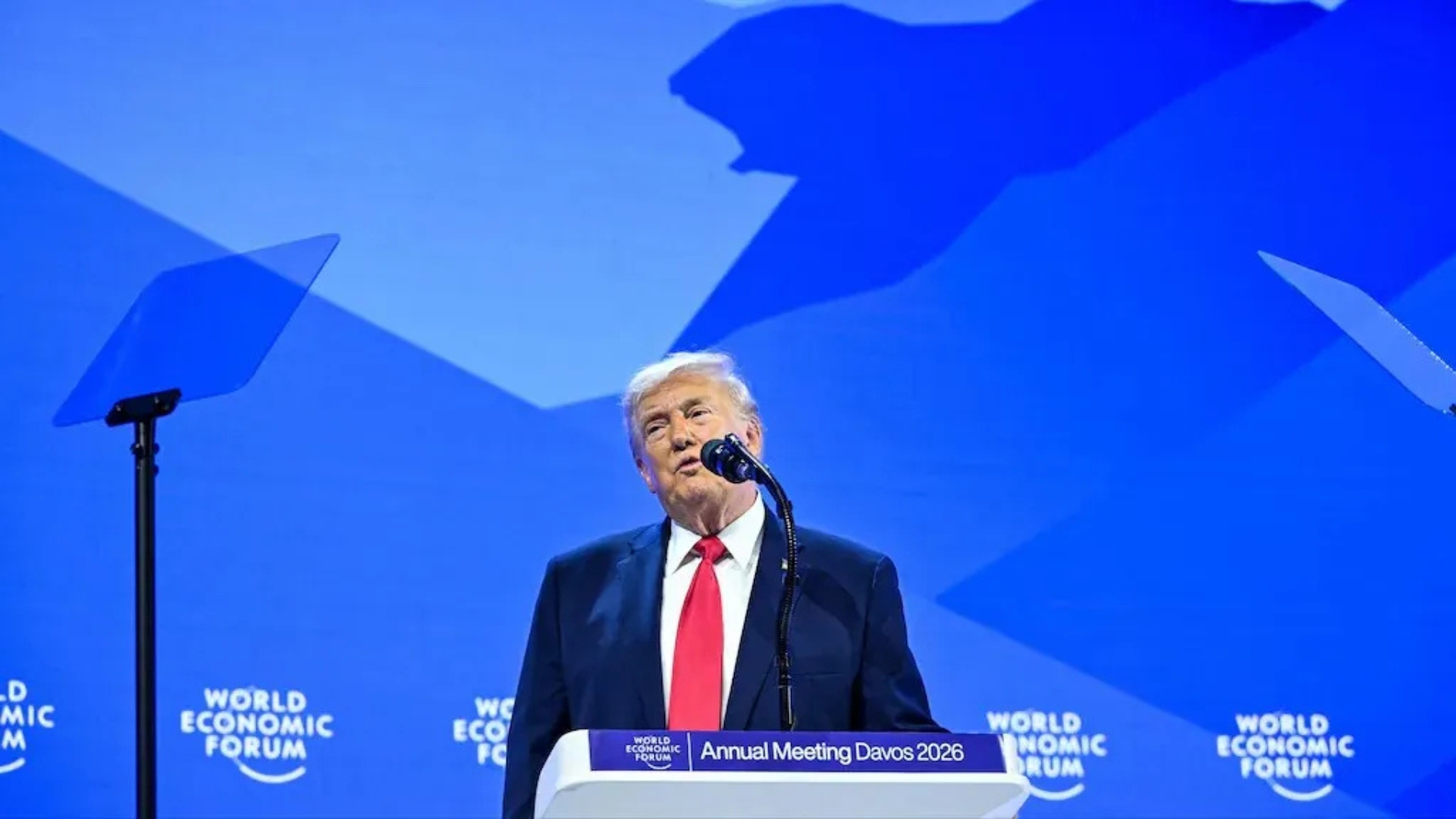
Trump's Shifting Greenland Strategy: Insights from Davos

As Trump reassesses his Greenland ambitions at Davos, what are the implications for global order and geopolitics?
4 mins read
Trump's Shifting Greenland Strategy: Insights from Davos
Not Started

1. Davos Signal and Temporary De-escalation

Global markets reacted positively after US President Donald Trump softened earlier threats of invading Greenland and imposing punitive tariffs on European allies. His speech at the World Economic Forum, Davos, and the announcement of a framework for a “future deal” created a perception of de-escalation.

However, the article cautions that this relief is fragile. The rhetorical shift does not imply abandonment of strategic ambitions, particularly over Greenland, but reflects tactical recalibration under international pressure.

If such signals are misread as structural moderation, global actors may underestimate emerging risks to sovereignty and stability.

“The rule-based world order was fading… the beginning of a brutal reality where geopolitics among the great powers is not subject to any constraints.”Mark Carney, Canadian Prime Minister

Short-term diplomatic easing should not be confused with long-term strategic restraint; misinterpretation weakens preparedness.

2. Greenland and the Logic of Great-Power Strategy

Greenland occupies a pivotal geostrategic position between the US, Russia, and China, making it central to Arctic security dynamics. President Trump justified interest in Greenland by invoking national and international security concerns.

The US already operates the Pituffik airbase in northern Greenland and jointly secures the Arctic under the North American Aerospace Defense Command (Norad) with Canada. This weakens claims that new control is essential for defence alone.

Unstated but critical is Greenland’s vast untapped mineral wealth, especially rare earths, vital for electronics, clean energy, and defence technologies.

Strategic context:

  • China controls ~70% of rare earth mining
  • China controls ~90% of rare earth processing
  • Chinese projects in Greenland operate under the “Polar Silk Road”

“Great powers are always searching for opportunities to gain power over their rivals.”John J. Mearsheimer, The Tragedy of Great Power Politics

Resource security and strategic dominance, not immediate defence gaps, drive contemporary territorial ambitions.

3. Coercive Instruments and Erosion of the Rules-Based Order

The use of invasion threats and tariff coercion against allies represents a departure from the rules-based order historically championed by the US after World War II. Such actions normalise power-centric diplomacy over legal and institutional constraints.

The article notes parallels with historical precedents, warning of creeping acquisition similar to the Sudeten crisis of 1938, where limited concessions emboldened further expansionism.

If coercion becomes accepted practice, sovereignty disputes worldwide may escalate beyond peaceful resolution.

Abandoning rules in favour of force undermines collective security and legitimises unilateral revisionism.

4. Europe’s Pushback and Strategic Signalling

Europe’s response, including limited military deployment in Nuuk and suspension of trade negotiations, signalled resistance rather than acquiescence. This pushback likely influenced the US decision to moderate its rhetoric.

The possibility that European nations could leverage their holdings of US treasuries and assets also altered cost-benefit calculations. The response demonstrated that coordinated economic and strategic pressure remains viable.

Such actions carry significance beyond transatlantic relations by reinforcing deterrence against unilateralism.

Firm collective response raises the cost of coercion and preserves negotiating parity.

5. Wider Implications for Global and Indian Security

The article situates the Greenland episode within a broader pattern of intensifying great-power rivalry. Regions such as eastern Europe, the South China Sea, Taiwan, Ladakh, and Arunachal Pradesh are all vulnerable if appeasement becomes the norm.

For India, this underscores the importance of strategic autonomy, credible deterrence, and support for a rule-based international system that protects territorial integrity.

Ignoring these trends risks normalising power-based redrawing of borders, directly impacting global and regional stability.

Global precedents shape local realities; tolerance of coercion elsewhere weakens security everywhere.

Conclusion

The Greenland episode highlights the fragile state of the rules-based global order amid intensifying great-power competition. Tactical de-escalation should not obscure strategic intent rooted in resource control and power projection. Sustained collective pushback and institutional restraint remain essential to prevent coercion from becoming an accepted tool of international politics.

Quick Q&A

Everything you need to know

The Greenland episode highlights a visible erosion of the post–World War II rules-based international order, which was founded on respect for sovereignty, multilateralism, and institutional restraint on the use of force. The open threat of invasion or coercive acquisition of territory—especially by a country that historically championed this order—signals a shift towards power-centric geopolitics where might increasingly overrides norms.

Conceptually, the rules-based order relied not merely on treaties but on the belief that even powerful states would exercise self-restraint because long-term stability served their interests. The article underscores this breakdown through the US President’s willingness to use tools such as punitive tariffs, military threats, and economic leverage against allies, rather than adversaries. Canadian Prime Minister Mark Carney’s remark about a “brutal reality” captures the sense that great-power rivalry is no longer constrained by shared rules.

Historically, periods where norms collapse—such as the 1930s—have seen aggressive territorial revisionism justified on strategic or ethnic grounds, as in the Sudeten crisis of 1938. The Greenland case, while not identical, raises similar anxieties about incremental encroachments. For UPSC candidates, this illustrates how international orders decay not suddenly, but through repeated exceptions made by powerful actors, weakening protections for smaller states.

Greenland’s strategic importance lies at the intersection of geography, security, and resources. Geographically, it sits astride the Arctic routes connecting North America, Europe, and Eurasia, making it critical for missile early-warning systems and emerging Arctic sea lanes. The US argument that Greenland is essential for national and international security is closely linked to its plans for a missile defence architecture such as the proposed Golden Dome.

From a military standpoint, the US already operates the Pituffik airbase in Greenland under agreements with Denmark and through NORAD with Canada. This raises legitimate questions about why sovereignty, rather than access, is being sought. The answer lies partly in the changing security environment of the Arctic, where melting ice is increasing strategic competition among the US, Russia, and China.

Equally important is Greenland’s vast untapped mineral wealth, particularly rare earth elements. With China controlling around 70% of global mining and 90% of processing, access to alternative sources has become a strategic imperative for advanced economies. Greenland thus represents not merely territory, but leverage in future technology, energy transition, and defence supply chains. This makes it a focal point of twenty-first-century geopolitical competition.

U.S. coercive diplomacy towards NATO allies has profound implications for alliance cohesion and credibility. Alliances are sustained not only by shared threats, but by trust that stronger partners will not exploit weaker ones. Threats of invasion or punitive tariffs against allies undermine this trust and introduce fear rather than reassurance into alliance relationships.

In the short term, such behaviour may force compliance, as allies seek to avoid economic or security costs. The article suggests that Europe may accept a compromise over Greenland that leaves it with the “thin end of the wedge.” However, this comes at the cost of long-term unity. Smaller allies may begin to hedge by increasing strategic autonomy, diversifying partnerships, or accommodating rival powers like Russia or China.

Historically, alliances weakened by coercion tend to fragment over time, as seen in the decline of imperial alliances. While NATO possesses deep institutional roots, repeated violations of its spirit—if not its letter—risk transforming it into a transactional arrangement rather than a values-based collective security system. This would diminish its deterrent power and reshape global security dynamics.

Europe’s decision to push back reflects a growing recognition of the dangers of appeasement. The suspension of trade negotiations with the US signals that European leaders understand the historical lesson that conceding sovereignty or principles under pressure often emboldens further demands rather than ensuring stability.

Economic leverage also played a role. European countries collectively hold trillions of dollars in US treasuries and assets. The possibility that these holdings could be reduced or weaponised in response to coercion likely contributed to Washington’s rhetorical de-escalation. This demonstrates that even in asymmetric relationships, economic interdependence can provide tools for resistance.

Finally, Europe’s response is shaped by broader global implications. As the article notes, what happens in Greenland sets precedents for other contested regions. By resisting coercion, Europe sends a signal that sovereignty cannot be negotiated through threats, thereby reinforcing norms that protect not only Europe but the wider international system.

The Greenland issue is emblematic of a broader pattern of great-power assertiveness across regions. In the South China Sea, China has advanced expansive claims through incremental actions, often justified on security or historical grounds. Similarly, Russia’s actions in Eastern Europe have challenged established borders under strategic pretexts.

What unites these cases is the use of power to reshape facts on the ground while testing the resolve of the international community. The article explicitly warns that if appeasement becomes the norm, regions such as Taiwan, Ladakh, and Arunachal Pradesh could face similar pressures. Greenland thus becomes a test case for whether coercion is resisted or normalised.

For India and other middle powers, the lesson is clear: the defence of norms in one theatre affects security in others. Silence or acceptance elsewhere weakens the collective ability to oppose coercion closer to home.

The Greenland episode offers critical lessons for India’s foreign and security policy. First, it reinforces the importance of strategic autonomy. Over-reliance on any single power—even a partner—can expose vulnerabilities if that power’s interests shift or its leadership adopts coercive tactics.

Second, it highlights the need to strengthen deterrence and diplomacy simultaneously. India’s emphasis on border infrastructure, military preparedness, and diversified partnerships aligns with this lesson. Just as Europe’s limited military deployment in Nuuk signalled resolve, India’s posture along the Line of Actual Control conveys that sovereignty is non-negotiable.

Finally, the episode underscores the value of defending international norms consistently. By supporting a rules-based order in forums such as the UN and through regional groupings, India contributes to an environment where power is constrained by principles. This is essential for safeguarding its interests in an era of intensifying great-power rivalry.

Attribution

Original content sources and authors

Sign in to track your reading progress

Comments (0)

Please sign in to comment

No comments yet. Be the first to comment!