
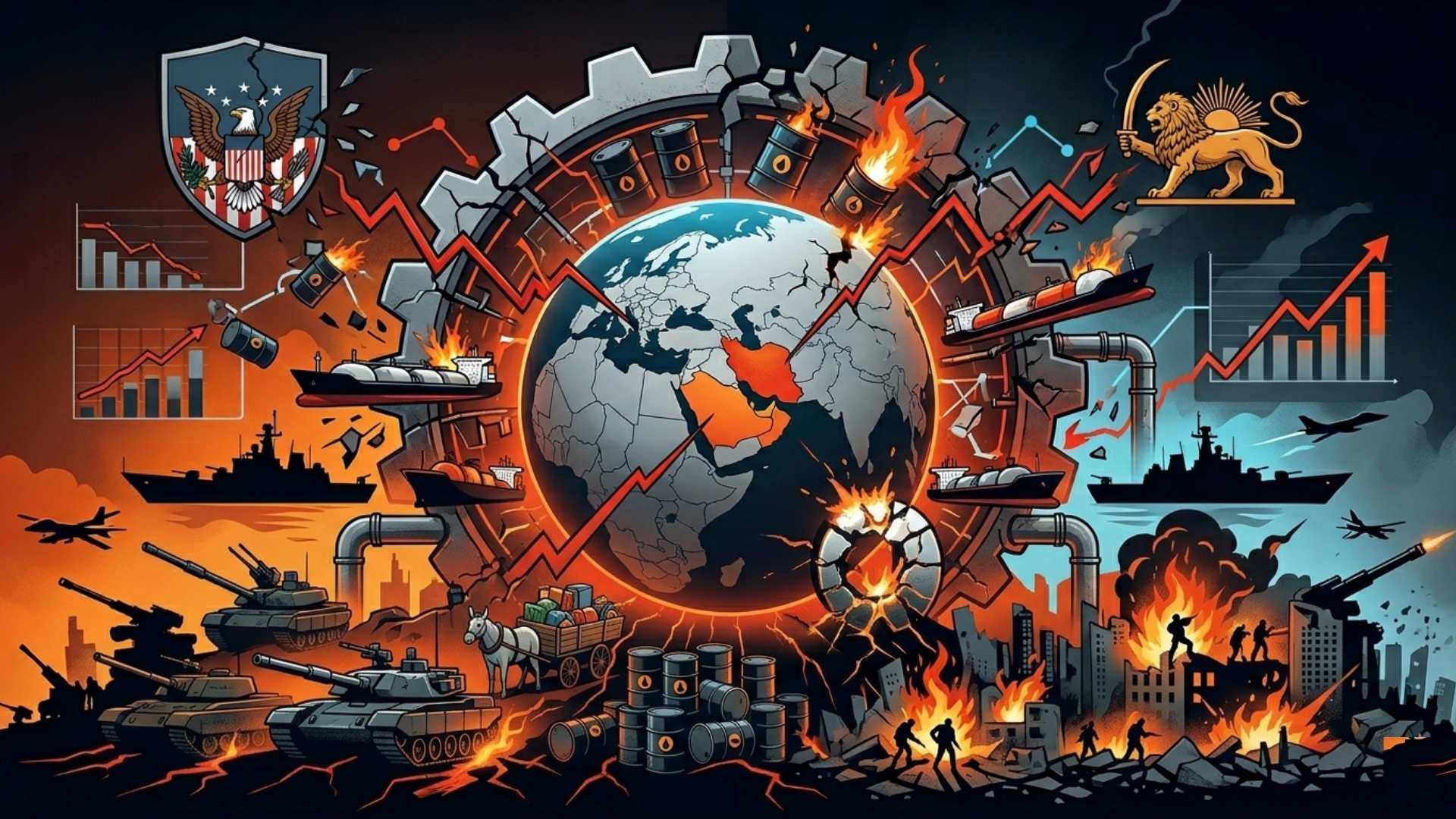
War and Emerging Geopolitical Faultlines in West Asia

Examining how the US-Iran conflict disrupts global economy and energy security amidst geopolitical tensions
GopiGopi
3 mins read
US-Iran Conflict Turns Energy Into Global Battleground

Introduction

The 2026 US–Iran conflict marks a critical shift in global geopolitics, where energy infrastructure has emerged as a primary battleground. The Strait of Hormuz alone handles ~20% of global oil and LNG trade, making it a vital chokepoint. India imports over 85% of its crude oil, with a significant share transiting through the Gulf. The conflict underscores how disruptions in energy supply chains can trigger systemic global economic shocks.


Background & Context

  • The conflict began as a targeted US-Israel strategy aimed at regime decapitation and nuclear deterrence.
  • It rapidly evolved into a broader economic warfare, targeting energy infrastructure and supply chains.
  • Iran’s closure of the Strait of Hormuz (March 1, 2026) marked a turning point.

Key Concepts

1. Energy Chokepoints

  • Strategic maritime routes critical for global energy supply.
  • Example: Strait of Hormuz, Bab-el-Mandeb.

2. Weaponisation of Interdependence

  • States exploit global economic dependencies for strategic gains.
  • Iran leveraged its geographic position to disrupt global energy flows.

3. Asymmetric Warfare

  • Use of low-cost, high-impact tools (drones, cyber-attacks, GPS disruption).
  • Raises costs for technologically superior adversaries.

“Interdependence can be a source of power rather than merely vulnerability.” — Henry Farrell & Abraham Newman


Major Developments in the Conflict

EventStrategic Significance
Closure of Strait of HormuzDisrupted ~20% global energy trade
Strike on South Pars (Iran)Targeting of world’s largest gas field
Attack on Ras Laffan (Qatar)LNG supply chain disruption
Expansion to UAE & Saudi ArabiaRegionalisation of conflict
Targeting civilian infrastructureBlurring civilian-military divide

Changing Nature of Warfare

  • Shift from territorial control → infrastructure targeting.
  • Civilian infrastructure (ports, airports, desalination plants) now part of conflict.
  • Reflects hybrid warfare combining military, economic, and cyber tools.

Global Economic Implications

  • Energy price volatility → inflationary pressures worldwide.

  • Supply chain disruptions affecting:

    • Aviation
    • Agriculture (fertilizers, fuel)
    • Manufacturing

Key Data

IndicatorImpact
Oil pricesSharp spikes due to supply uncertainty
LNG marketsSevere disruption due to Gulf concentration
Global inflationLikely increase due to energy costs

Geopolitical Implications

1. Gulf States’ Strategic Shift

  • Increased hedging behaviour.
  • Diversification of partnerships (China, Russia).

2. Major Power Responses

  • China: Likely to secure energy routes, diversify imports.
  • Europe: Heightened vulnerability post previous energy crises.
  • Russia: Short-term gains (higher prices), long-term uncertainty.

3. Rise of Multipolarity

  • Weakening of US unilateral dominance.
  • Increasing role of regional and alternative powers.

Implications for India

Energy Security Risks

  • India imports ~85% of crude oil; ~60% from West Asia.
  • Hormuz disruption directly threatens energy access and price stability.

Economic Impact

  • Higher oil prices → CAD widening, inflation, fiscal stress.
  • Impact on sectors: transport, fertilizers, MSMEs.

Strategic Concerns

  • Safety of Indian diaspora in Gulf (~8 million).
  • Need for naval preparedness in Indian Ocean Region.

Policy Responses & Way Forward

1. Diversification of Energy Sources

  • Increase imports from Africa, US, Latin America.
  • Invest in renewables and green hydrogen.

2. Strategic Petroleum Reserves (SPR)

  • Expand reserves to cushion short-term shocks.

3. Maritime Security Cooperation

  • Strengthen QUAD, IOR partnerships for sea lane security.

4. Energy Transition

  • Reduce dependency on fossil fuels.
  • Promote solar, wind, and electric mobility.

Critical Analysis

  • The conflict highlights limits of military superiority in interconnected systems.
  • Demonstrates how economic infrastructure is both asset and vulnerability.
  • Marks a shift toward systemic warfare affecting global commons.

Conclusion

The US–Iran conflict of 2026 represents a turning point in global geopolitics, where energy infrastructure has become both a strategic tool and target. It underscores the fragility of global interdependence and the risks of chokepoint vulnerabilities. For countries like India, it reinforces the urgency of energy diversification, strategic autonomy, and resilient supply chains in an increasingly volatile world order.

Quick Q&A

Everything you need to know

The transformation of the US-Iran conflict into a global energy-centric conflict can be understood through the intersection of military objectives and economic interdependence. Initially aimed at strategic military goals such as regime decapitation and counter-proliferation, the conflict quickly expanded due to the centrality of hydrocarbons in the Gulf region. Energy infrastructure—oil fields, LNG terminals, and shipping routes—forms the backbone of both regional power and global economic stability.

As the conflict escalated, both sides began targeting critical energy nodes. Iran’s closure of the Strait of Hormuz and subsequent attacks on shipping routes demonstrated its ability to disrupt global energy flows. Similarly, strikes on facilities like South Pars and Ras Laffan highlighted how energy assets have become strategic targets. These actions shifted the conflict from a localized military engagement to a broader economic confrontation with global repercussions.

This transformation reflects a deeper structural reality: modern conflicts cannot remain isolated when they intersect with global supply chains. The dependence of major economies on Gulf energy ensures that any disruption has cascading effects worldwide. Thus, the conflict illustrates how energy has become both a strategic asset and a battlefield in contemporary geopolitics.

The targeting of critical infrastructure represents a fundamental shift in modern warfare from conventional military engagements to systemic disruption. Traditionally, wars focused on defeating enemy armed forces or capturing territory. However, in an interconnected global economy, infrastructure such as energy facilities, ports, and communication networks has become equally, if not more, important.

In the US-Iran conflict, attacks have extended beyond military targets to include LNG terminals, desalination plants, and even data centers. This blurring of civilian and military domains reflects the integrated nature of modern economies, where infrastructure serves both economic and strategic functions. For example, damaging a desalination plant in the Gulf not only disrupts water supply but also creates humanitarian crises.

The implications are profound. Such targeting amplifies economic costs, disrupts global supply chains, and increases civilian vulnerability. It also raises ethical and legal concerns under international humanitarian law. Thus, this shift signifies a move toward total or hybrid warfare, where the objective is to weaken the adversary’s entire socio-economic system rather than just its military capability.

Chokepoints such as the Strait of Hormuz play a निर्णायक role in shaping global energy geopolitics due to their control over critical supply routes. Handling nearly one-fifth of global oil and LNG flows, Hormuz acts as a strategic bottleneck. Any disruption—whether through military action, piracy, or political decisions—can significantly impact global energy availability and prices.

In the current conflict, Iran’s attempt to weaponise Hormuz through tanker interdictions and GPS disruptions demonstrates how chokepoints can be leveraged for strategic advantage. By threatening to block this narrow passage, Iran effectively exerts pressure not only on its adversaries but also on energy-dependent economies worldwide, including China, India, and European nations.

This dynamic influences strategic calculations in multiple ways. Countries are compelled to diversify supply routes, invest in alternative infrastructure like pipelines, and strengthen naval capabilities to secure maritime trade. It also accelerates the push toward renewable energy to reduce dependence on vulnerable transit points. Thus, chokepoints are not merely geographic features but pivotal elements in global power politics.

The US-Iran conflict has significant implications for the emerging multipolar world order, where power is distributed among multiple global actors rather than dominated by a single hegemon. One key trend is the shifting alignment of Gulf states, which are increasingly balancing their traditional security ties with the United States against growing economic engagements with China and Russia.

For major powers, the conflict presents both opportunities and challenges. China, heavily dependent on Gulf energy, may adopt a more assertive role in securing supply chains or accelerating diversification. Russia, on the other hand, benefits from higher energy prices in the short term but faces long-term uncertainty due to shifting global dynamics. Europe remains vulnerable, highlighting its continued dependence on external energy sources.

However, the conflict also exposes the limitations of unilateral power. The United States, despite its military superiority, finds it difficult to ensure maritime security without broader international cooperation. This underscores the need for multilateral approaches to global challenges. Overall, the conflict accelerates the transition toward a fragmented and competitive global order, marked by strategic hedging and complex interdependencies.

Regional conflicts in the Gulf have a disproportionate impact on the global economy due to the region’s central role in energy production and trade. For instance, the disruption of the Strait of Hormuz during the US-Iran conflict led to immediate volatility in global oil and gas markets. Price spikes increased costs for transportation, manufacturing, and agriculture worldwide.

Another example is the targeting of major energy facilities such as South Pars and Ras Laffan. These are critical hubs in the global LNG supply chain, and any disruption affects countries dependent on imported gas, including those in Europe and East Asia. Such disruptions can lead to energy shortages, increased electricity costs, and slower economic growth.

Additionally, attacks on infrastructure like ports and airports further amplify the impact by disrupting trade and logistics. For example, damage to Gulf ports can delay shipments of essential goods, affecting global supply chains. These examples highlight how localized conflicts can create ripple effects, transforming regional instability into systemic global crises.

The 2026 US-Iran conflict provides critical lessons for ensuring global energy security in an interconnected world. One key lesson is the importance of diversification. Overdependence on a single region or transit route, such as the Gulf or the Strait of Hormuz, creates systemic vulnerabilities. Countries must diversify both energy sources and supply routes, including investments in renewables, African LNG, and alternative shipping corridors.

Another lesson is the need for resilient infrastructure and international cooperation. Protecting critical energy assets requires coordinated efforts among nations, including joint naval patrols and intelligence sharing. The conflict also highlights the importance of strategic reserves, which can buffer short-term disruptions and stabilize markets during crises.

Finally, the case study underscores the urgency of transitioning to sustainable energy systems. While hydrocarbons remain dominant, their geopolitical risks are increasingly evident. Investing in renewable energy, storage technologies, and energy efficiency can reduce exposure to such conflicts. Thus, the path to energy security lies in a combination of diversification, resilience, and long-term structural transformation.

Attribution

Original content sources and authors

Sign in to track your reading progress

Comments (0)

Please sign in to comment

No comments yet. Be the first to comment!