Introduction
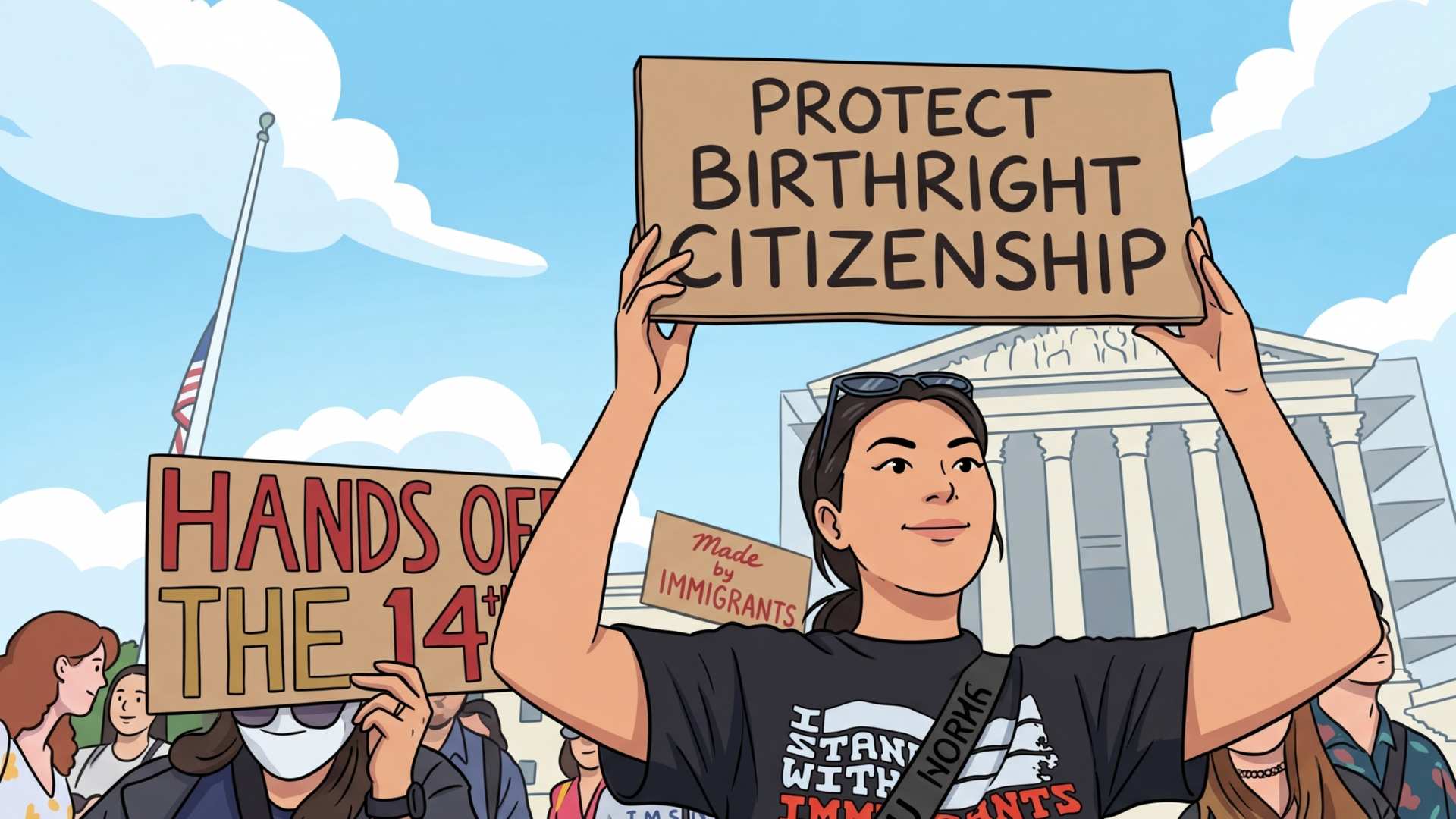
The United States faces a landmark constitutional battle over birthright citizenship, as President Trump's executive order of January 20, 2025 attempts to redefine who qualifies as an American — directly threatening Indian nationals on H-1B visas and green card queues.
"We have the president of the United States trying to radically reinterpret the definition of American citizenship." — Cecillia Wang, Legal Director, American Civil Liberties Union (ACLU)
| Data Point | Figure |
|---|---|
| Constitutional basis under challenge | 14th Amendment (1868) |
| Trump's executive order date | January 20, 2025 |
| Babies affected annually in the U.S. | 2.5 lakh+ |
| Lower courts that declared order illegal | Every court that examined it |
| Key Indian community affected | H-1B visa holders, green card applicants |
Background and Context
The 14th Amendment and Birthright Citizenship Ratified in 1868 after the Civil War, the 14th Amendment's Citizenship Clause states:
"All persons born or naturalized in the United States, and subject to the jurisdiction thereof, are citizens of the United States."
This clause was enacted to overturn the Dred Scott decision (1857), which denied citizenship to African Americans. It has since granted citizenship to virtually all persons born on U.S. soil — the principle of jus soli (right of soil).
Trump's Executive Order Signed on January 20, 2025 ("Protecting the Meaning and Value of American Citizenship"), the order argues that children born to undocumented immigrants or those on temporary visas are not "subject to the jurisdiction" of the U.S. and therefore not entitled to birthright citizenship. The order was set to take effect February 19, 2025, but has been blocked by federal courts.
Key Concepts
| Concept | Explanation |
|---|---|
| Jus Soli | Citizenship by place of birth — basis of U.S. birthright citizenship |
| Jus Sanguinis | Citizenship by descent/parentage — basis in most Asian and European countries including India |
| 14th Amendment | Post-Civil War constitutional provision guaranteeing citizenship to all born on U.S. soil |
| H-1B Visa | U.S. work visa for skilled foreign nationals — largest share held by Indians |
| Green Card Backlog | Indians face decades-long wait for permanent residency due to per-country caps |
| Nationwide Injunction | Court order blocking a federal policy across the entire country |
Constitutional Arguments
Government's Position
- Persons in the U.S. illegally or temporarily are not fully "subject to the jurisdiction" of the U.S. in the constitutional sense.
- Backed by conservative legal scholarship arguing the 14th Amendment was never intended to cover undocumented or temporary residents.
Challengers' Position
- Plain text, history, and 86 years of federal law (Nationality Acts of 1940 and 1952) unambiguously support birthright citizenship.
- Every court that has examined the order has found it likely unconstitutional.
"An impossible task in light of the Constitution's text, history, this Court's precedents, federal law, and Executive Branch practice." — Justice Sonia Sotomayor, U.S. Supreme Court
India-Specific Impact: A Critical Dimension
Official Indian Government Position
- India's Ministry of External Affairs stated that the H-1B visa programme benefits both India and the United States — signalling its importance as a bilateral issue.
- The Indian government told the Trump administration it will cooperate in identifying and repatriating undocumented Indian nationals — a diplomatic balancing act between protecting legal migrants and managing bilateral relations.
- U.S. Secretary of State Marco Rubio discussed "irregular migration" with External Affairs Minister S. Jaishankar, indicating the issue has entered formal diplomatic channels.
Scale of Indian Exposure
| Indicator | Figure |
|---|---|
| Indians in green card queue | 12 lakh (1.2 million) |
| Annual U.S. employment-based green cards | 1.1 lakh (1,10,000) |
| Per-country green card cap | 7% of total annual quota |
| H-1B visas granted to Indians (2023) | 72% of all H-1B visas |
| Undocumented Indians in the U.S. | 3.75–7.25 lakh (Pew/MPI estimates) |
| Total Indian immigrants in the U.S. | 27 lakh (2021) |
The Green Card Backlog — The Cruel Irony
Only 1,40,000 employment-based green cards are available annually across all nationalities, with a 7% per-country cap. For Indians — the largest H-1B community — this creates a backlog stretching decades. Birthright citizenship had served as a critical safety net for U.S.-born children of Indian professionals caught in this bureaucratic trap. The executive order eliminates this safety net entirely for children born after February 19, 2025.
Ground Reality
Indian families in the U.S. have been severely impacted emotionally and practically. The order forced many Indian immigrant families to opt for preterm deliveries to secure citizenship for their child before the February 19 deadline — a stark human cost of the policy's abrupt announcement.
"This impacts us directly." — Akshay Pise, Indian software engineer, San Jose, California
Broader Immigration Context
Trump's birthright citizenship order is part of a wider immigration crackdown:
| Policy Measure | Nature |
|---|---|
| Stepped-up deportations | Enforcement |
| Reduction in refugee admissions | Administrative |
| Suspension of asylum at the border | Executive action |
| Stripping of Temporary Protected Status (TPS) | Administrative rollback |
| Alien Registration Requirement (EO 14159) | Documentation enforcement |
| Birthright citizenship restriction | Constitutional reinterpretation |
Comparative Analysis: India vs USA on Citizenship
| Dimension | USA (Current) | USA (Proposed) | India |
|---|---|---|---|
| Basis | Jus Soli | Jus Sanguinis | Jus Sanguinis with restrictions |
| Undocumented parent | Child gets citizenship | Child denied | Child denied (post-2003 amendment) |
| Temporary resident parent | Child gets citizenship | Child denied | Child denied |
| Constitutional basis | 14th Amendment | Executive reinterpretation | Citizenship Act 1955 (amended 2003) |
Current Legal Status
| Stage | Status |
|---|---|
| Executive order signed | January 20, 2025 |
| Intended effective date | February 19, 2025 |
| Federal courts' response | Multiple preliminary injunctions issued — order blocked |
| Supreme Court (procedural) | Limited nationwide injunctions; did not rule on merits |
| Supreme Court (merits) | Oral arguments scheduled spring 2026; decision expected early summer 2026 |
Implications
Constitutional
- A ruling in Trump's favour would be the most significant reinterpretation of the 14th Amendment in modern U.S. history.
- Would narrow the scope of nationwide injunctions — affecting judicial checks on executive overreach broadly.
Diplomatic
- Directly strains India-U.S. bilateral relations — the largest source of skilled legal migrants bears disproportionate impact.
- Tests the strategic partnership framework, including iCET (Initiative on Critical and Emerging Technologies), built on people-to-people ties.
For Indian Diaspora
- Forces Indian H-1B families to reconsider long-term U.S. settlement plans.
- May accelerate brain drain toward Canada, Australia, and Germany — reducing U.S. competitiveness in attracting global talent.
- Children born during the decades-long green card wait face statelessness or forced return to India at age 21.
Conclusion
The U.S. birthright citizenship battle is simultaneously a constitutional contest, a humanitarian crisis, and a diplomatic challenge for India. The Indian government's calibrated response — affirming the H-1B programme's bilateral value while cooperating on repatriation of undocumented nationals — reflects the complexity of managing asymmetric power relations with a strategic partner. For India, the stakes are direct: 12 lakh Indians await green cards, 72% of H-1B visas go to Indian professionals, and U.S.-born children of these legal, tax-paying workers now face an uncertain future. India must robustly advocate for green card backlog reform and fair treatment of legal migrants in its bilateral negotiations with Washington — making clear that the treatment of skilled Indian professionals is inseparable from the broader health of the India-U.S. partnership.