
1. Context: Greenland Crisis and a Temporary De-escalation
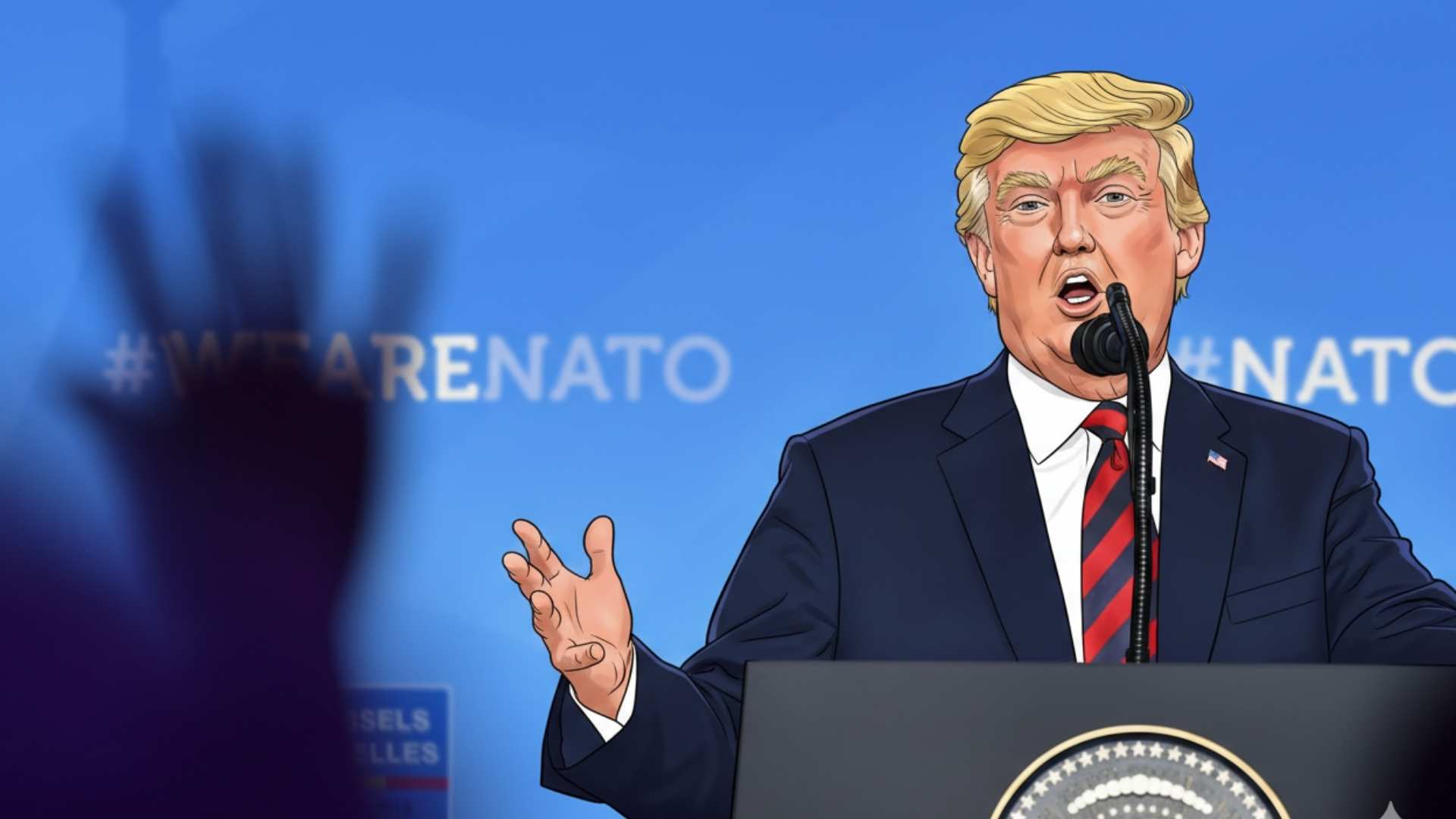
US President Donald Trump has stepped back from earlier threats to annex Greenland by force and abandoned tariff coercion against European allies. He has instead referred to a vague “framework” agreement, temporarily defusing a crisis involving Denmark, Greenland, and Nato.
Greenland is an autonomous territory of Denmark, and the mere suggestion of military takeover by the US marked an unprecedented moment in trans-Atlantic relations. It challenged assumptions about alliance solidarity and respect for sovereignty within Nato.
The immediate de-escalation provides short-term relief for Europe. However, the episode has exposed deeper structural stresses in the international order and within Nato that cannot be ignored without long-term consequences.
If treated as an isolated incident, policymakers risk overlooking how rapidly alliance norms and trust can erode under shifting great power priorities.
The governance logic is that crisis avoidance does not equal crisis resolution; ignoring underlying causes allows instability to resurface in more disruptive forms.
2. Issue: Trump’s Security Logic and the Questioning of Nato Commitments
President Trump has consistently argued that Greenland is vital for US national security, citing concerns over Chinese and Russian interest in its mineral resources and its role in missile defence, particularly his proposed “Golden Dome” system.
While the US already maintains around 200 military personnel at Greenland’s Pituffik Space Base under a 1951 US–Denmark treaty, Trump has argued that security requires ownership, not alliance-based protection. This logic departs from established norms of collective defence.
Trump’s statements raised doubts about whether the US would honour Article 5 of the North Atlantic Treaty, which obligates members to treat an attack on one as an attack on all. He has previously suggested that allies not meeting US expectations may not be defended and did not rule out exiting Nato during the Greenland controversy.
Such rhetoric undermines deterrence and creates uncertainty about alliance guarantees, weakening Nato’s credibility as a security institution.
The strategic logic of alliances depends on trust and predictability; questioning core commitments hollow out deterrence even without formal withdrawal.
3. Implications: Erosion of the Trans-Atlantic Security Order
No previous US president has generated comparable doubt about America’s commitment to European security. This scepticism is reflected in the US National Security Strategy, which portrays Europe as economically declining and strategically less important than regions like East Asia and Latin America.
European leaders fear that the Greenland episode signals a broader shift: from alliance-based security to transactional and coercive diplomacy. This perception has led to talk of a “rupture” in the global order, as articulated by Canada’s Prime Minister Mark Carney at Davos.
If the US is no longer a reliable guarantor, Nato as traditionally conceived may gradually unravel—not through abrupt collapse, but through erosion of confidence and coordination.
This uncertainty compels Europe to reassess long-standing assumptions about its security dependence on Washington.
The institutional logic is that alliances decay when confidence erodes; formal structures survive, but their effectiveness diminishes.
4. European Response: From Dependence to Strategic Agency
Europe’s initial response involved diplomatic restraint, but signs of firmer resolve have emerged. The European Parliament suspended ratification of a trade agreement with the US, and leaders discussed counter-tariffs and the use of the EU’s anti-coercion instrument.
Denmark witnessed symbolic financial signalling as a pension fund announced plans to offload $100 million in US Treasuries. These actions indicate growing willingness to respond collectively to economic and political pressure.
The crisis has reinforced the view that Europe must reduce its reliance on American protection. European leaders increasingly recognise that US strategic priorities are shifting regardless of who occupies the White House.
Failure to convert this moment into sustained policy change would leave Europe vulnerable to future coercion.
The governance logic is that autonomy requires credible options; without building them, strategic dependence persists despite political intent.
5. Feasibility of European Strategic Autonomy
Europe possesses substantial material capacity for self-defence. Standard indicators—population, GDP, technological capability—suggest that it can ensure its own security if political coordination improves.
Nato countries (excluding the US) have significantly increased defence spending. Only 2 countries met the 2% of GDP defence target in 2014; by 2025, all had reached it, with 6 countries spending 3% or more. Combined European defence spending reached $608 billion, more than four times Russia’s expenditure.
However, Europe faces structural challenges: fragmented sovereignty, duplication in defence production, and slow decision-making. These are political, not material, constraints.
If political will is not mobilised, material capacity alone will not translate into effective deterrence.
Defence capacity indicators:
- Defence spending (Europe, excl. US): $608 billion
- Countries meeting 2% GDP target in 2025: All
- Countries spending ≥3% GDP: 6
The development logic is that resources require coordination to generate outcomes; fragmentation dilutes strategic effectiveness.
6. Russia Factor and Eastern Flank Security
Russia is often cited as the primary justification for continued US security leadership in Europe. However, the article argues that Russia does not pose an unmanageable threat, citing its poor performance in Ukraine.
Nearly four years into the Ukraine war, Russia has suffered heavy losses for limited territorial gains. The war’s estimated economic cost of $2.4 trillion suggests long-term weakening rather than expansionary capacity.
Concerns of Eastern European states such as Poland and the Baltics remain valid. However, Europe could address these through a focused eastern flank strategy and a long-term defence partnership with Ukraine.
Overestimating Russia’s strength risks paralysing European strategic initiative.
The security logic is that threat assessment must be evidence-based; exaggeration sustains dependency rather than resilience.
7. Way Forward: Reconfiguring European Security Architecture
Europe faces a structural choice: continue as a junior partner dependent on uncertain US protection or pursue collective political agency. The latter requires rethinking an America-centric security model.
Key steps include modernising military hardware, improving integrated air and missile defences, investing in drones and command-and-control systems, and rationalising defence production across countries.
Long-term cooperation with Ukraine can enhance deterrence while strengthening Europe’s defence-industrial base. Institutional experience within the EU shows that deep integration, though difficult, is achievable.
Failure to act decisively risks leaving Europe strategically exposed in a world of shifting power balances.
Priority areas:
- Integrated air and missile defence
- Drones and advanced air power
- Command, control, and interoperability
- Defence-industrial coordination
The governance logic is that autonomy is built through institutions and investment; delay entrenches vulnerability.
Conclusion
The Greenland episode has revealed more than a momentary diplomatic crisis—it has exposed a structural shift in trans-Atlantic relations. As US strategic priorities evolve, Europe must adapt by translating its economic and military capacity into political and strategic autonomy. The long-term stability of European security will depend not on restoring old certainties, but on building credible, collective self-reliance within a changing global order.

.jpeg)