Gaza Reconstruction, International Stabilisation Force & Global Governance Dynamics – UPSC Notes
1. Context: Creation of the “Board of Peace” under U.S. Initiative
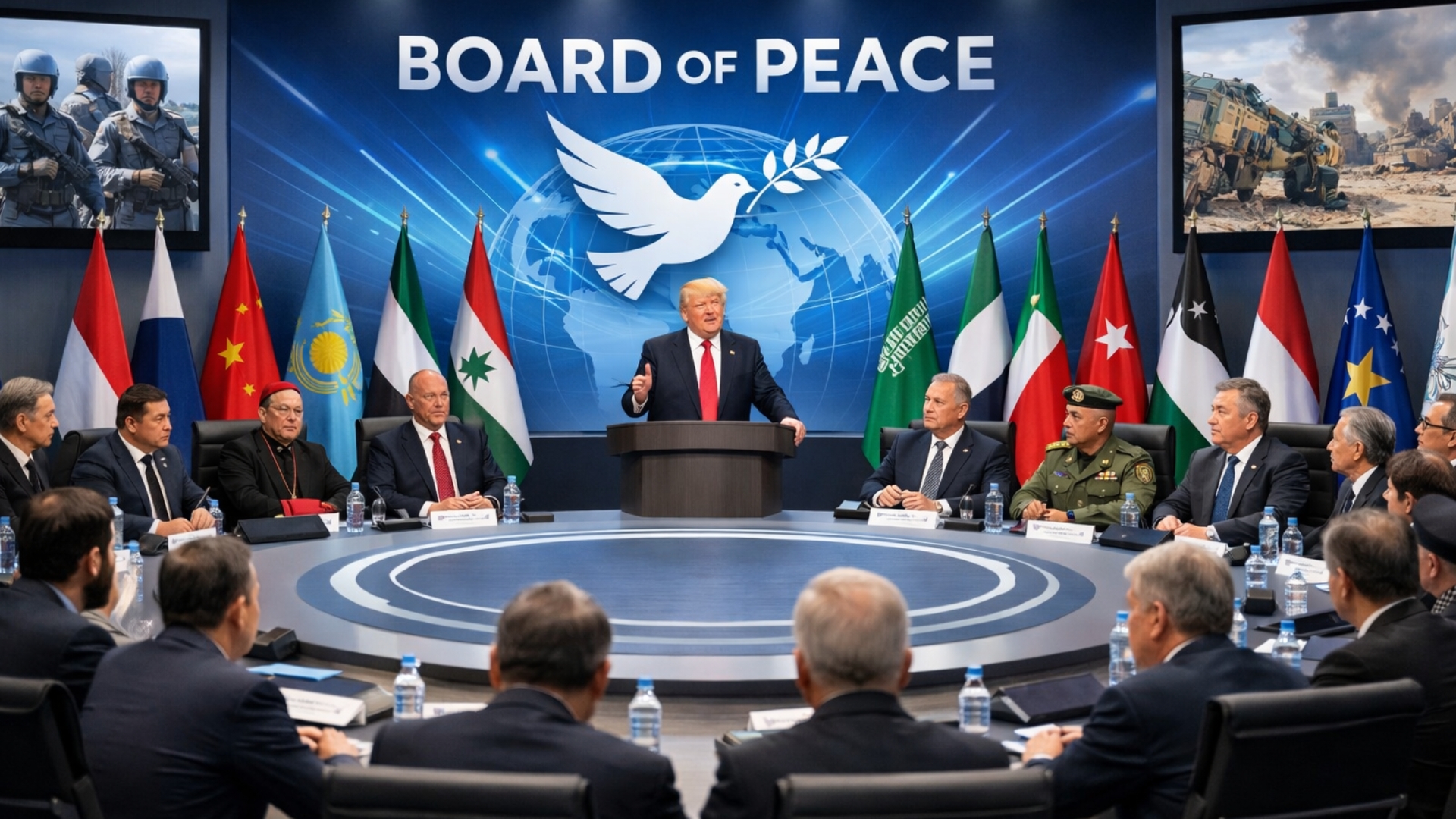
The U.S. administration announced the establishment of a “Board of Peace” as part of a broader peace plan aimed at stabilising Gaza after two years of conflict. The body seeks to coordinate financial assistance, security arrangements, and post-conflict reconstruction.
At its inaugural meeting, participating states pledged financial and military contributions to support a Gaza relief and stabilisation package. The initiative reflects an attempt to integrate humanitarian reconstruction with international security oversight.
However, the expansion of the Board’s mandate beyond Gaza has triggered debate regarding its institutional legitimacy and its relationship with existing multilateral structures, particularly the United Nations.
Post-conflict governance requires coordination between security, finance, and diplomacy. If new institutional mechanisms lack legitimacy or clarity, they may face resistance and coordination challenges.
2. Financial Commitments and Reconstruction Gap
Nine members of the Board pledged 10 billion, though specific allocation details were not clarified.
Countries making financial pledges include:
- Kazakhstan
- Azerbaijan
- United Arab Emirates
- Morocco
- Bahrain
- Qatar
- Saudi Arabia
- Uzbekistan
- Kuwait
Despite these commitments, the funds represent only a fraction of the estimated $70 billion required to rebuild Gaza after prolonged conflict.
"Every dollar spent is an investment in stability and the hope of new and harmonious (region)." — President Donald Trump
The scale of the funding gap highlights the long-term nature of reconstruction and the need for sustained international support.
Insufficient financial mobilisation may delay rebuilding efforts, prolong humanitarian distress, and undermine peace consolidation.
3. International Stabilisation Force: Security Framework
A central element of the initiative is the deployment of an International Stabilisation Force to maintain order and support demilitarisation efforts.
-
Countries pledging troops:
- Indonesia
- Morocco
- Kazakhstan
- Kosovo
- Albania
-
Egypt and Jordan committed to training police forces.
The proposed structure includes:
- 20,000 soldiers
- 12,000 police personnel
Initial deployment will focus on Rafah, identified as a priority area for reconstruction and stabilisation.
"With these first steps, we help bring the security that Gaza needs for a future of prosperity and enduring peace." — Maj. Gen. Jasper Jeffers
The stabilisation force aims to provide security guarantees necessary for reconstruction and political transition.
Security provision is foundational to post-conflict recovery. Without credible enforcement and coordination, reconstruction efforts may remain vulnerable to renewed violence.
4. Disarmament of Hamas and Ceasefire Fragility
The ceasefire between Israel and Hamas remains fragile, with demilitarisation emerging as a core challenge. Disarming Hamas is central to Israel’s demands and to the stabilisation plan.
However, Hamas has shown limited indications of willingness to disarm. U.S. officials have acknowledged significant challenges in achieving demilitarisation.
"We have a long ways to go." — U.S. Secretary of State Marco Rubio
The uncertainty surrounding disarmament raises concerns regarding the sustainability of the ceasefire and the effectiveness of the stabilisation mission.
Peace agreements without enforceable security guarantees risk breakdown. Demilitarisation is often the most contentious and complex phase of conflict resolution.
5. Multilateralism and Institutional Legitimacy Concerns
The Board of Peace has drawn scrutiny from sections of the international community. Some states and observers fear that it could evolve into a parallel structure to the United Nations.
More than 40 countries and the European Union sent representatives to the meeting, while several states such as Germany, Italy, Norway, Switzerland, and the United Kingdom are participating as observers rather than full members.
The UN Security Council held a high-level meeting on the ceasefire and West Bank developments, indicating continued UN engagement. Vatican representatives emphasised that international crises should primarily be managed through the UN system.
In response, U.S. leadership asserted that the Board would complement and strengthen the UN rather than replace it.
Parallel institutional arrangements may either complement or fragment global governance. Legitimacy and broad participation determine whether new mechanisms enhance or dilute multilateral cooperation.
6. Geopolitical Implications and Power Dynamics
The initiative reflects evolving global power dynamics, where major powers may seek flexible, coalition-based mechanisms outside traditional multilateral frameworks. The participation of Middle Eastern and Central Asian states signals a diversified coalition-building approach.
The expansion of the Board’s remit beyond Gaza to potentially address global conflicts suggests an ambition to reshape international conflict management frameworks.
However, scepticism among certain U.S. allies indicates geopolitical sensitivities. Divergent approaches to conflict resolution may affect coordination and long-term sustainability.
Conflict resolution increasingly involves hybrid models combining coalition politics with multilateral engagement. Without consensus among key actors, implementation challenges may intensify.
7. Security–Development Nexus in Post-Conflict Settings
The Gaza initiative demonstrates the interlinkage between security provision, reconstruction financing, and governance reform. The stabilisation force is intended to create conditions for economic rebuilding and political normalisation.
The reconstruction requirement of $70 billion underscores the scale of physical, institutional, and social rebuilding necessary after prolonged conflict.
This case illustrates broader themes relevant to international relations:
- Peacebuilding and state capacity restoration
- Role of external actors in internal conflicts
- Challenges of ceasefire monitoring and enforcement
- Interaction between humanitarian relief and strategic interests
Durable peace requires simultaneous attention to security, economic recovery, and political legitimacy. Neglecting any dimension can undermine the entire peace architecture.
Conclusion
The establishment of the Board of Peace and the proposed international stabilisation force represent a significant attempt to integrate reconstruction financing with security enforcement in Gaza. While initial financial pledges and troop commitments are substantial, the scale of rebuilding needs and the fragility of the ceasefire pose major challenges.
The long-term success of the initiative will depend on effective coordination with existing multilateral institutions, credible demilitarisation efforts, and sustained international consensus. Ultimately, durable peace in Gaza will require aligning security guarantees with inclusive political processes and comprehensive reconstruction efforts.*