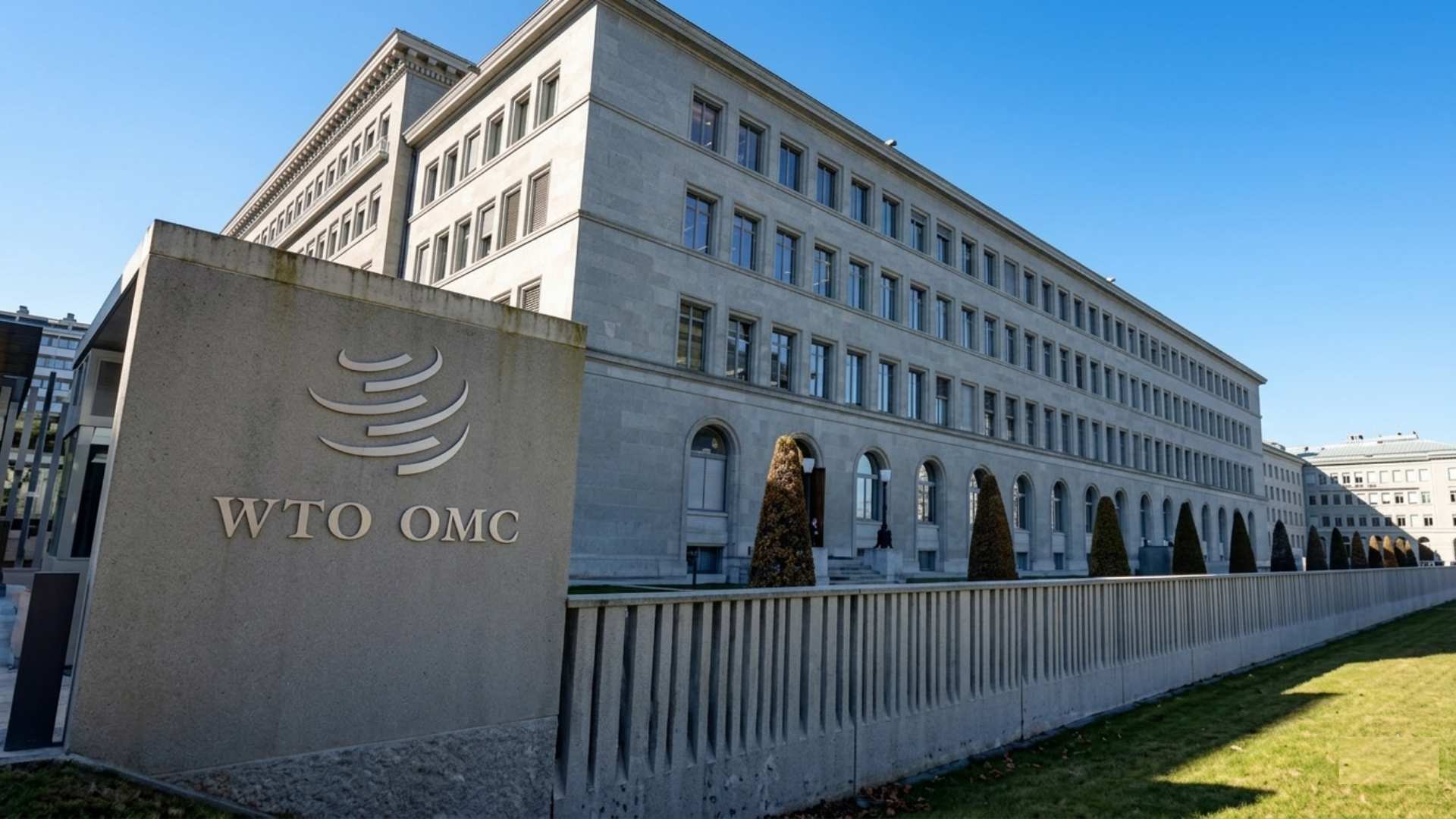
Rebalancing Global Trade: The WTO's Opportunity in Cameroon

The upcoming WTO Ministerial Conference in Cameroon must focus on establishing rules for trade rather than yielding to geopolitical coercion.
3 mins read
WTO faces crisis amid shifting global trade

Introduction

The World Trade Organization (WTO), established in 1995, governs over 98% of global trade with 166 member countries. However, rising geopolitical tensions, protectionism, and technological shifts are challenging its relevance. As global trade becomes increasingly power-driven rather than rule-based, the upcoming Ministerial Conference (MC14), 2026 presents a critical opportunity to reform and revitalise the multilateral trading system.


1. Background and Context

  • WTO created to:

    • Ensure rules-based global trade
    • Provide dispute resolution mechanisms
  • Current shift:

    • From multilateralism → bilateralism/unilateralism
    • Rise of economic coercion and trade wars

Example: U.S.-China trade tensions, tariff wars


2. Key Challenges Facing WTO

(a) Paralysis of Dispute Settlement System

  • Appellate Body non-functional due to:

    • Blocked appointments
  • Impact:

    • Weak enforcement of rules
    • Declining trust

(b) Slow and Ineffective Decision-Making

  • Consensus-based system with 166 diverse members

  • Leads to:

    • Deadlocks
    • Delayed negotiations

(c) Outdated Trade Rules

  • WTO rules designed for 20th-century trade

  • Challenges:

    • Rise of digital economy
    • Complex global value chains

(d) Rise of Protectionism

  • Increasing use of:

    • Tariffs as political tools
    • Economic sanctions

Quote (Munich Security Report 2026):

“Wrecking-ball politics” — preference for disruption over institutional reform


3. Changing Nature of Global Trade

AspectEarlier SystemCurrent Trends
Trade DriversGoodsDigital services, data
Power StructureRules-basedPower-based
ProductionNationalGlobal value chains
AgreementsMultilateralBilateral/Plurilateral

4. Importance of WTO

(a) Stability and Predictability

  • Provides common rules
  • Reduces uncertainty in global trade

(b) Protection for Developing Countries

  • Ensures:

    • Fair dispute resolution
    • Protection from coercion

(c) Global Economic Integration

  • Facilitates:

    • Trade liberalisation
    • Economic cooperation

5. Key Areas for Reform

(a) Restoring Dispute Settlement Mechanism

  • Re-establish functional Appellate Body
  • Ensure binding enforcement

(b) Updating Trade Rules

  • Address:

    • E-commerce
    • Digital trade
    • Climate-related measures

(c) Ensuring Fairness

  • Resolve issues like:

    • Agricultural subsidies
    • Market distortions

Concept:

  • Rule of Law vs Rule of Justice

    • Legal equality ≠ equitable outcomes

(d) Reforming Decision-Making

  • Introduce:

    • Flexible negotiation frameworks
    • Plurilateral agreements (with inclusivity)

(e) Revisiting Special & Differential Treatment (SDT)

  • Ensure:

    • Relevance to current economic realities
    • Balance between developed & developing nations

6. Challenges to Reform

  • Diverging interests among members
  • Developed vs developing country divide
  • Rise of economic nationalism
  • Lack of political will

7. Implications for India

(a) Opportunities

  • Protection under multilateral rules
  • Platform to raise concerns (e.g., subsidies, tariffs)

(b) Challenges

  • Pressure on:

    • Agricultural subsidies
    • Developing country status

(c) Strategic Importance

  • Balance between:

    • Domestic policy space
    • Global trade commitments

8. Way Forward

  • Strengthen multilateralism over unilateralism

  • Ensure inclusive and transparent reforms

  • Promote:

    • Digital trade frameworks
    • Sustainable trade policies
  • Build consensus among members

Expert Insight:

“Rules-based systems protect weaker nations in an unequal world.”


Conclusion

The WTO stands at a crossroads between relevance and redundancy. In a world increasingly shaped by power politics, strengthening a rules-based multilateral trading system is essential for stability and fairness. The success of MC14 will depend on members’ ability to balance sovereignty, fairness, and cooperation, ensuring that global trade remains predictable and inclusive.

Quick Q&A

Everything you need to know

The World Trade Organization (WTO) is currently facing a deep institutional crisis that threatens its relevance in global trade governance. One of the most critical issues is the paralysis of the dispute settlement mechanism, particularly the Appellate Body, due to stalled appointments. Without a functional enforcement system, WTO rules lose their binding nature, weakening trust among member states.

Other major challenges include:

  • Outdated rules: Existing frameworks do not adequately address modern issues like digital trade and e-commerce.
  • Consensus-based decision-making: With 166 members, reaching agreement has become slow and cumbersome.
  • Geopolitical tensions: Increasing use of tariffs and trade restrictions as political tools.
  • Rise of unilateralism: Countries are bypassing multilateral rules through bilateral or regional agreements.

For example, disputes like U.S.-China trade tensions have increasingly been handled outside the WTO framework, highlighting its declining influence.

Thus, the WTO faces both structural and geopolitical challenges that require urgent reforms to maintain its central role in global trade.

The WTO dispute settlement system is often described as the backbone of the multilateral trading system because it ensures that agreed rules are enforced in a fair and predictable manner. Its weakening undermines the credibility of the entire WTO framework.

The concerns arise due to:

  • Lack of enforceability: Without a functioning Appellate Body, disputes cannot be conclusively resolved.
  • Rise of unilateral actions: Countries may impose tariffs or sanctions without fear of legal consequences.
  • Uncertainty in trade: Businesses face unpredictability in cross-border transactions.
  • Disadvantage for smaller nations: They rely on rules-based systems to counter powerful economies.

For instance, developing countries like India depend on WTO mechanisms to challenge unfair trade practices by larger economies. Without such mechanisms, power asymmetry becomes more pronounced.

Therefore, restoring the dispute settlement system is essential to maintain trust, stability, and fairness in global trade.

Global trade has undergone significant transformation in recent decades, driven by technological advancements, global value chains, and the rise of emerging economies. Traditional trade in goods is increasingly complemented by digital commerce, services, and data flows.

Key changes include:

  • Digital trade expansion: E-commerce and cross-border data flows are growing rapidly.
  • Complex supply chains: Production is now spread across multiple countries.
  • Climate-linked trade policies: Carbon taxes and green regulations are emerging.
  • Shift in economic power: Emerging economies are exporting high-tech products.

However, WTO rules were designed in the late 20th century and do not fully address these developments. For example, there is no comprehensive global framework for regulating digital trade or data governance.

Thus, updating WTO rules is necessary to ensure they remain relevant and effective in managing 21st-century trade dynamics.

The shift from rule-based multilateralism to power-based trade relations represents a fundamental change in the global economic order. Traditionally, the WTO ensured that trade was governed by agreed rules and principles, providing predictability and fairness.

However, recent trends show:

  • Increased unilateral tariffs: Countries use trade measures as political tools.
  • Bilateral agreements: Preference for negotiated deals over multilateral commitments.
  • Economic coercion: Use of trade dependencies to exert influence.

While this approach may offer short-term strategic advantages for powerful nations, it has significant drawbacks:
  • Undermines global stability: Creates uncertainty and unpredictability.
  • Marginalises weaker countries: They lack bargaining power in bilateral negotiations.
  • Weakens institutions: Reduces the relevance of multilateral bodies like the WTO.

For example, the U.S.-China trade war and retaliatory tariffs illustrate how power-based approaches can disrupt global markets.

Thus, while power-based trade may reflect current geopolitical realities, it risks eroding the cooperative framework necessary for sustainable global trade.

Trade is increasingly being used as a geopolitical tool, where economic measures are employed to achieve strategic or political objectives rather than purely economic goals.

Key examples include:

  • U.S.-China trade war: Imposition of tariffs on billions of dollars’ worth of goods.
  • Sanctions regimes: Economic restrictions imposed on countries like Iran and Russia.
  • Export controls: Restrictions on critical technologies such as semiconductors.
  • Retaliatory tariffs: Countries responding to trade barriers with countermeasures.

In the Indian context, warnings of retaliatory tariffs against the U.S. over steel and aluminium duties highlight how trade disputes are increasingly politicised.

These examples show that:
  • Trade policies are intertwined with national security concerns.
  • Economic interdependence can be weaponised.


Therefore, the growing politicisation of trade underscores the need for strong multilateral institutions like the WTO to ensure fairness and stability.

WTO reforms are essential not only to improve efficiency but also to address concerns related to fairness and development. While the WTO promotes rule-based trade, many developing countries argue that these rules do not always produce equitable outcomes.

Key issues include:

  • Agricultural subsidies: Developed countries provide large subsidies, distorting global markets.
  • Unequal market access: Developing nations face barriers despite liberalisation commitments.
  • Special and Differential Treatment (SDT): Needs updating to reflect current realities.

At the same time, reforms must balance fairness with efficiency. Overemphasis on flexibility may dilute rules, while rigid frameworks may ignore development needs.

For example, India has consistently advocated for protecting its agricultural sector and ensuring food security within WTO negotiations.

Thus, WTO reforms must aim to create a system that is not only legally sound but also developmentally just, ensuring inclusivity and equity in global trade.

Reforming the WTO requires a comprehensive approach that addresses both institutional weaknesses and emerging global challenges. As a policymaker, the focus should be on restoring credibility while adapting to new trade realities.

Key reform measures would include:

  • Reviving dispute settlement: Restoring the Appellate Body with consensus among members.
  • Updating rules: Introducing frameworks for digital trade, e-commerce, and climate-related measures.
  • Flexible negotiation models: Allowing plurilateral agreements while ensuring inclusivity.
  • Transparency in subsidies: Better monitoring of trade-distorting practices.

Additionally, development concerns must be addressed by strengthening SDT provisions and ensuring fair participation of developing countries.

For example, plurilateral agreements on e-commerce can help move negotiations forward while eventually integrating them into the WTO framework.

In conclusion, a balanced approach combining institutional reform, rule تحديث, and inclusivity is essential to ensure that the WTO remains relevant and effective in governing global trade.