Introduction
The post-World War II rules-based international order — built around the UN, IMF, World Bank, and WTO — is under unprecedented stress. The United States has withdrawn from over 60 global organisations, China recorded its largest-ever trade surplus of $1.2 trillion in 2025 while weaponising rare earth monopolies, and two active wars continue to destabilise the global security architecture. In this vacuum of superpower responsibility, middle powers — nations too significant to be ignored but too constrained to act alone — are emerging as potential architects of a reformed global order. India, with its Non-Aligned Movement legacy, G20 presidency experience, and G4 membership, is uniquely positioned to lead this charge.
Background: The Collapsing Rules-Based Order
The liberal international order, constructed after 1945, rested on two assumptions — American leadership and multilateral consensus. Both are now fractured:
- USA: Raising tariffs aggressively, withdrawing from multilateral bodies, and using economic coercion as foreign policy
- China: Claiming free trade support while posting record surpluses, dumping goods globally, and leveraging rare earth monopolies as geopolitical weapons
- Russia: Ongoing military aggression in violation of UN Charter principles
- G2 Dysfunction: The US-China rivalry has paralysed key multilateral institutions — UNSC vetoes block resolutions, WTO appellate body remains non-functional, IMF voting reform stalled
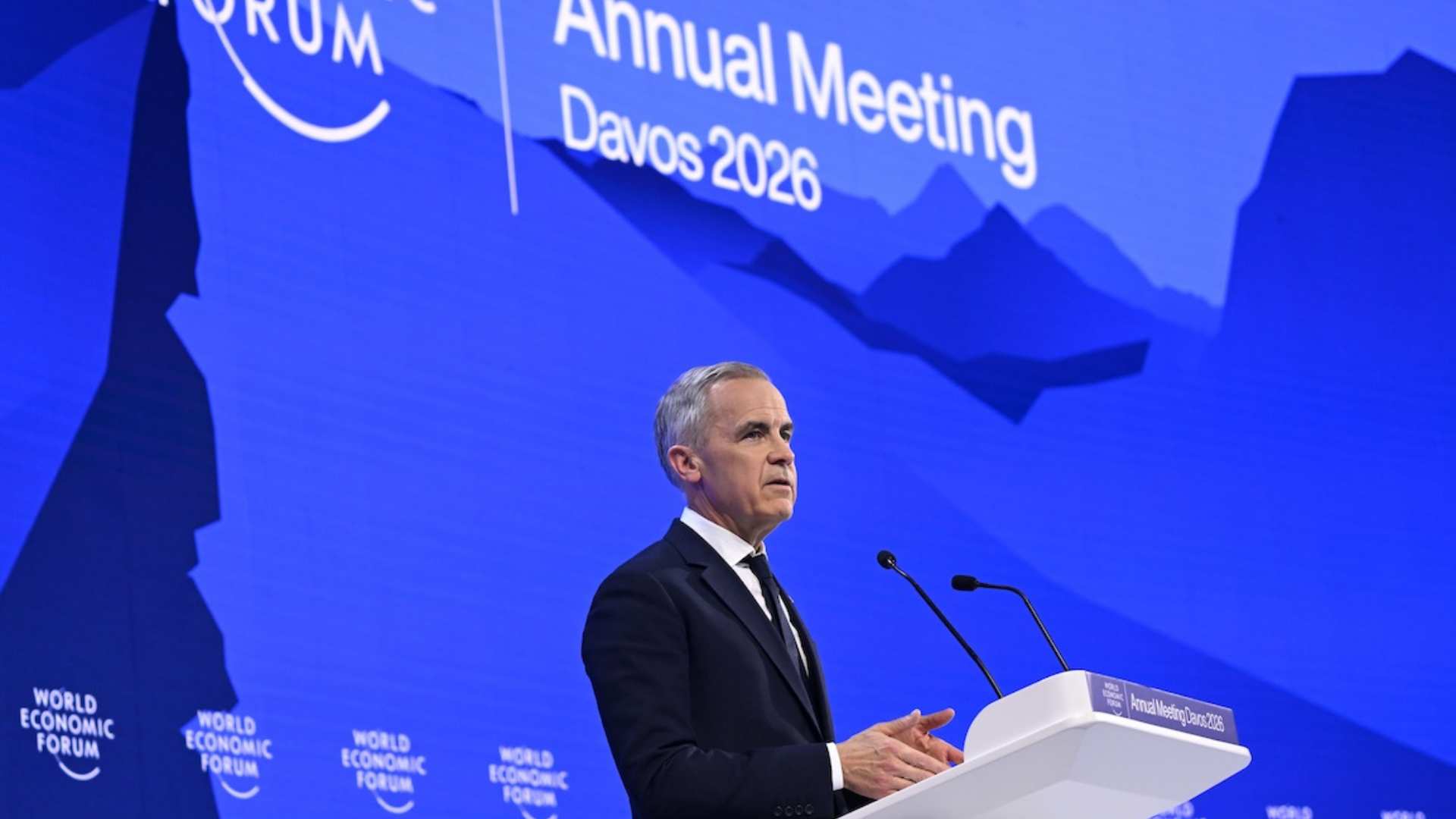
"In a world of great power rivalry, the countries in between have a choice — compete with each other for favour, or combine to create a third path with impact... The middle powers must act together, because if we're not at the table, we're on the menu." — Mark Carney, Prime Minister of Canada, Davos 2025
Key Concept: Who Are Middle Powers?
Middle powers are states that lack superpower status but possess sufficient economic, diplomatic, or military weight to shape regional or global outcomes. They typically:
- Support multilateralism and rule-based systems (as they benefit from predictability)
- Lack unilateral coercive capacity but can build coalitions
- Bridge developed and developing world perspectives
| Country | Why a Middle Power |
|---|---|
| India | 4th largest economy (PPP), G4, Global South voice, nuclear state |
| Germany | Largest EU economy, industrial powerhouse, NATO anchor |
| Japan | 3rd largest economy, technology leader, Indo-Pacific stakeholder |
| Brazil | Largest Latin American economy, Amazon stewardship, BRICS |
| Indonesia | World's largest Muslim democracy, ASEAN anchor, G20 member |
| South Africa | Africa's most industrialised economy, AU leadership |
| Canada | G7 member, middle power diplomatic tradition, Arctic stakeholder |
The R7 Proposal: A Coalition for Reform
The article proposes a new grouping — R7 (Reform 7) — of the most consequential middle powers committed to reforming global institutions.
Core Principles of R7:
- Not a closed bloc — open to expansion (R10, R12) as consensus builds
- Focused on institutional reform, not superpower replacement
- Initial exclusion of US, China, Russia unless they engage the reform agenda
- UK and France included only upon commitment to curtailing their own institutional privileges (UNSC veto)
Demographic and Economic Weight:
| Grouping | Population Share | Implication |
|---|---|---|
| R7 (core) | 2.2 billion (~27% of world) | Significant legitimacy base |
| R7 + EU | ~35% of world population | Near-majority of non-superpower world |
Proposed Institutional Reforms
1. UN Security Council (UNSC)
- Expand permanent membership from P5 to P11 — as proposed by G4 (India, Germany, Japan, Brazil)
- Abolish the veto or replace with proportional voting based on population, economic size, and UN peacekeeping contributions
- All unilateral military invasions deemed illegal under new rules — regardless of justification (human rights, counter-terrorism etc.)
2. World Trade Organization (WTO)
- Move beyond fair trade rules to periodic outcome reviews
- Countries with persistent trade surpluses or deficits must take corrective measures
- Addresses the structural problem that WTO rules govern process, not outcomes — allowing chronic mercantilism to persist legally
3. IMF and World Bank
- End the convention of US-nominated World Bank President and European-nominated IMF Managing Director
- Leadership and voting rights to reflect current economic realities — not 1944 Bretton Woods power structures
- Greater representation for Global South in governance
4. Cultural and Political Pluralism as a Norm
- Democracy cannot be a precondition for participation in the rules-based order
- Religious freedom cannot be defined exclusively through Western/Abrahamic frameworks
- Each nation must be trusted to evolve politically — sovereignty over developmental models respected
India's Role: From NAM to Reform Leadership
India has a strong historical and structural case to lead the R7:
| Historical Role | Current Leverage |
|---|---|
| Founding member & prime mover of Non-Aligned Movement (1961) | G4 membership; UNSC reform advocate |
| Champion of New International Economic Order (NIEO, 1970s) | G20 Presidency (2023); Voice of Global South Summit |
| South-South cooperation leadership | Quad member; SCO member; BRICS member |
| Anti-colonialism and sovereign equality advocacy | 4th largest economy; strategic autonomy tradition |
India's strategic autonomy doctrine — maintaining equidistance from superpowers while advancing national interests — is precisely the posture needed to lead a middle power coalition without being captured by either Washington or Beijing.
Analytical Dimensions
1. Why Now?
The convergence of US unilateralism, Chinese mercantilism, two active wars (Ukraine, West Asia), and the paralysis of multilateral institutions has created a reform window — a moment when even traditional beneficiaries of the old order (Canada, Japan, Germany) recognise its dysfunction.
2. Challenges to R7 Cohesion
- Divergent interests: Japan and Germany are US treaty allies; their participation in a reform coalition risks straining these alliances
- China pressure: Beijing will likely pressure Indonesia, South Africa, and Brazil — all with significant Chinese economic ties — to undermine the coalition
- India-China tension: India's bilateral tensions with China may make it difficult to lead a truly neutral reform agenda
- Institutional inertia: P5 members (especially US and China) have structural incentives to block UNSC reform
3. The Veto Problem
UNSC reform has been discussed since the 1990s — the Uniting for Consensus group (led by Italy, Pakistan, South Korea) opposes G4 expansion. Any reform requires amendment of the UN Charter under Article 108, which itself requires P5 ratification — a near-impossible threshold without superpower buy-in.
4. WTO Paralysis
The WTO Appellate Body has been non-functional since 2019 due to US blocking of new appointments. Without a dispute settlement mechanism, WTO rules are effectively unenforceable — a structural crisis that R7 must prioritise.
Comparison: Reform Coalitions in History
| Coalition | Era | Objective | Outcome |
|---|---|---|---|
| Non-Aligned Movement (NAM) | 1961 | Avoid Cold War bloc alignment | Symbolic; limited institutional change |
| G77 + NIEO | 1970s | Reform global economic order | Failed; debt crisis weakened Global South |
| G4 (UNSC reform) | 2004–present | Expand UNSC permanent seats | Stalled; P5 resistance |
| BRICS | 2009–present | Alternative to Western-led order | NDB created; limited reform impact |
| Proposed R7 | 2025– | Comprehensive multilateral reform | Yet to be tested |
Implications and Challenges
- Legitimacy vs. effectiveness: A larger coalition has more legitimacy but less decisiveness — the R7 must stay lean enough to formulate principles before expanding
- Economic leverage: Middle powers collectively represent significant trade volumes — coordinated positions in WTO negotiations could compel reform
- Security dimension: Without a collective security guarantee, middle powers remain vulnerable to superpower coercion — R7 needs an economic and diplomatic, not military, foundation
- India's balancing act: India must navigate its Quad commitments (US-aligned), SCO membership (China-Russia dominated), and BRICS participation (China-led) while positioning itself as a neutral reform leader
Conclusion
The rules-based international order is not dead — but it is broken. The G2 of the United States and China has demonstrated that superpower rivalry, not superpower leadership, defines the current moment. Middle powers, representing over a quarter of humanity and a disproportionate share of global goodwill toward multilateralism, have both the incentive and the opportunity to drive reform. The proposed R7 framework — focused on UNSC expansion, WTO outcome accountability, IMF-World Bank democratisation, and pluralistic norm-setting — offers a credible architecture for a reformed world order. India, with its civilisational pluralism, strategic autonomy, and Global South credibility, is uniquely placed to be the moving spirit of this transformation. The question is not whether India can afford to lead — it is whether India can afford not to.