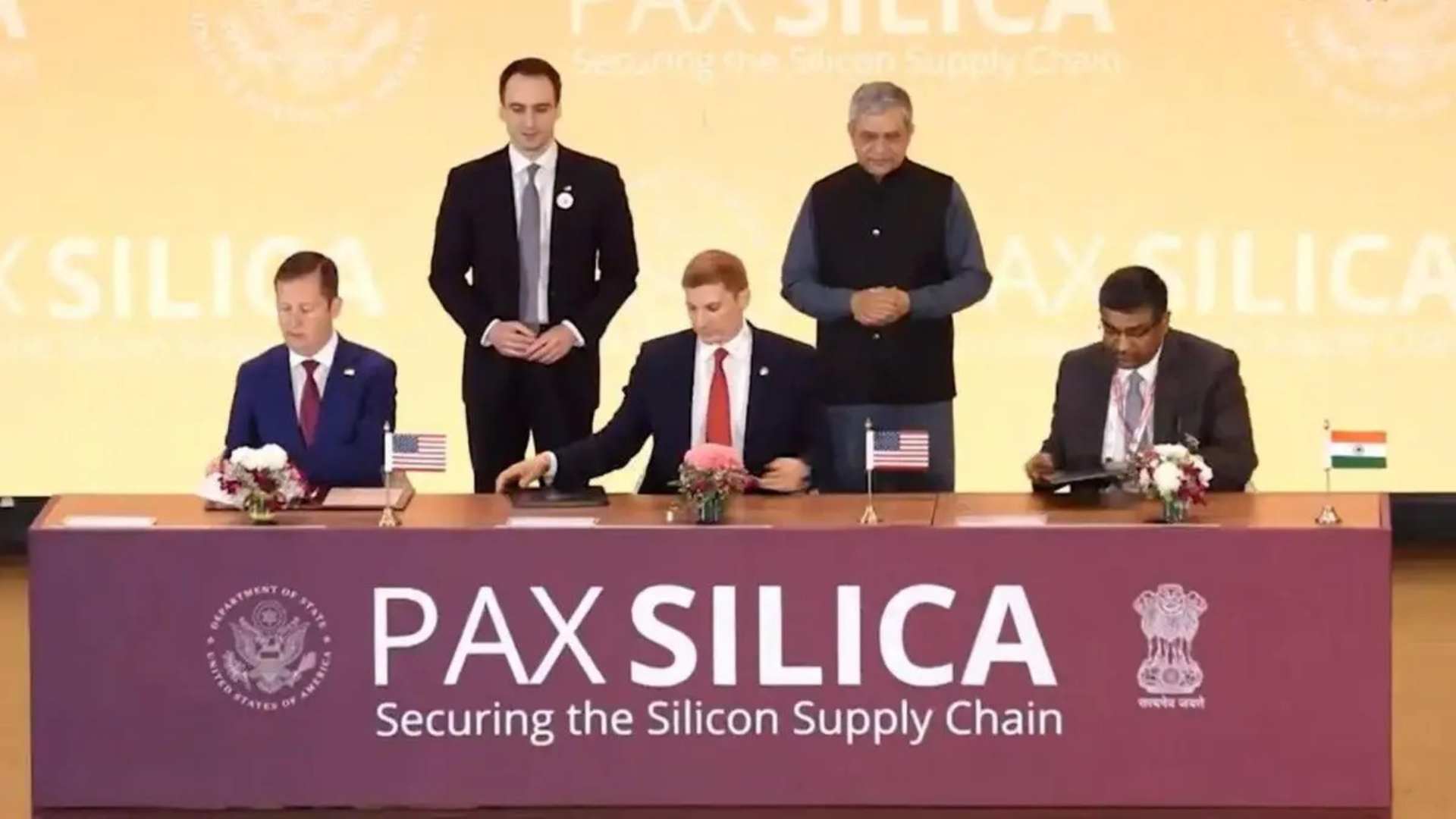
India’s Entry into Pax Silica – Strategic, Economic & Governance Implications
1. What is Pax Silica?
India has joined Pax Silica, a US-led technology and supply-chain coalition launched in December 2025. The grouping seeks to secure supply chains in semiconductors, artificial intelligence (AI) infrastructure, and critical minerals while reducing dependence on China.
Member countries include the United States, Japan, South Korea, United Kingdom, Singapore, Israel, the Netherlands, Australia, UAE, Qatar, and Greece, with Canada, the European Union, and Taiwan as observers. The coalition aims to coordinate investment across the value chain—from mineral extraction and processing to chip fabrication, advanced computing, and data infrastructure.
The initiative reflects a broader global trend of supply-chain realignment amid geopolitical competition, particularly in high-technology sectors critical to economic and national security.
In an era where technology supply chains shape strategic power, participation in such coalitions influences economic security, industrial policy, and foreign policy autonomy. Ignoring such alignments may increase vulnerability to supply disruptions.
2. Strategic Rationale: Reducing Dependence on China
China accounts for over 90% of global rare-earth processing capacity, creating structural concentration risks. India imports 80–90% of its rare-earth magnets and related materials from Chinese suppliers.
Recent Chinese export controls and licensing conditions disrupted India’s automobile and electronics sectors, demonstrating the vulnerability of concentrated supply chains.
Pax Silica provides avenues for diversified sourcing, joint processing partnerships, and coordinated stockpiling mechanisms to mitigate such risks.
Supply-chain concentration creates economic coercion risks. Diversification enhances resilience, but failure to act may expose critical sectors like EVs, defence, and electronics to recurring disruptions.
Key Dependence Indicators:
- China’s share in rare-earth processing: >90%
- India’s rare-earth magnet imports from China: 80–90%
3. Alignment with India’s Domestic Industrial Policy
India’s entry into Pax Silica complements its domestic semiconductor and rare-earth industrial push. The government has approved semiconductor projects worth approximately ₹1.6 trillion, supported by incentives of around ₹76,000 crore.
Fabrication units, compound semiconductor plants, and design ecosystems are being developed, with global firms such as Micron and domestic groups like Tata investing.
The Union Budget 2026–27 announced:
- “Rare Earth Corridors” in Odisha, Kerala, Andhra Pradesh, and Tamil Nadu
- A ₹7,280 crore Rare Earth Permanent Magnet scheme
- Target of 6,000 tonnes per annum integrated magnet capacity
These measures aim to integrate mining, processing, research, and manufacturing.
International alignment strengthens domestic industrial strategy. However, without infrastructure readiness and regulatory clarity, domestic capacity may lag behind strategic ambitions.
4. Expanding Beyond Minerals: AI & Digital Infrastructure
Pax Silica extends beyond critical minerals to AI infrastructure, data centres, fibre networks, and foundational models.
India’s strengths include:
- Large-scale digital public infrastructure (DPI)
- Expanding AI market
- Substantial engineering and technology talent pool
Participation enhances India’s integration into global AI and semiconductor ecosystems, potentially attracting capital, technology transfer, and advanced research partnerships.
Technological ecosystems are increasingly interconnected. Exclusion from advanced computing alliances may limit innovation capacity and digital competitiveness.
5. Trade-offs: Strategic Autonomy & Dependency Risks
Supply-chain bifurcation between China-led and Pax Silica-led systems may intensify expectations on export controls, technology standards, and investment-security norms.
There is also a risk of replacing one dependency with another. Advanced lithography equipment, high-end AI chips, and computing hardware remain concentrated within US-aligned ecosystems.
Concerns arise regarding the durability of US-led multilateral commitments, as the US has withdrawn from multiple global agreements, including the India-led International Solar Alliance.
Strategic alignment must be calibrated to avoid overdependence. Without careful negotiation, economic security initiatives could constrain policy flexibility and strategic autonomy.
6. Economic Security vs Geopolitical Alignment
Pax Silica is ultimately a US-led initiative aimed at advancing American economic-security objectives. While it offers cooperation opportunities, India must evaluate long-term reliability and cost-benefit implications.
Membership may provide access to capital, markets, and advanced technology. However, effective gains depend on India’s regulatory preparedness, environmental safeguards in mining, infrastructure capacity, and sustained R&D investment.
Economic security is not ensured merely by joining alliances; it requires internal capability building and diversified partnerships.
External coalitions can complement but not substitute domestic capacity. Without strong internal ecosystems, alliance participation may yield limited strategic dividends.
7. Governance & Implementation Challenges
For Pax Silica membership to translate into tangible benefits, India must address:
- Infrastructure readiness in semiconductor fabrication
- Environmental and social safeguards in rare-earth mining
- Clear regulatory frameworks for foreign investment and technology transfer
- Skilled workforce development and research funding
Integration into global value chains requires policy coherence across industrial, trade, digital, and environmental domains.
Economic diplomacy must be matched by administrative efficiency. Weak implementation capacity can dilute strategic gains from international partnerships.
Conclusion
India’s entry into Pax Silica reflects a strategic effort to enhance supply-chain resilience in semiconductors, AI infrastructure, and rare-earth processing amid geopolitical realignment. It aligns with domestic industrial initiatives worth ₹1.6 trillion in semiconductors and targeted rare-earth capacity expansion.
However, durable economic security will depend on infrastructure readiness, regulatory stability, environmental safeguards, and preservation of strategic autonomy. Balanced engagement, diversified partnerships, and sustained domestic capability building will determine whether Pax Silica becomes a catalyst for technological transformation or a limited geopolitical alignment.