
The Quad’s Year of Pause, Not Retreat

Despite leadership churn and a missing summit, the Indo-Pacific grouping shows resilience amid intensifying U.S.–China rivalry
GopiGopi
3 mins read
Quad strengthens Indo-Pacific cooperation, resilience, and maritime security
Not Started

The Quad in 2025: Resilience Amid Indo-Pacific Geopolitical Churn


1. Global Geopolitical Context in 2025

Context

  • 2025 witnessed major geopolitical disruption driven by leadership transitions and intensifying great power rivalry.
  • The return of Donald Trump to the U.S. presidency revived uncertainty around Washington’s multilateral commitments.
  • The Indo-Pacific emerged as the most contested strategic theatre due to rising U.S.–China competition.

Key Issues

  • Increased contestation over:

    • Maritime trade routes
    • Strategic influence
    • Regional rule-making
  • Risks of fragmentation in regional security architecture if multilateral platforms weaken.

Implications

  • Direct impact on:

    • Global trade stability
    • Maritime security
    • Regional economic growth
  • Smaller and middle powers face higher vulnerability to coercive diplomacy.

The governance logic is that geopolitical churn tests the durability of regional institutions; without resilient mechanisms, power vacuums can destabilise development and security outcomes.


2. The Quad: Strategic Rationale and Objectives

Context

  • The Quadrilateral Security Dialogue (Quad) comprises India, Australia, Japan, and the United States.
  • Revived in 2017 to address concerns over unilateralism and erosion of the rules-based order.

Core Objectives

  • Uphold a:

    • Rules-based international order
    • Free, open, and inclusive Indo-Pacific
  • Act as a platform for:

    • Strategic coordination
    • Delivery of global public goods

Broader Significance

  • The Quad is not a formal military alliance.
  • It balances security cooperation with developmental initiatives such as infrastructure and maritime safety.

The strategic logic is to combine deterrence with cooperation; absence of such a forum would weaken collective norm-setting in the Indo-Pacific.


3. Leadership Transitions and Institutional Constraints

Context

  • The Quad lacks:

    • A permanent secretariat
    • A binding treaty framework
  • Political momentum depends heavily on leader-level summits.

Developments

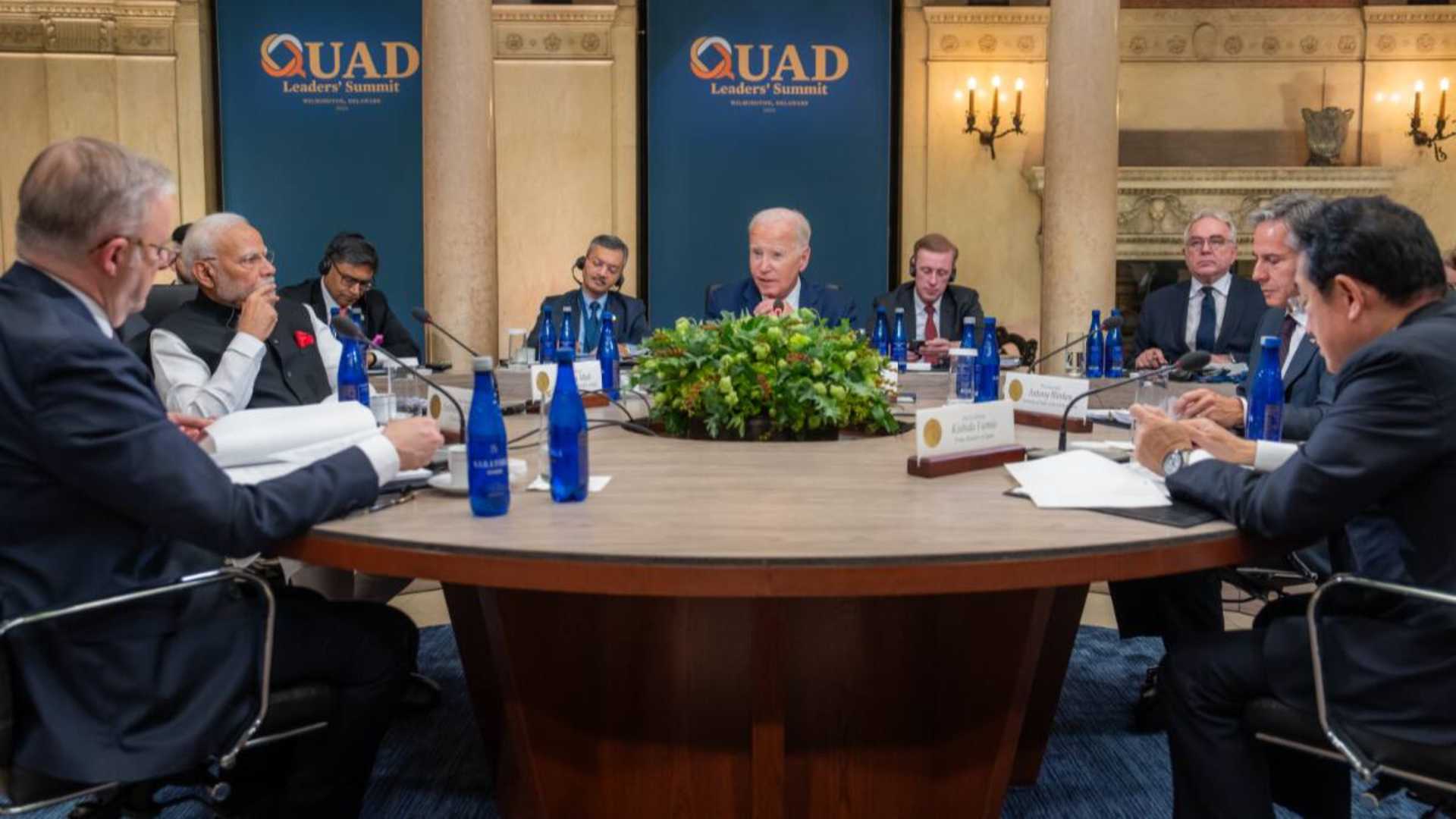
  • Six leader-level summits held between 2021–2024.

  • Last summit: 2024, Wilmington (U.S.).

  • No leader-level summit in 2025, despite India being the scheduled host.

  • Leadership changes:

    • U.S. President Donald Trump
    • Japanese Prime Minister Sanae Takaichi (October 2025)

Challenges

  • Reduced political signalling and agenda-setting.
  • Risk of perception that the Quad is losing momentum.

The institutional logic is that informal groupings rely on leadership diplomacy; without it, strategic convergence may gradually weaken.


4. Operational Continuity Through Quad Initiatives

Context

Despite summit-level disruption, the Quad continued functional cooperation in 2025, demonstrating resilience.

Key Initiatives

  • Quad-at-Sea: Ship Observer Mission

    • Operationalised in June 2025
    • Enhances Coast Guard cooperation and maritime domain awareness
  • Ports of the Future Partnership

    • First meeting: October 2025, Mumbai
    • Focus on sustainable and resilient port infrastructure
  • Malabar Naval Exercise

    • Held in Guam
    • Enhances naval interoperability
    • Quad-aligned but not formally under the Quad framework

Significance

  • Converts strategic intent into operational outcomes.
  • Maintains credibility even during diplomatic pauses.

The development logic is that functional cooperation sustains trust and relevance when political engagement slows.


5. Implications for India and the Indo-Pacific Order

For India

  • Supports strategic autonomy through issue-based alignment.
  • Strengthens India’s maritime role without formal alliance commitments.
  • Enhances capacity to shape regional norms.

For the Indo-Pacific

  • Reinforces:

    • Freedom of navigation
    • Infrastructure transparency
    • Maritime stability
  • Acts as a counterweight to coercive economic and security practices.

Risks

  • Prolonged absence of leader-level summits could dilute strategic momentum.

The strategic logic is that resilience must be matched with renewal; operational success alone cannot sustain long-term regional stability.


6. Way Forward

Policy Priorities

  • Early convening of a Quad leader-level summit in 2026.
  • Sustaining and expanding operational initiatives.
  • Strengthening diplomatic coordination without formal institutionalisation.

Long-term Focus

  • Balance security cooperation with development-oriented public goods.
  • Preserve flexibility while enhancing strategic coherence.

Conclusion

The year 2025 tested the Quad’s cohesion but affirmed its resilience. Continued operational engagement prevented strategic drift, yet long-term effectiveness depends on renewed political leadership. A revitalised Quad can remain central to maintaining a stable, rules-based Indo-Pacific order.


Quick Q&A

Everything you need to know

The Quadrilateral Security Dialogue, or Quad, is a strategic forum comprising India, the United States, Japan, and Australia. Formed initially in 2004 following the Indian Ocean tsunami, the Quad was revived in 2017 to provide a coordinated response to growing geopolitical and security challenges in the Indo-Pacific. Its primary objective is to sustain a rules-based, free, open, and inclusive Indo-Pacific that promotes regional stability and international norms.
Significance:

  • It counters rising Chinese assertiveness and expansion in the region.
  • It fosters cooperation on maritime security, disaster response, and infrastructure development.
  • It serves as a platform for like-minded democracies to coordinate on emerging challenges, including cyber security, climate change, and resilient supply chains.

Example: Operational initiatives like the Ports of the Future Partnership and the Quad-at-Sea Ship Observer Mission exemplify how the Quad translates strategic objectives into tangible regional cooperation.

The year 2025 was marked by leadership transitions that disrupted high-level coordination within the Quad. The return of President Donald Trump in the U.S. and the assumption of office by Japanese Prime Minister Sanae Takaichi meant that scheduled leader-level summits could not be convened, including the summit planned to be hosted by India. Leader-level summits are vital for conceptualizing new initiatives and achieving strategic convergence among the four nations.
Despite these challenges, operational initiatives such as the Quad-at-Sea mission, the Ports of the Future Partnership in Mumbai, and the Malabar naval exercises continued. This indicates that while summit diplomacy was temporarily disrupted, the Quad maintained its functional momentum.
Thus, 2025 can be considered a year of interregnum — testing the resilience of the Quad — but the group’s continued activity demonstrates its enduring strategic relevance in the Indo-Pacific.

The Quad operationalized its agenda through multiple mechanisms despite the lack of a summit:

  • Quad-at-Sea Ship Observer Mission: Launched in June 2025 to enhance Coast Guard-level cooperation among member nations.
  • Ports of the Future Partnership: Its maiden meet in Mumbai in October 2025 promoted sustainable and resilient port infrastructure across the Indo-Pacific.
  • Malabar Naval Exercise: Though not officially a Quad initiative, it involved all four countries to improve naval interoperability and maritime security.
Additionally, regular Foreign Minister-level summits ensured continuity in dialogue and coordination, maintaining operational momentum. Example: Even without summit-level engagement, these initiatives strengthened regional security, economic cooperation, and resilience, demonstrating the Quad’s capacity to function as a strategic force even amid political turbulence.

The Quad’s continued relevance stems from several interlinked strategic, geopolitical, and operational factors:

  • Geopolitical context: The Indo-Pacific has become a key arena for U.S.-China competition. The Quad acts as a balancing mechanism to maintain regional stability.
  • Shared values: Member countries, all democracies, coordinate to uphold a rules-based order, freedom of navigation, and transparent economic practices.
  • Operational effectiveness: Initiatives like joint naval exercises, sustainable port infrastructure programs, and Coast Guard coordination translate dialogue into tangible outcomes.

For instance, despite leadership changes in the U.S. and Japan in 2025, Quad initiatives continued, demonstrating that its agenda is underpinned by structural mechanisms rather than solely dependent on summit diplomacy.

Leadership changes in the U.S. and Japan presented both challenges and opportunities for the Quad:
Challenges:

  • Trump’s America First outlook initially raised questions about the U.S.’s commitment to multilateral engagement in the Indo-Pacific.
  • The absence of a leader-level summit in 2025 delayed high-level coordination and the formal announcement of new initiatives.
Opportunities:
  • Despite summit disruptions, Foreign Minister-level meetings and operational programs continued, reflecting continuity in strategic priorities.
  • Operational initiatives, such as Quad-at-Sea and Ports of the Future Partnership, progressed, reinforcing the Quad’s functional resilience.
Thus, while leadership transitions can disrupt political diplomacy, the Quad’s structural robustness allows it to maintain practical cooperation and regional influence effectively.

Several initiatives showcase the Quad’s commitment to regional cooperation:

  • Quad-at-Sea Ship Observer Mission: Initiated in June 2025 to improve maritime coordination among Coast Guards.
  • Ports of the Future Partnership: First convened in Mumbai in October 2025, it promotes sustainable and resilient port infrastructure across the Indo-Pacific.
  • Malabar Naval Exercise: Engages all four countries to enhance naval interoperability and collective maritime security.

These initiatives demonstrate that the Quad’s efforts extend beyond political dialogue to concrete programs that strengthen security, economic resilience, and regional trust-building, ensuring a rules-based order in the Indo-Pacific.

The year 2025 itself serves as a case study for the Quad’s resilience. Despite leadership changes in the U.S. (President Trump’s return) and Japan (Prime Minister Sanae Takaichi assuming office), the Quad continued to operationalise key initiatives:

  • Quad-at-Sea: The first Ship Observer Mission was conducted to enhance maritime coordination.
  • Ports of the Future Partnership: Its maiden meet in Mumbai promoted sustainable port infrastructure.
  • Malabar Naval Exercise: Strengthened interoperability among member navies.

Even without a leader-level summit for over a year, these activities underscored the Quad’s institutional resilience. Operational continuity maintained regional security and cooperation, highlighting that the Quad’s effectiveness does not solely depend on summit diplomacy but also on sustained practical engagement.

Attribution

Original content sources and authors

Sign in to track your reading progress

Comments (0)

Please sign in to comment

No comments yet. Be the first to comment!