
India's Strategic Absence from Trump's Board of Peace

Understanding the implications of India's absence from Trump's peace initiative amid ongoing Gaza conflict and international pressure.
GopiGopi
5 mins read
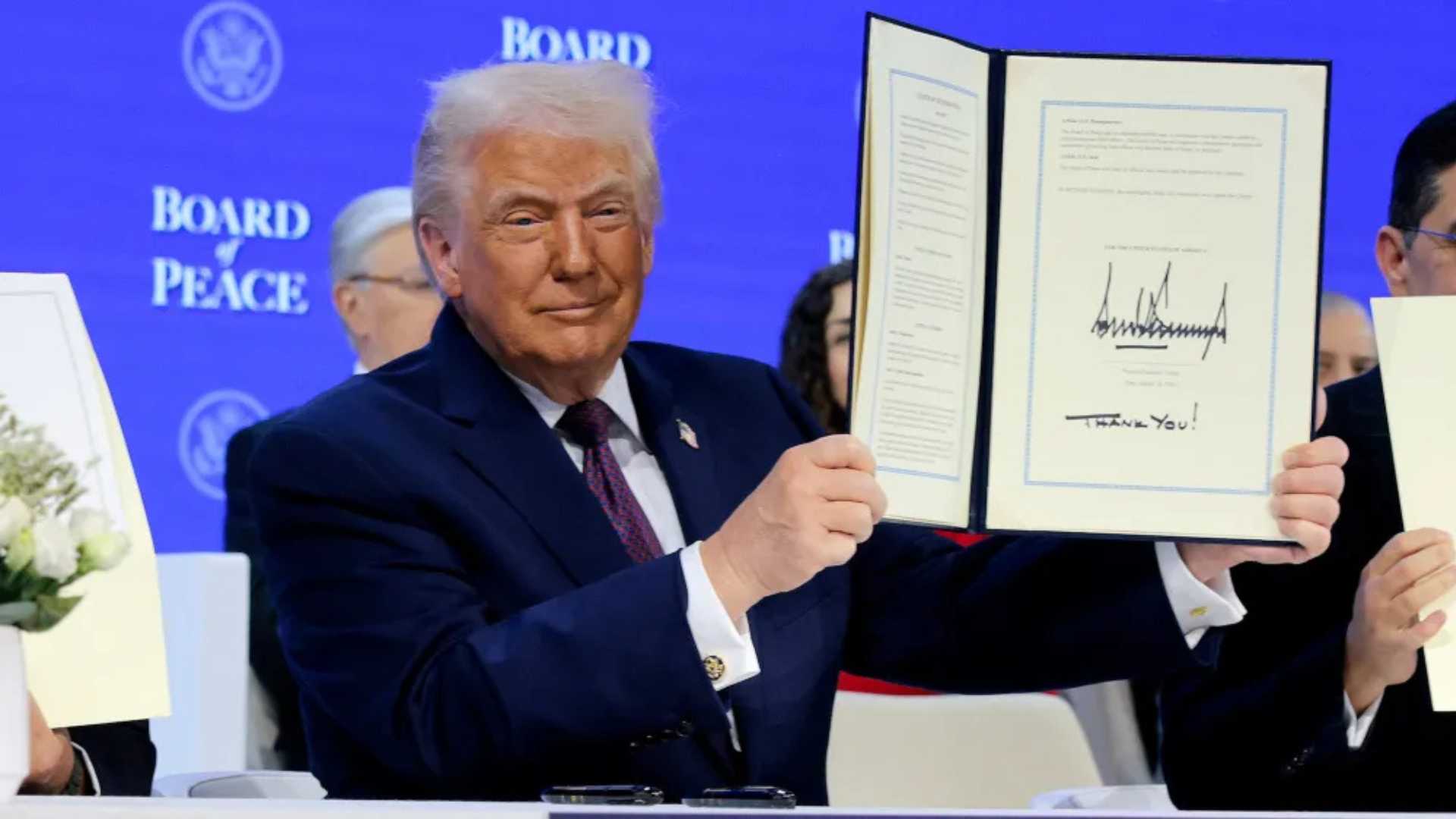
Trump inaugurates ‘Board of Peace’ at Davos amid global scepticism
Not Started

1. Background: The U.S. ‘Board of Peace’ and the Gaza Ceasefire Context

The U.S. President Donald Trump inaugurated the “Board of Peace” (BoP) at Davos in January 2026 as part of Phase 2 of the U.S.-led Gaza Peace Proposal. The initiative follows a ceasefire between Israel and Hamas, the return of all living Israeli hostages, and a UN Security Council clearance of the original proposal (with Russia and China abstaining).

The BoP is envisaged to oversee ceasefire maintenance, humanitarian assistance, reconstruction of Gaza, and facilitate talks towards a two-state solution. The proposal gained initial international traction as it halted Israel’s prolonged military campaign in Gaza, which resulted in over 70,000 Palestinian deaths, including 20,000 children, following the October 2023 Hamas attacks.

While Mr. Trump claimed 59 countries have signed on, only 19 countries were represented at the Davos ceremony, alongside the U.S. Several major democracies have either declined or deferred participation, indicating uncertainty about the body’s mandate and legitimacy.

This context highlights how post-conflict governance initiatives can gain momentum during ceasefires but still face legitimacy challenges if their structure and intent remain unclear. Ignoring these concerns risks undermining long-term peace-building efforts.


2. India’s Current Position and Strategic Dilemma

India skipped the Davos announcement despite Prime Minister Narendra Modi receiving an invitation to join the Board. Officially, New Delhi is yet to take a final call, indicating ongoing internal deliberations rather than outright rejection.

India’s dilemma arises from competing considerations. On one hand, India has historically supported the Palestinian cause, recognised Palestine, and provided sustained humanitarian assistance, including through UNRWA. Participation could allow India to directly contribute to Gaza’s reconstruction and enhance its Global South leadership credentials.

On the other hand, geopolitical pressures are evident. Key regional actors such as Saudi Arabia, the UAE, Israel, and Türkiye have joined the BoP, while strained U.S.-India trade negotiations and recent frictions in bilateral ties create incentives not to alienate Washington at an early stage.

The Indian case reflects the classic foreign policy trade-off between principled positions and pragmatic diplomacy. Premature decisions, however, can constrain strategic autonomy if institutional risks are underestimated.


3. Structural and Legitimacy Concerns with the Board of Peace

Despite UN backing for the original Gaza plan, leaked versions of the BoP charter suggest unilateral alterations. Notably, the revised mandate reportedly does not explicitly mention Gaza and proposes expanding the BoP to other conflicts, raising concerns that it may seek to supplant UN functions.

The governance structure further raises red flags. Mr. Trump has appointed himself Chairman, with personal associates and family members on the Executive Board. The top tier is restricted to heads of state, concentrating decision-making power and reducing institutional checks.

Mr. Trump’s own remarks underline this ambition:

“This is not the United States, this is for the world.” — Donald Trump
“I think we can spread it out to other things as we succeed in Gaza.” — Donald Trump

Institutional design matters for legitimacy. If governance bodies lack transparency and collective ownership, they risk becoming tools of unilateral influence rather than platforms for cooperative peace-building.


4. Exclusion of Palestinian Political Representation

A major concern is the absence of Palestinian political leadership within the BoP. While Palestinian technical experts are to be appointed, the charter excludes the recognised Palestinian leadership altogether.

This exclusion contrasts sharply with the inclusion of Israeli Prime Minister Benjamin Netanyahu, who faces genocide allegations from UN agencies. For countries like India that recognise Palestine, this asymmetry undermines the principle of sovereign equality and inclusive peace processes.

The arrangement risks reducing Palestinian agency in determining Gaza’s future, potentially weakening local legitimacy and long-term stability of any reconstruction or governance framework.

Peace processes that marginalise key stakeholders often produce fragile outcomes. Ignoring representative legitimacy can entrench grievances rather than resolve conflict.


5. Specific Red Flags for India’s National Interests

Beyond normative concerns, the BoP poses concrete strategic risks for India. Pakistan’s decision to join is particularly sensitive, as it raises the possibility of Kashmir being brought under the BoP’s conflict-resolution ambit.

The proposal for a two-tier membership structure is another concern. “Permanent” membership reportedly requires a fee of $1 billion, blurring the line between multilateral governance and pay-to-influence arrangements.

India could also face pressure to contribute troops to an International Stabilization Force (ISF), which operates outside UN frameworks. Once committed, India’s ability to dissent from unilateral or arbitrary decisions could be limited.

Key risks for India:

  • Potential internationalisation of the Kashmir issue
  • Financial and military commitments without clear decision-making safeguards
  • Reduced policy autonomy within a leader-centric institution

From a governance perspective, participation without clarity on mandate and exit options can lock states into obligations that outlast their strategic benefits.


6. International Responses and the Emerging Multilateral Divide

While several countries from West Asia, Central Asia, and the Global South have joined, notable democracies such as France, the UK, Sweden, Norway, and Slovenia have opted out, at least for now. Others, including China and Russia, remain non-committal.

Mr. Trump has alternated between projecting the BoP as a UN alternative and claiming it will work “in conjunction with the United Nations,” reflecting ambiguity about its long-term institutional role.

This mixed response underscores a broader fragmentation in global governance, where ad hoc coalitions compete with established multilateral institutions.

Such divides weaken collective action on global peace and security if parallel institutions erode trust in existing multilateral frameworks.


Conclusion

India’s decision on the Board of Peace must balance humanitarian commitment, strategic autonomy, and institutional credibility. A cautious, consultative approach—especially with Palestinian stakeholders and like-minded partners—aligns better with India’s long-term interests. Sustaining faith in inclusive, rule-based multilateralism remains critical for durable peace and stable global governance.


Quick Q&A

Everything you need to know

The Board of Peace (BoP) is an international initiative launched by U.S. President Donald Trump aimed at overseeing post-conflict stabilization, humanitarian assistance, and reconstruction, initially focusing on the Gaza Strip.

According to its charter, the BoP seeks to:

  • Promote stability and restore lawful governance in conflict-affected areas.
  • Coordinate humanitarian assistance and reconstruction funding.
  • Encourage durable peace through pragmatic, solutions-oriented approaches, sometimes independent of traditional institutions like the United Nations.

Strategic intent: While officially focused on Gaza, the BoP envisions extending its role to other global conflict zones, effectively creating a parallel mechanism to the UN. It is structured with a top tier of heads of state and an executive board, led personally by President Trump, with permanent membership available for financial contribution. Critics have raised concerns over its legitimacy, lack of representation for affected populations, and potential overlap with established multilateral institutions.

India’s non-participation in the BoP reflects a combination of principled diplomacy, strategic caution, and domestic considerations.

First, India has historically been a consistent supporter of the Palestinian cause and a provider of humanitarian aid through UNRWA. Joining a body where the Palestinian leadership is excluded would contradict India’s long-standing principled stance.

Second, the BoP is perceived as a U.S.-dominated initiative, with unilateral control and a top-tier board that does not fully represent the interests of conflict-affected populations. India must weigh the risk of legitimizing a potentially partisan body against the diplomatic benefits of participation. Third, India is consulting with partners, including the Palestinians, and assessing regional dynamics, particularly given that Pakistan, UAE, Saudi Arabia, and Turkey have joined. Overall, New Delhi is prioritizing strategic autonomy, balancing global influence with principled engagement.

Benefits: Participation could allow India to directly contribute to humanitarian relief, reconstruction, and stabilization in Gaza, strengthening its profile as a responsible global actor. It may also provide India a platform to influence multilateral conflict-resolution processes and collaborate with regional powers actively involved in Middle East diplomacy.

Risks: Joining a board dominated by the U.S. and led personally by President Trump could undermine India’s credibility as a neutral actor, especially given the absence of Palestinian representation. Additionally, the BoP’s proposal to extend its mandate to other conflicts could embroil India in disputes outside its traditional purview, including Kashmir if politicized by other members. There is also the risk of being perceived as legitimizing a parallel body that may compete with the UN, potentially affecting India’s multilateral relationships.

Conclusion: India must weigh pragmatic diplomatic gains against potential reputational, strategic, and policy costs, ensuring any decision aligns with its long-term foreign policy and principled support for Palestinian self-determination.

The BoP’s structure is a key factor in India’s cautious approach.

The top tier consists exclusively of heads of state, personally chaired by U.S. President Trump, with an executive board largely comprised of his personal associates. Membership includes a two-tier system, with permanent membership obtainable through financial contribution. The Palestinian leadership is excluded, while leaders accused of human rights violations, such as Netanyahu, are included. These structural choices challenge India’s traditional principles of impartiality and adherence to multilateral norms.

For India, this raises questions about governance, accountability, and legitimacy. Participation could entail complicity in a process where India has limited influence, and where operational decisions might bypass established UN mechanisms. Consequently, New Delhi is consulting closely with partners and affected parties to ensure any engagement is consistent with its diplomatic principles and international law obligations.

Several geopolitical dynamics shape India’s decision.

First, regional pressures: UAE, Saudi Arabia, Israel, and Turkey have joined the BoP, which could influence India diplomatically. Pakistan’s participation raises the risk of politicization of bilateral issues, particularly Kashmir.

Second, U.S.-India relations: Although India seeks to maintain strong ties with the U.S., joining hastily could be interpreted as acquiescence to unilateral American initiatives, potentially constraining India’s autonomy in multilateral diplomacy.

Third, global perception and multilateral credibility: Participation without Palestinian consent or representation may affect India’s image as a principled actor in international forums. Balancing these considerations, India is carefully assessing both strategic benefits and potential diplomatic costs before taking a formal stance.

India has historically demonstrated a blend of principle and pragmatism in international diplomacy.

For instance, in the Israel-Palestine conflict, India recognized Palestine in 1988 while simultaneously developing strong bilateral relations with Israel. This allowed India to provide humanitarian assistance and political support to Palestinians while cooperating with Israel in defense, agriculture, and technology sectors.

Similarly, India maintained a neutral stance during the Syrian civil war, contributing to humanitarian aid without directly intervening militarily. These examples underscore India’s approach of principled engagement combined with strategic pragmatism — a framework likely guiding its current deliberation on the Board of Peace, where it must weigh moral imperatives against geopolitical realities.

India should adopt a consultative and multilateral approach.

First, it must maintain dialogue with Palestinian authorities and civil society to understand their perspective and ensure any engagement aligns with their interests. Direct coordination would reinforce India’s principled stance as a supporter of Palestinian self-determination.

Second, India should coordinate with global partners such as the UN, EU, and non-aligned nations to gauge collective approaches and avoid being isolated or seen as endorsing a U.S.-centric initiative. This can include parallel humanitarian or reconstruction initiatives in Gaza under UN oversight.

Finally, India must retain flexibility, signaling openness to future participation if structural and procedural reforms are introduced in the BoP, ensuring that its engagement is both principled and pragmatic, consistent with long-term foreign policy objectives.

Attribution

Original content sources and authors

Sign in to track your reading progress

Comments (0)

Please sign in to comment

No comments yet. Be the first to comment!