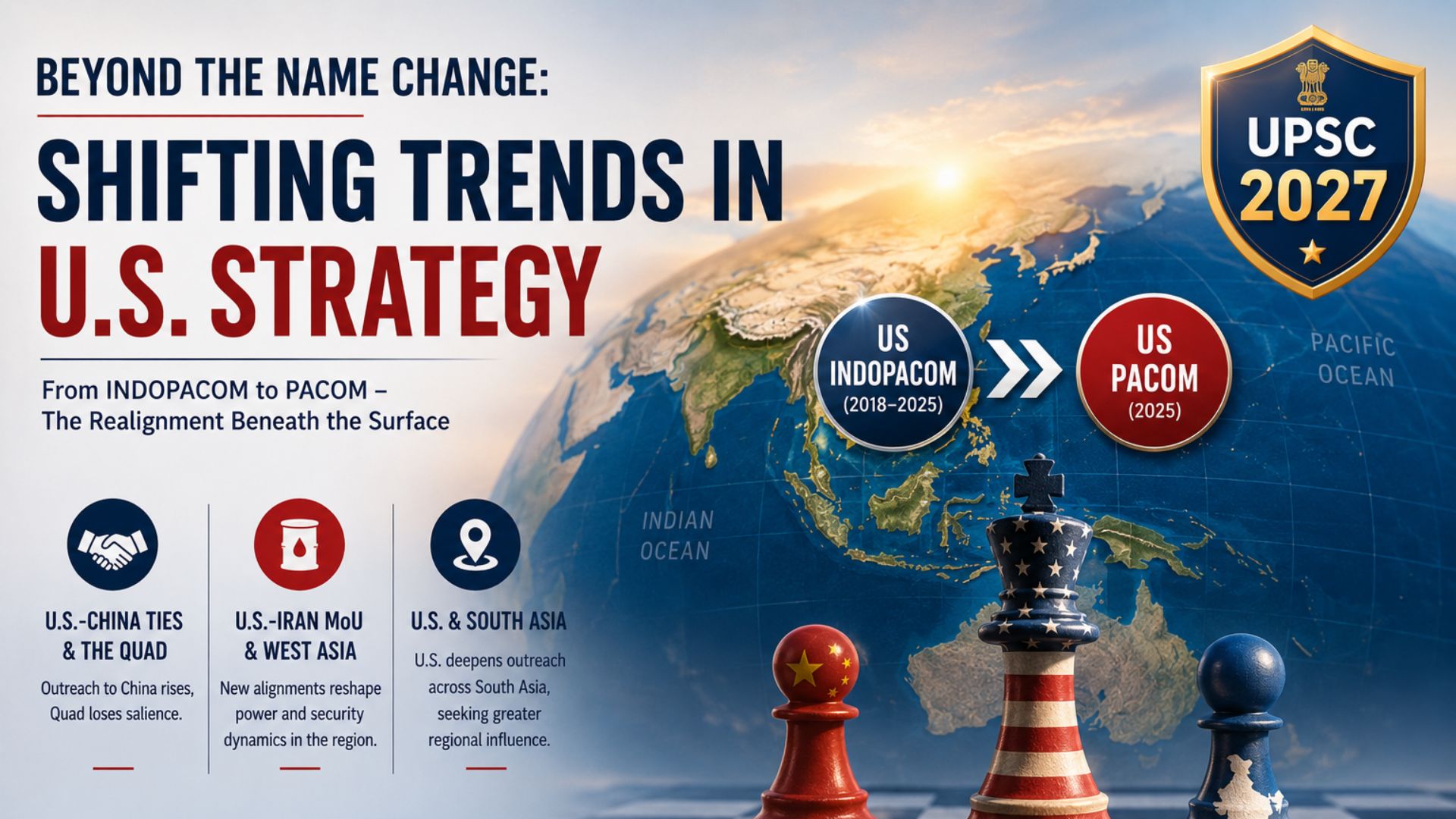
Shifting U.S. Strategic Priorities and Their Implications for India's Foreign Policy

"In international relations, strategic signals often matter more than symbolic gestures."
The United States' decision to rename its military command from US Indo-Pacific Command (INDOPACOM) back to US Pacific Command (PACOM) may appear symbolic, but it reflects deeper shifts in American strategic priorities. Along with evolving U.S. policies towards China, West Asia and South Asia, these developments require India to reassess its foreign policy and regional strategy.
Why the Name Change Matters
| Earlier (2018) | Present (2026) |
|---|---|
| US Pacific Command renamed as Indo-Pacific Command | Reverted to US Pacific Command |
| Recognised growing importance of the Indian Ocean and India | Signals reduced emphasis on the Indo-Pacific concept |
| Indo-Pacific became central to India's strategic thinking | Raises questions about future U.S. regional priorities |
The command's geographical responsibility remains unchanged, but the shift indicates a possible change in U.S. strategic focus.
Three Strategic Geographies Affecting India
1. U.S.-China Relations and the Future of the Quad
Recent developments suggest that the U.S. seeks temporary strategic accommodation with China despite long-term rivalry.
Key indicators include:
- High-level exchanges between U.S. and Chinese leadership.
- Reduced emphasis on Taiwan.
- References to a possible "G-2" world order.
- Declining strategic importance of the Quad.
The Quad appears to be narrowing its agenda.
| Earlier Objective | Present Focus |
|---|---|
| Strategic balancing of China | Maritime security |
| Broad Indo-Pacific cooperation | Economic prosperity |
| Security cooperation | Critical minerals and emerging technologies |
| Strategic coordination | Disaster response |
Challenges include:
- Limited progress on Artificial Intelligence cooperation.
- Restrictions on access to advanced U.S. AI technologies.
- Uncertainty regarding future Quad summits.
Example:
If the Quad gradually shifts from
a strategic security grouping
to a limited functional partnership,
India may need to strengthen
alternative arrangements such as
the Australia-India-Japan trilateral.
2. Changing Dynamics in West Asia
The post-conflict understanding between the U.S. and Iran indicates changing regional power equations.
Major developments include:
- U.S. commitment to reduce military presence near Iran.
- Greater Iranian influence over the Strait of Hormuz.
- Large-scale reconstruction assistance for Iran.
- Increasing diplomatic importance of Oman and Qatar.
- Gulf countries exploring new security partnerships.
These developments alter India's carefully balanced West Asia policy.
Areas requiring reassessment include:
- Dependence on Israel and the UAE.
- Compliance with U.S. sanctions on Iranian oil.
- Future of the Chabahar Port project.
3. Growing U.S. Engagement in South Asia
The appointment of a combined U.S. Ambassador to India and Special Envoy for South and Central Asia reflects expanding American regional engagement.
Recent diplomatic outreach includes visits to:
- Nepal
- Bhutan
- Bangladesh
- Sri Lanka
- Maldives
This suggests increasing competition between the U.S. and China for influence in South Asia.
At the same time:
- SAARC remains largely inactive.
- BIMSTEC faces political constraints.
- China continues expanding alternative regional mechanisms.
Example:
If regional institutions remain weak,
external powers gain greater opportunities
to shape South Asian geopolitics,
reducing India's traditional regional influence.
Implications for India
The evolving U.S. strategy presents multiple challenges.
- Reduced centrality of the Indo-Pacific concept.
- Possible weakening of the Quad as a strategic platform.
- Shifting balance of power in West Asia.
- Greater external competition in South Asia.
- Need for greater strategic autonomy in foreign policy.
India must avoid overdependence on any single strategic framework while preserving its regional leadership.
Way Forward
- Continue pursuing a policy of strategic autonomy.
- Strengthen alternative maritime partnerships such as the Australia-India-Japan trilateral.
- Revitalise regional institutions including SAARC and BIMSTEC.
- Reassess India's West Asia policy in light of evolving geopolitical realities.
- Enhance engagement with Indian Ocean regional organisations.
- Deepen bilateral partnerships across Southeast Asia, the Gulf and Africa.
- Maintain balanced relations with both major powers while safeguarding national interests.
Conclusion
The renaming of the U.S. military command is less significant than the broader strategic shifts it represents. Changes in U.S. relations with China, West Asia and South Asia indicate an evolving geopolitical landscape that directly affects India's security and foreign policy. To protect its long-term interests, India must reinforce strategic autonomy, strengthen regional institutions and proactively shape the evolving regional order rather than merely responding to external realignments.
Attribution
Original content sources and authors


Syllabus classification
How this article maps to GS papers
Main syllabus
GS2International RelationsQuick Q&A
What is the Indo-Pacific strategic concept, and how do recent changes in United States strategic signalling affect India's foreign policy and maritime interests?
Critically analyse how changing United States-China relations could reshape the Quad and influence India's strategic autonomy in the Indo-Pacific region.
How should India recalibrate its foreign policy towards West Asia in light of evolving geopolitical alignments involving the United States, Iran, Israel and Gulf countries?
What are the major reasons behind increasing geopolitical competition in South Asia, and how should India respond to preserve its regional leadership?
Using recent shifts in United States strategic priorities as a case study, explain how India can strengthen its strategic autonomy while adapting to an increasingly multipolar world order.
Practice questions
2 questions for mains preparation