The G2 Handshake: Does China-US Rapprochement Help or Hurt India?

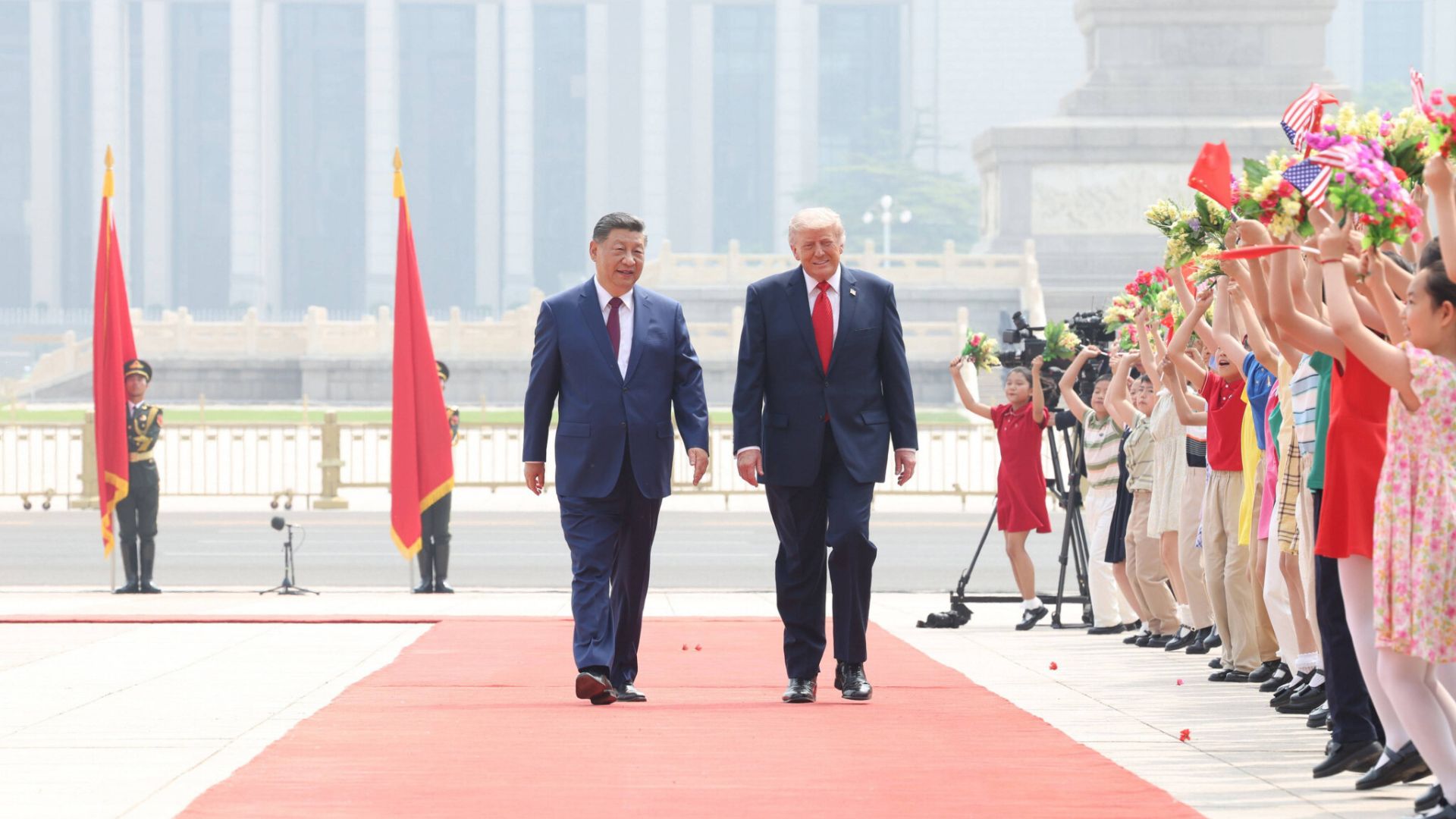
After a nine-year hiatus, US President Donald Trump landed in Beijing — and the world took notice. Compared to the Mao-Nixon meeting of 1972, the summit signals something larger than trade deals: the quiet consolidation of a G2 world order, where two superpowers set the rules and everyone else navigates around them. For India, sitting outside this arrangement, the question is neither celebratory nor paranoid — it is strategic.
What the Summit Actually Delivered
- Both leaders agreed on a "constructive relationship of strategic stability" — providing bilateral guidance for the next three years
- 17 American business titans flew to Beijing, including Elon Musk, Tim Cook, and Jensen Huang (NVIDIA) — the last reportedly boarding Air Force One at the last minute
- Trade outcomes included a Board of Trade, Board of Investment, agricultural market access agreements, and reciprocal tariff reductions
- On Taiwan, Trump was explicit: "I'm not looking to have somebody go independent and we're supposed to travel 9,500 miles to fight a war" — Beijing read this as Washington accepting its red lines
- On AI, both sides agreed coordination is crucial — signalling that tech decoupling has practical limits
Summit Pillars          China's Framing         Strategic Reality
────────────────────────────────────────────────────────────────
Trade                   "Ballast stone"         Tariff war paused, not ended
Tech/AI                 "Bellwether"            Supply chain decoupling slowing
People-to-people        "Lubricant"             Soft power competition continues
Taiwan                  "Red line respected"    Ambiguity managed, not resolved
Why India Cannot Simply Cheer This
China's official commentary assures India that the rapprochement is good for everyone. That deserves scrutiny:
- The Quad dimension: US-China stability could reduce Washington's urgency to deepen security commitments with India — the threat perception that animates the Quad partially loses its edge
- The trade asymmetry: India runs a significant trade deficit with China (~$85 billion). A US-China trade normalisation benefits Chinese exports globally — India's manufacturing competitiveness narrative gets harder to sustain if Chinese goods flow more freely
- CPEC and neighbourhood: No amount of diplomatic warmth addresses China's continued infrastructure presence in Pakistan-occupied territory — India's core security concern remains structurally unchanged
- Border reality: The LAC disengagement of 2024 was fragile. China-US stability at the top does not translate into Chinese restraint at the border
Where India's Strategic Autonomy Actually Stands
China's op-ed explicitly endorses India's "foreign policy of strategic autonomy" — which is itself a signal. Beijing prefers an autonomous India over an India firmly in the US camp.
- India's multi-vector diplomacy — Quad, SCO, BRICS, bilateral partnerships — remains its strongest asset
- But strategic autonomy without economic weight is rhetorical. India's leverage depends on becoming an indispensable manufacturing and technology node — not just a swing vote
- The BRICS expansion and India's G20 presidency have built diplomatic capital. The question is whether India converts that into rule-shaping power, not just participation
Way Forward
- India must resist the binary: China-US rapprochement is neither a threat to be feared nor a gift to be welcomed — it is a structural shift requiring recalibration
- Accelerate manufacturing depth: If US-China supply chains stabilise, India's "China+1" opportunity window narrows — urgency on PLI execution matters more now
- Deepen Quad's non-military dimensions — technology, health, and infrastructure — so it survives fluctuations in US-China temperature
- Engage China bilaterally on India's terms: Border stability, trade rebalancing, and CPEC concerns must be addressed directly — not via multilateral reassurances
- On AI governance, India must shape global standards through ISA, GPAI, and bilateral frameworks — not cede that space to a G2 consensus
Conclusion
The Beijing Moment is real — but its meaning for India depends entirely on what India does next. A stable G2 reduces the risk of great-power war, which benefits everyone. But it also risks marginalising middle powers who lack the economic or technological weight to shape the rules being written. India's answer cannot be anxiety — it must be acceleration. Strategic autonomy is only meaningful when backed by strategic capability. The handshake in Beijing should be India's reminder, not its reassurance.
Attribution
Original content sources and authors

Syllabus classification
How this article maps to GS papers
Main syllabus
GS2International RelationsQuick Q&A
What is the strategic significance of the recent China-U.S. summit in the context of contemporary global geopolitics?
The summit has implications beyond bilateral ties. China and the U.S. influence global trade, technology, financial systems, and international institutions. Their cooperation affects commodity markets, energy prices, and supply chains. For example, previous tensions over tariffs and semiconductor restrictions disrupted global manufacturing and inflation trends.
From a UPSC perspective, this summit illustrates the concept of great power management. Similar to Nixon’s 1972 visit to China, such diplomatic engagements reshape alliances and regional equations. It reflects how summit diplomacy can reduce uncertainty, reassure markets, and create strategic predictability in a multipolar world.
Why is economic and technological cooperation considered the foundation of China-U.S. relations despite strategic rivalry?
Technology cooperation is equally significant. The presence of major business leaders such as Elon Musk, Tim Cook, and Jensen Huang demonstrates that private sector interests often push against political decoupling. Areas like AI, semiconductors, and renewable technologies require cross-border collaboration because innovation ecosystems are globally integrated.
A practical example is AI governance. Unregulated AI development may pose security and ethical risks globally. Cooperation between China and the U.S. on standards, regulation, and innovation can benefit humanity. Thus, strategic competition coexists with selective cooperation in areas of mutual gain.
How does the Taiwan issue continue to remain the central red line in China-U.S. relations?
For the United States, Taiwan occupies a strategic position in the Indo-Pacific. It lies along critical sea lanes and is central to semiconductor production. While the U.S. officially follows the One-China policy, it also maintains security relations with Taiwan, creating strategic ambiguity.
The issue can escalate beyond bilateral tensions. A conflict in the Taiwan Strait could disrupt global shipping and chip supplies, affecting economies including India. Therefore, both sides emphasise prudence. This demonstrates how territorial disputes can become flashpoints for wider international crises.
Critically analyse whether China-U.S. rapprochement can constrain India’s strategic autonomy.
However, closer China-U.S. coordination may affect India in certain sectors. For instance, if the U.S. softens technology restrictions on China, India’s role as an alternative manufacturing destination may face competition. Likewise, strategic convergence may alter U.S. attention toward Indo-Pacific balancing.
Yet India’s policy of strategic autonomy remains robust. India simultaneously engages with the U.S. through QUAD, with Russia for defense, and with China through BRICS and SCO. This diversified diplomacy ensures flexibility. Therefore, rapprochement may reshape opportunities but does not fundamentally constrain India’s independent foreign policy.
What lessons can India draw from China-U.S. people-to-people and scientific exchanges?
India can replicate this model in regional diplomacy. Greater student exchanges, research partnerships, and tourism cooperation with neighboring countries can improve regional trust. For example, India’s scholarships to BIMSTEC and ASEAN students serve this purpose.
Scientific collaboration is equally important. Joint work in AI, healthcare, and clean energy creates shared interests that discourage conflict. India can deepen scientific partnerships under G20, BRICS, and bilateral frameworks to strengthen both development and diplomacy.
As a case study, how could stable China-U.S. relations influence India’s economic and foreign policy choices?
At the same time, India may need to recalibrate economic strategy. If China regains stronger access to U.S. markets and investments, India’s ambition to attract manufacturing under ‘Make in India’ may face increased competition. Policymakers would need to focus on ease of doing business and infrastructure competitiveness.
Diplomatically, India gains room for balanced engagement. It can continue strategic partnerships with the U.S. while expanding cooperation with China through BRICS and regional institutions. Thus, stability between major powers often creates opportunities for middle powers like India to strengthen multialignment.
Practice questions
1 question for mains preparation