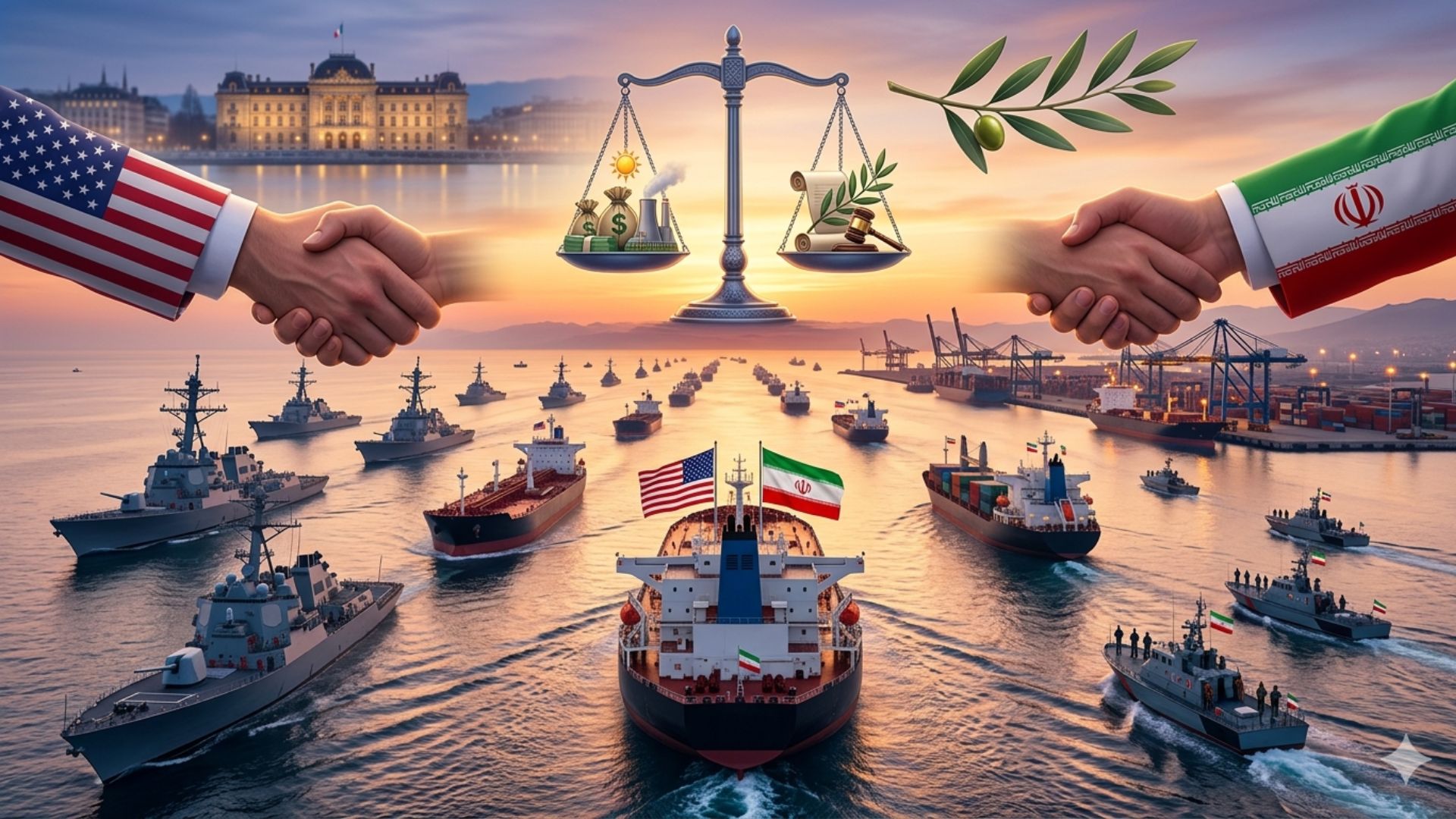
U.S.-Iran Peace Deal: Opening the Strait of Hormuz

Why in News?
The United States and Iran have reached a preliminary agreement to end the war that began in February 2026, remove maritime restrictions in the Gulf region, and initiate negotiations on Iran's nuclear programme and Western sanctions.
The agreement was digitally signed on June 14, 2026, while an in-person signing ceremony is scheduled in Geneva on June 19, 2026.
“The Deal with the Islamic Republic of Iran is now complete… Ships of the World, start your engines. Let the oil flow!” — U.S. President Donald Trump
Background to the Conflict
Timeline of Key Events
| Date | Development |
|---|---|
| February 28, 2026 | U.S. and Israel launched military operations against Iran |
| Post-war period | Iran took control of the Strait of Hormuz |
| April 12, 2026 | U.S. imposed naval blockade on Iranian ports in the Gulf of Oman |
| June 14, 2026 | Digital signing of preliminary peace agreement |
| June 19, 2026 | Proposed formal signing ceremony in Geneva |
The blockade followed failed direct negotiations between Washington and Tehran in Islamabad.
Major Provisions of the Agreement
Security and Military Measures
Both sides agreed to:
- Immediate and permanent termination of military operations.
- End hostilities across all fronts.
- Remove the U.S. naval blockade against Iran.
- Extend the ceasefire for a 60-day period while negotiations continue.
Iran's Supreme National Security Council stated:
“The war and military operations on all fronts, including Lebanon, are ended immediately and permanently.”
Strait of Hormuz: Strategic Importance
The Strait of Hormuz connects:
- Persian Gulf
- Gulf of Oman
- Arabian Sea
It is among the world's most important energy chokepoints.
Persian Gulf
      ↓
Strait of Hormuz
      ↓
Gulf of Oman
      ↓
Arabian Sea
      ↓
Global Energy Markets
Developments
- Iran had assumed control over the Strait after the outbreak of war.
- The U.S. announced removal of its naval blockade.
- Trump stated that oil shipments had already begun moving through the waterway.
“Ships are starting to move, many loaded up with oil, out of the Strait of Hormuz.”
Transit Arrangements
Iran clarified:
-
No transit tolls would be imposed.
-
Charges may apply for:
- Navigation services
- Environmental protection
- Ship insurance
- Maritime support services
Economic and Financial Dimensions
A major component of the understanding involves Iranian financial assets frozen abroad.
Iranian Position
Iran insists that:
- Release of frozen assets is essential.
- Compensation for war-related damages must be addressed.
“The release of the frozen Iranian assets as well as the reparations for damages are two essential points.”
Divergent Claims
| Issue | Iranian Position | U.S. Position |
|---|---|---|
| Frozen assets | Release required | No immediate cash payment promised |
| Reparations | Essential component | No detailed commitment publicly disclosed |
| Asset release reports | Mehr reported $24 billion release | U.S. officials have not confirmed |
According to Iranian media reports, final negotiations may begin only after partial asset release and complete lifting of restrictions.
Nuclear Programme and Sanctions Negotiations
The preliminary agreement does not settle core disputes.
Instead, it creates conditions for future talks on:
- Iran's nuclear programme
- Western sanctions
- Long-term regional security arrangements
Negotiation Framework
- Ceasefire to remain in force for 60 days.
- Technical discussions to occur during this period.
- Core negotiations will proceed after implementation of initial commitments.
Ceasefire
      ↓
Implementation of Commitments
      ↓
Technical Meetings
      ↓
Nuclear & Sanctions Talks
      ↓
Final Agreement
Role of Pakistan as Mediator
Pakistan played a central diplomatic role in facilitating negotiations.
Prime Minister Shehbaz Sharif confirmed:
- Immediate cessation of military operations.
- Ongoing mediation efforts.
- Organization of pre-implementation meetings before formal signing.
This highlights Pakistan's emergence as an important intermediary in regional diplomacy.
The Lebanon Dimension
Iran considers developments in Lebanon inseparable from the broader agreement.
According to Tehran:
- Ending the conflict in Lebanon is part of the understanding.
- The U.S. must ensure Israeli compliance with commitments.
However, significant differences remain.
Israeli Position
Israeli Defence Minister Israel Katz stated:
- Israeli troops would remain in occupied areas of southern Lebanon.
- Any Iranian attack would be met with force.
Domestic Debate in Israel
Opposition leader Yair Lapid criticized the government's handling of the conflict, arguing that Israel had suffered a diplomatic setback on the Iranian front.
Key Challenges Ahead
- Verification of ceasefire implementation.
- Removal of naval restrictions.
- Release of frozen Iranian assets.
- Agreement on war reparations.
- Future of Iran's nuclear programme.
- Israeli-Iranian tensions regarding Lebanon.
- Building trust during the 60-day negotiation window.
Way Forward
- Ensure transparent implementation of ceasefire commitments.
- Establish independent monitoring mechanisms.
- Facilitate phased negotiations on sanctions and nuclear issues.
- Maintain uninterrupted maritime security in the Strait of Hormuz.
- Address humanitarian, economic, and reconstruction concerns.
- Encourage sustained multilateral diplomatic engagement.
Conclusion
The preliminary U.S.–Iran agreement marks a significant de-escalation in a conflict that threatened regional stability and global energy security. While the reopening of maritime routes and cessation of hostilities provide immediate relief, critical issues—including sanctions, nuclear negotiations, frozen assets, reparations, and the Lebanon question—remain unresolved. The success of the agreement will ultimately depend on implementation, mutual trust, and sustained diplomatic engagement.
Attribution
Original content sources and authors
.jpeg)

Syllabus classification
How this article maps to GS papers
Main syllabus
GS2International RelationsQuick Q&A
What is the significance of the preliminary United States-Iran peace agreement and its implications for regional stability and global energy security?
Why is the reopening of the Strait of Hormuz considered strategically important for global trade and energy markets?
How do sanctions, frozen assets, and nuclear negotiations influence the diplomatic relationship between the United States and Iran?
What are the major reasons behind the involvement of mediators such as Pakistan in the United States-Iran peace process?
What are the major challenges and controversies surrounding the implementation of the United States-Iran peace agreement?
What practical examples and historical precedents demonstrate the importance of diplomacy in resolving international conflicts?
How can the 2026 United States-Iran agreement be analysed as a case study in conflict resolution and international diplomacy?
Practice questions
1 question for mains preparation