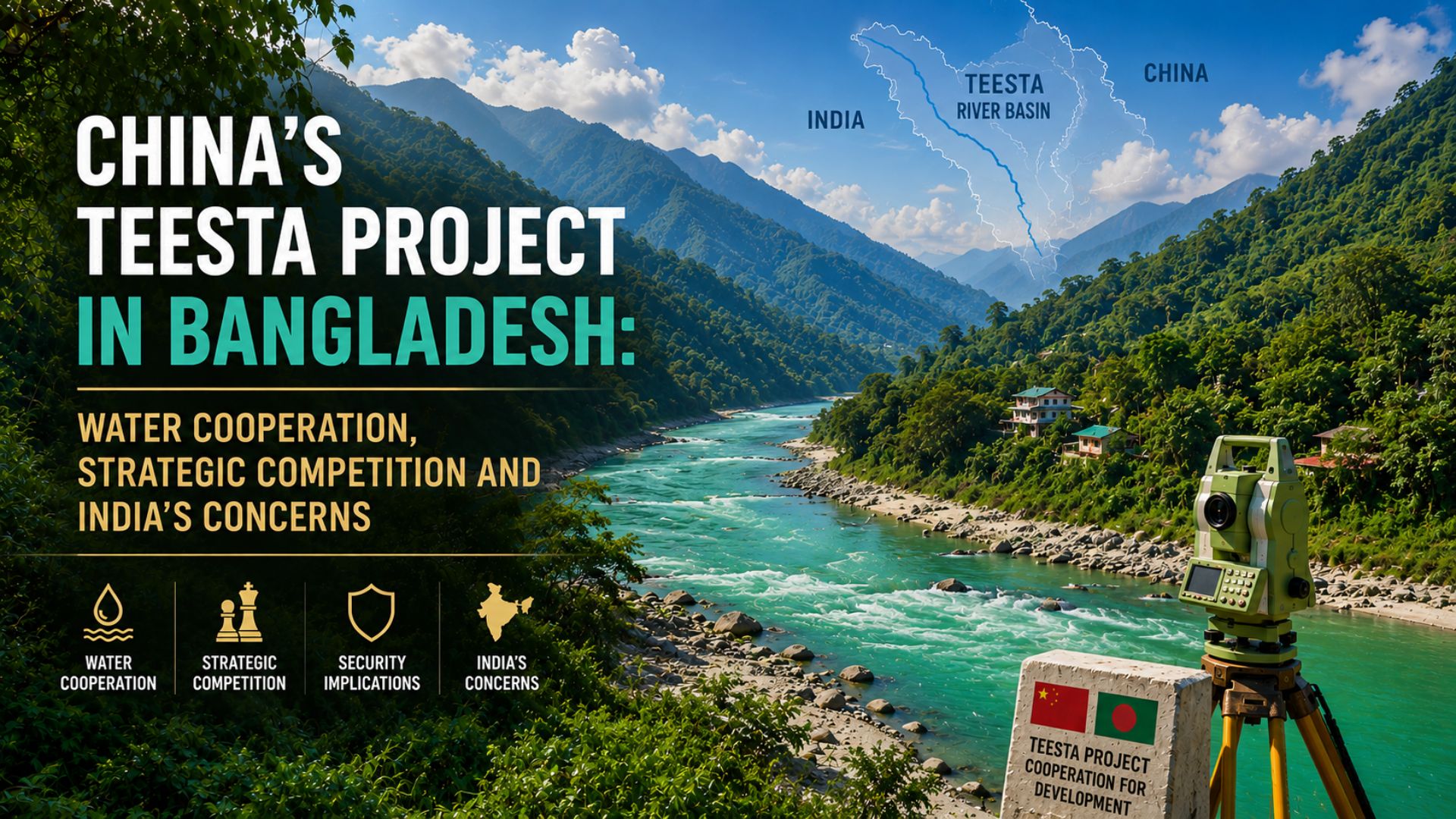
China’s Teesta Project in Bangladesh: Water Cooperation, Strategic Competition and India’s Concerns

"Shared rivers are not merely sources of water; they are instruments of diplomacy, development and strategic influence."
The proposed Teesta River Comprehensive Management and Restoration Project has re-emerged as an important geopolitical issue after Bangladesh Prime Minister Tarique Rahman secured Chinese assurances during his June 2026 visit to Beijing. Beyond river management, the project reflects the growing intersection of water security, regional diplomacy and strategic competition in South Asia.
Why is the Teesta Project significant?
China and Bangladesh have discussed Teesta's development since 2016, with the cooperation continuing across successive governments.
| Chinese Proposal | Key Features |
|---|---|
| River restoration | Dredging 140 million m³ of sediment |
| Land reclamation | 171 sq km reclaimed |
| Flood control | Repair of 110 km and construction of 124 km of embankments |
| Connectivity | 224 km road network |
| Inland transport | 82 jetty facilities |
| Environmental management | Riverbank erosion control, disaster reduction and ecological preservation |
The project focuses on Bangladesh's downstream stretch of the Teesta and therefore does not alter the river's upstream course inside India.
Objective:
Restore river flow → Reduce floods → Improve irrigation →
Enhance transport → Generate economic development
Why does Bangladesh seek such a project?
Northern Bangladesh depends heavily on the Teesta for agriculture.
Major beneficiary districts include:
- Nilphamari
- Rangpur
- Dinajpur
- Bogura
- Joypurhat
- Gaibandha
The principal challenge arises during the December-February dry season, when river discharge falls sharply, affecting irrigation for paddy and vegetable cultivation.
To address this, Bangladesh constructed the Teesta Barrage Irrigation Project (TBIP) in the 1990s, its largest irrigation scheme. However, reduced river flow has repeatedly affected its functioning, including the closure of barrage gates during low-flow periods.
Problem Cycle

Low winter discharge
        ↓
Reduced irrigation storage
        ↓
Lower agricultural productivity
        ↓
Economic losses in northern Bangladesh
Why is the Teesta equally important for India?
The Teesta originates from the Cholamu (Tso Lhamu) Lake in Sikkim before flowing through West Bengal into Bangladesh.
India utilises the river for:
- Hydropower generation through multiple projects in Sikkim.
- Irrigation via the Gajoldoba Barrage in West Bengal.
- Water supply for agriculture in West Bengal, Sikkim and Assam.
- Tourism and ecological conservation, including migratory bird habitats.
Thus, India also has significant developmental dependence on the river.
Why has the India-Bangladesh water-sharing agreement remained unresolved?
India and Bangladesh negotiated an interim Teesta water-sharing agreement around 2010-11.
However, the agreement was not signed during Prime Minister Manmohan Singh's 2011 Dhaka visit due to objections from the Government of West Bengal.
Joint Statement (2011): Both Prime Ministers agreed to conclude Teesta and Feni river agreements "on a fair and equitable basis" at the earliest.
Despite repeated discussions by former Prime Minister Sheikh Hasina with India, including renewed technical consultations in 2024, a final agreement has not materialised.
India also proposed financing nearly a US$1 billion Teesta management project inside Bangladesh before the political transition in Dhaka.
Why does China's involvement concern India?
The project extends beyond infrastructure into strategic geography.
| Indian Concern | Explanation |
|---|---|
| Strategic proximity | Project lies near the Siliguri Corridor ("Chicken's Neck"), India's narrow link with the Northeast. |
| Chinese presence | Long-term deployment of Chinese engineers and technical personnel near a sensitive region. |
| Strategic capability | POWERCHINA possesses expertise in large infrastructure with links to China's strategic sectors. |
Bangladesh, however, argues that it routinely undertakes international infrastructure projects involving foreign experts, citing examples such as:
- Ruppur Nuclear Power Plant (Russia and other foreign personnel)
- Padma Bridge constructed with Chinese assistance.
Broader implications
The Teesta issue illustrates multiple dimensions simultaneously:
- Water security and food security are closely interconnected.
- Transboundary rivers require cooperative basin-level management.
- Domestic federal politics can influence international treaty-making.
- Infrastructure projects increasingly carry geopolitical significance.
- China's expanding footprint in South Asia continues to reshape regional strategic dynamics.
Way Forward
- Conclude an equitable India-Bangladesh Teesta Water Sharing Agreement based on scientific assessment.
- Strengthen the Joint Rivers Commission for continuous basin management.
- Promote integrated river basin planning involving ecology, irrigation and disaster management.
- Increase data sharing on river flows and flood forecasting.
- Ensure transparency in third-country infrastructure projects to minimise strategic mistrust.
- Encourage trilateral cooperation where developmental interests converge without compromising sovereignty.
Conclusion
The Teesta is no longer merely a river-sharing dispute but a test of cooperative water governance, neighbourhood diplomacy and strategic balancing in South Asia. A sustainable solution lies in reconciling developmental needs with ecological sustainability while fostering mutual trust among regional stakeholders. As climate variability intensifies pressure on shared rivers, cooperative management will become indispensable for long-term regional stability.
Attribution
Original content sources and authors


Syllabus classification
How this article maps to GS papers
Main syllabus
GS2Neighbourhood RelationsAlso covers
Quick Q&A
What is the Teesta River Comprehensive Management and Restoration Project, and why has it emerged as a strategically significant issue in India-Bangladesh-China relations?
Why has the sharing of Teesta River waters remained unresolved despite decades of negotiations between India and Bangladesh, and what factors have complicated the issue?
How does the Teesta River influence the economic, environmental and strategic interests of both India and Bangladesh, and what lessons does it offer for transboundary river governance?
Critically analyse China's growing involvement in the Teesta River project and assess its implications for India's neighbourhood policy and regional strategic environment.
How can the Teesta River dispute serve as a case study for understanding the challenges and opportunities of water diplomacy, cooperative federalism and regional cooperation in South Asia?
Practice questions
1 question for mains preparation