Introduction
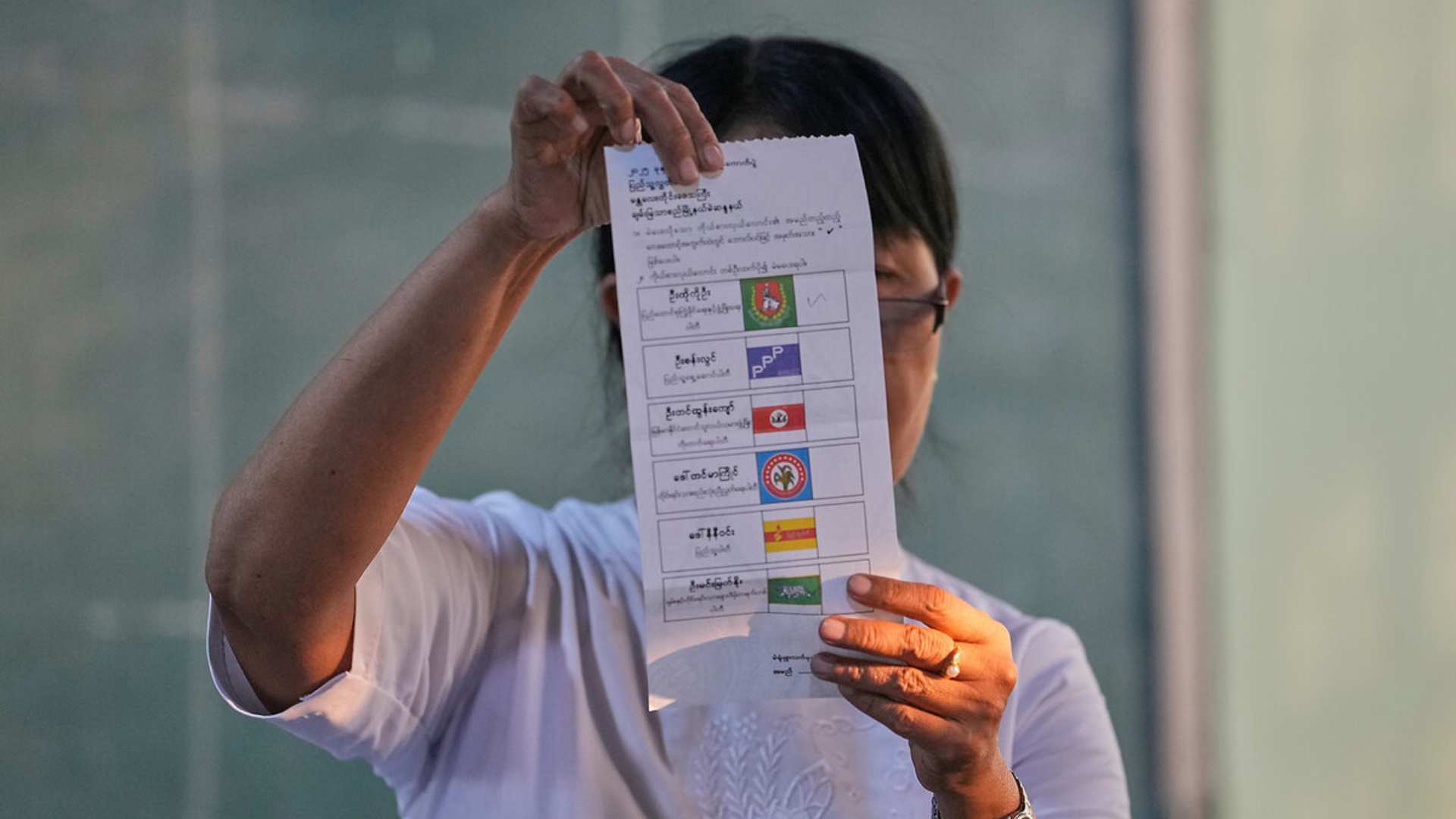
Myanmar's military-conducted elections (December 2025 – January 2026) reveal a country where democratic form has been hollowed of democratic substance. The USDP — the military's civilian vehicle — has swept a Parliament engineered to legitimise authoritarian rule, not reflect popular will.
"The significance of Myanmar's recent election lies not in what it has achieved, but in what it reveals — a country that remains, fundamentally, unresolved."
"Elections are not primarily about democracy; they are instruments through which the military has sought to manage, contain, or eliminate political forces."
| Indicator | 2015 & 2020 Elections | 2025–26 Elections |
|---|---|---|
| Voter turnout | ~70% | 54–55% (official) |
| Major opposition | NLD participated | NLD excluded |
| Conflict zone participation | Largely included | Largely absent |
| Electoral character | Competitive | Predetermined |
Background and Context
Myanmar's Political Timeline:
| Period | Key Development |
|---|---|
| 2008 | Military-drafted Constitution — guaranteed 25% parliamentary seats to military |
| 2010 | Quasi-civilian rule begins under Thein Sein |
| 2011 | Historic meeting between Thein Sein and Aung San Suu Kyi — democratic opening |
| 2015 & 2020 | NLD wins landslide elections; ~70% voter turnout |
| Feb 1, 2021 | Military coup; Suu Kyi detained; State Administration Council (SAC) takes power |
| 2025–26 | Military-conducted elections; new Parliament convenes March 2026 |
The 2008 Constitution — Built-in Military Control:
- Reserves 25% of parliamentary seats for military appointees.
- Gives military control over three key ministries: Home, Defence, Border Affairs.
- Allows military intervention under declared emergencies — the constitutional basis for the 2021 coup.
Key Concepts
Procedural Legitimacy vs. Democratic Legitimacy: Myanmar's military has consistently used the form of democracy — elections, parliaments, constitutions — without its substance. The 2026 election exemplifies this: Opposition parties excluded, conflict zones disenfranchised, outcomes predetermined. This is a textbook case of electoral authoritarianism — where elections serve regime consolidation rather than popular representation.
Ethnic Federalism vs. Military Centralism: Myanmar has over 135 recognised ethnic groups. Ethnic Armed Organisations (EAOs) along the periphery have fought decades-long civil wars against the Bamar-dominated central authority. The democratic opening of 2010–2021 offered a framework — however imperfect — to negotiate federal arrangements. The coup has destroyed that framework, and EAOs have expanded territorial control significantly since 2021.
Patchwork Governance: Post-coup Myanmar is no longer governed through a single chain of authority. Three parallel governance structures now operate:
- Military-SAC controlled urban and plains areas.
- EAO-controlled peripheral regions (Chin, Kachin, Karen, Shan states).
- Resistance-aligned People's Defence Force (PDF) zones in contested areas.
Electoral Outcome: 2026 Parliament
| House | Total Seats | USDP Seats Won | Military Reserved Seats | Effective Military Control |
|---|---|---|---|---|
| Lower House (Pyithu Hluttaw) | 330 contested | 231+ | 110 (25%) | Dominant majority |
| Upper House (Amyotha Hluttaw) | Contested | 108 | 56 (25%) | Dominant majority |
Parliament convened: Lower House (March 16), Upper House (March 18), State/Regional Assemblies (March 20, 2026).
Implications and Challenges
For Myanmar's Internal Stability:
- Ethnic armed groups have expanded control since 2021 — the election does not address, let alone resolve, these territorial realities.
- Healthcare and education systems have collapsed in conflict zones — structural damage with generational consequences.
- Economic activity has retreated into informal channels; formal economic integration is severely disrupted.
For India:
- Myanmar shares a 1,643 km border with India (Arunachal Pradesh, Nagaland, Manipur, Mizoram).
- Instability in Myanmar directly fuels insurgency networks, cross-border arms and drug trafficking, and refugee pressures into India's Northeast.
- India's Act East Policy and connectivity projects (Kaladan Multimodal Transit, India-Myanmar-Thailand Trilateral Highway) are at risk.
- India must balance its democratic values against strategic interests — particularly given China's deepening foothold in Myanmar.
For ASEAN:
- Myanmar's internal collapse tests ASEAN's foundational principle of non-interference and its capacity for collective action.
- The ASEAN Five-Point Consensus (April 2021) — calling for cessation of violence and inclusive dialogue — has made negligible progress.
- Myanmar's instability risks becoming a template for military impunity within the regional bloc.
The China Factor:
- China shares a long border with Myanmar and has significant economic investments (pipelines, ports, SEZs).
- Post-coup, Myanmar's military has deepened ties with China and Russia, absorbing Western sanctions through alternative support networks.
- China's influence gives it de facto veto power over any externally brokered settlement.
The NLD's Moral Complexity
The NLD, despite its global democratic credentials, faces serious credibility questions:
- During 2015–2021, the NLD defended military actions in Rakhine State against Rohingya, including at the International Court of Justice.
- Suu Kyi's government refused to use the term "Rohingya," adopting state-sanctioned terminology instead.
- This undermined the NLD's moral authority as a genuinely inclusive democratic force.
However, in Opposition since 2021, NLD-aligned forces have shown greater willingness to engage with Rohingya representatives and acknowledge citizenship questions — a significant, if belated, shift.
Key Data Points for Exam Answers
- Myanmar population: ~55 million
- 2015 & 2020 voter turnout: ~70%
- 2025–26 voter turnout (official): 54–55% (likely lower in conflict zones)
- USDP seats (Lower House): 231+ of 330 contested
- Military reserved seats: 25% of all parliamentary seats (2008 Constitution)
- India-Myanmar border: 1,643 km
- Recognised ethnic groups: 135+
Conclusion
Myanmar's 2026 election is not a democratic milestone — it is a mirror held up to the limits of procedural democracy when stripped of genuine pluralism. The military's consistent strategy of using constitutional instruments to contain rather than accommodate political diversity has produced a fractured, ungovernable state. For India, Myanmar represents both a security challenge and a diplomatic test — demanding calibrated engagement that protects strategic interests without endorsing authoritarian consolidation. More broadly, Myanmar's crisis is a cautionary tale for Asia: durable stability cannot be imposed through electoral theatre. It must be built on the genuine accommodation of ethnic, linguistic, and political diversity — a lesson as relevant to India's neighbourhood as it is to Myanmar itself.