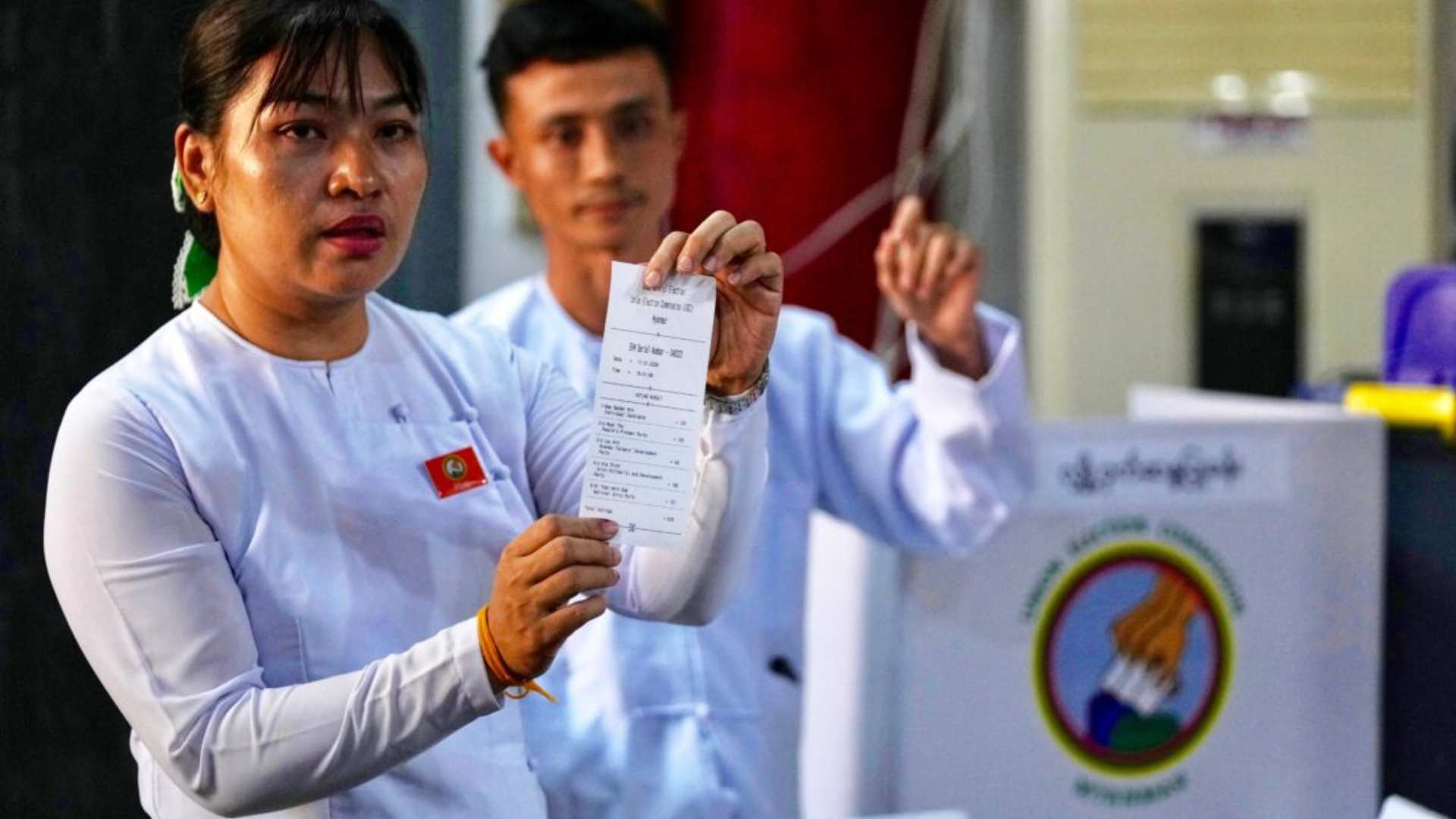
1. Context: Myanmar’s Post-Coup Elections and the Illusion of Political Normalcy
Five years after the February 1, 2021 military coup, Myanmar’s junta conducted elections in three phases between December 2025 and January 2026, projecting them as a return to constitutional order. Predictably, the military-backed Union Solidarity and Development Party (USDP) secured victory, reinforcing perceptions of a pre-scripted political exercise rather than democratic renewal.
Voting was permitted in only 265 of 330 townships, largely confined to urban wards, as vast rural areas remain under resistance control. This selective participation significantly undermined representativeness and legitimacy, exposing the elections as an administrative mechanism rather than a political settlement.
The junta claimed a 55% voter turnout (13.14 million of 24 million eligible voters), a sharp fall from the nearly 70% turnout in 2015 and 2020. This decline signals popular rejection of military-managed processes rather than electoral fatigue.
In governance terms, elections held without territorial control, political inclusivity, and security cannot confer legitimacy; ignoring this risks mistaking procedural form for substantive democracy.
2. Issue: Systematic Exclusion and Militarisation of the Political Space
The credibility deficit was deepened by the junta-appointed Union Election Commission, which dissolved major opposition parties, including the National League for Democracy (NLD), and jailed senior leaders such as Daw Aung San Suu Kyi and U Win Myint. This effectively eliminated electoral competition.
Senior General Min Aung Hlaing fielded serving and retired military officials under the USDP banner, ensuring institutional continuity of military power through civilian facades. The Parliament to be formed within two months is therefore structurally skewed.
Elections conducted under incarceration, party bans, and armed conflict violate core democratic principles of choice and contestation.
The political logic is that when electoral arenas are militarised, elections become instruments of control, not representation, perpetuating instability rather than resolving it.
3. Context: Civil War Conditions and the Expanding Resistance
Since the coup, Myanmar has descended into widespread violence. At least 7,738 people have been killed, over 30,000 arrested, with 22,767 still in detention, and 11,497 sentenced, often on political charges. These figures highlight the human cost of authoritarian consolidation.
More than 1,13,000 houses and structures have been destroyed, especially in Sagaing and Magway, intensifying displacement and economic collapse. This brutality has catalysed resistance rather than compliance.
The People’s Defence Forces, operating alongside ethnic armed organisations, now control large territories, including 91 towns, significantly constraining the junta’s post-election authority.
Ignoring the conflict environment risks assuming state capacity where fragmentation prevails, leading to flawed diplomatic and policy assumptions.
4. Implications: Why Elections Have Not Altered Conflict Dynamics
Despite electoral claims, resistance groups retain decisive influence across Myanmar. The USDP’s victory does not translate into effective governance on the ground, suggesting that the conflict is likely to intensify rather than stabilise.
The elections have failed to produce a political settlement acceptable to key stakeholders, reinforcing cycles of violence and fragmentation.
This disconnect between formal institutions and territorial realities weakens state coherence and undermines prospects for economic recovery.
From a development perspective, political legitimacy is a prerequisite for stability; elections that bypass social consent deepen conflict traps.
5. India’s Position: Strategic Interests and Democratic Signalling
Myanmar is central to India’s Act East Policy, serving as a land bridge to Southeast Asia and sharing a 1,643-km border with four northeastern States. Consequently, instability directly affects India’s security and connectivity interests.
India’s official position, reiterated by MEA spokesperson Randhir Jaiswal, maintains support for a “free, fair and inclusive” democratic process involving all stakeholders. This calibrated language avoids legitimising the elections while preventing diplomatic rupture.
New Delhi has also clarified that Indians present during the elections did so in a personal capacity, signalling deliberate political distance from the process.
The diplomatic logic lies in preserving strategic engagement without normative endorsement; ignoring this balance could either erode principles or compromise security.
6. Engagement without Endorsement: India’s Pragmatic Diplomacy
High-level engagement has continued despite political caution. At the SCO meeting in August 2025, Prime Minister Narendra Modi met Senior General Min Aung Hlaing, reviewing bilateral ties while emphasising inclusive elections.
India has also sustained humanitarian engagement, including relief and medical assistance under Operation Brahma following the March 2025 earthquake, and the establishment of a temporary field hospital.
This dual-track approach allows India to remain relevant and responsive without conferring political legitimacy on the junta.
Effective neighbourhood policy often requires separating humanitarian and strategic engagement from political endorsement.
7. Implications for India: Security, Refugees, and Connectivity
Instability in Myanmar directly impacts India’s internal security. India currently hosts 90,100 displaced Myanmar nationals in Mizoram and Manipur, straining State capacities in the absence of a national refugee policy.
Infrastructure projects such as the Kaladan Multi-Modal Transit Transport Project and the India–Myanmar–Thailand Trilateral Highway face persistent delays due to insecurity, forcing reassessment of timelines and risk exposure.
Non-traditional security threats have escalated, including narcotics trafficking, human trafficking, and cybercrime. Notably, 2,165 Indians have been rescued since 2022 from cyber scam and cyber slavery networks operating in Myanmar’s conflict zones.
Impacts:
- Border instability and refugee inflows
- Delayed strategic connectivity projects
- Rise of transnational crime and cyber insecurity
Failure to address these spillovers holistically risks exporting instability into India’s border regions.
8. The Path Ahead: Managing a Fractured Neighbourhood
With ASEAN and several regional and Western actors withholding recognition of the election outcomes, India’s balanced approach gains relevance. Limited engagement with the regime, alongside outreach to local actors, allows flexibility amid uncertainty.
Myanmar’s elections have not marked a political turning point. Instead, they underline the persistence of state fragmentation and contested legitimacy.
For India, navigating this landscape requires sustained pragmatism, issue-based engagement, and readiness for prolonged instability.
Neighbourhood diplomacy in conflict settings demands patience, adaptability, and acceptance of imperfect outcomes.
Conclusion
Myanmar’s post-coup elections have reinforced, rather than resolved, political fragmentation and conflict. For India, they highlight the enduring challenge of balancing democratic principles with strategic imperatives in its neighbourhood. Sustained engagement, humanitarian commitment, and security preparedness will remain essential as New Delhi manages relations with a deeply fractured neighbour amid uncertain regional dynamics.