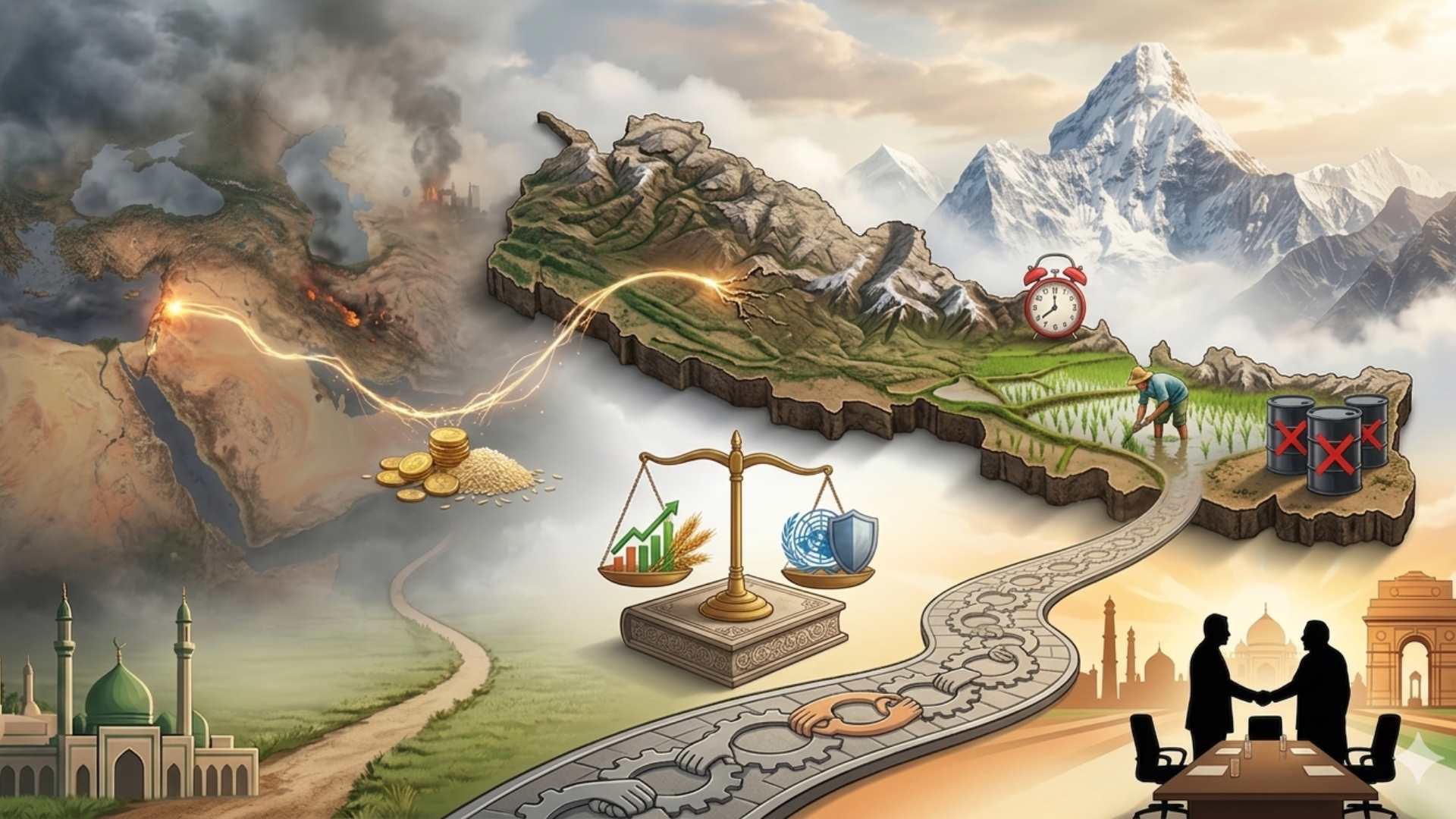
Nepal's Foreign Policy Reorientation & India-Nepal Relations
Introduction
India and Nepal share one of South Asia's most complex bilateral relationships — bound by an open border, deep civilisational ties, and the 1950 Treaty of Peace and Friendship, yet periodically strained by territorial disputes, economic dependence, and great-power competition. Nepal's remittance economy — contributing over 25% of GDP — makes it acutely vulnerable to regional conflicts. With a new Gen-Z government under PM Balendra Shah (Rastriya Swatantra Party) taking office in 2025, India-Nepal ties enter a potentially reset phase, even as the West Asia conflict tests Kathmandu's economic resilience.
"Non-alignment and territorial integrity are not negotiable — but fast economic growth is our priority." — Shisir Khanal, Nepal's Foreign Minister (2025)
Nepal's Remittance Vulnerability: Key Data
| Indicator | Data |
|---|---|
| Nepalis working in Gulf/West Asia | ~2 million |
| Remittance share of Nepal's GDP | ~25–27% |
| Nepal citizens killed in West Asia conflict | 1 |
| Nepal citizens injured | 27 |
| India-Nepal bilateral mechanisms | 40+ |
Background: Structural Features of India-Nepal Relations
Treaties & Framework:
- 1950 Treaty of Peace and Friendship — open border, special privileges for citizens of both nations
- 1996 Mahakali Treaty — hydropower cooperation
- BIMSTEC & SAARC — multilateral engagement platforms
Chronic Irritants:
- 2015 economic blockade — perceived by Nepal as Indian pressure during constitution drafting
- Territorial disputes: Kalapani-Lipulekh-Limpiyadhura (Nepal's claim vs. India's position)
- China's expanding BRI footprint in Nepal — India's strategic concern
- Perception gap: Nepal sees India as overbearing; India sees Nepal drifting toward Beijing
The New Government's Foreign Policy Posture
Continuity:
- Non-alignment as constitutional principle
- Territorial integrity and sovereignty as non-negotiable
- Nepal's "equidistance" between India and China continues
Change in approach:
- Structured, mechanism-first diplomacy before political visits
- Economic growth as the primary foreign policy driver
- Emphasis on prioritising Nepal's needs before engaging India's 40+ bilateral mechanisms
- Democratic consolidation: rule of law, anti-corruption focus — no political vendetta against previous leadership
West Asia Conflict: Impact on Nepal
Nepal is a non-party but deeply affected state — a textbook case of how regional conflicts produce asymmetric global spillovers.
| Impact Area | Nature of Challenge |
|---|---|
| Remittances | Risk of exodus of 2 million Gulf workers |
| Fuel prices | Import-dependent economy absorbs full price shock |
| Fertiliser supply | Rice planting season threatened |
| Food security | Compounded by landlocked geography |
| Macroeconomic stability | Multiplier effect on inflation and trade deficit |
Pakistan's diplomatic role: Islamabad hosted inconclusive U.S.-Iran ceasefire talks — Nepal's FM welcomed South Asia's visibility in global diplomacy, reflecting a broader SAARC-region interest in conflict resolution beyond its borders.
India-Nepal Reset: Opportunities & Challenges
Opportunities:
- PM Modi's early congratulatory outreach signals India's priority for Nepal ties
- Mechanism-first approach (technical visits → ministerial → PM visit) is mature diplomacy
- Shared interest in hydropower, connectivity, and trade facilitation
- Gen-Z leadership less ideologically rigid; more transactional and growth-oriented
Challenges:
- Territorial disputes remain structurally unresolved
- 2015 blockade memory still shapes Nepali public opinion and political discourse
- China offers Nepal BRI infrastructure without political conditionalities — India must compete on delivery
- Domestic political instability in Nepal (frequent government changes) makes sustained engagement difficult
NCERT Connect
- Class 12 Political Science — Contemporary World Politics: Non-Alignment Movement, South-South cooperation
- Class 12 Political Science — Politics in India since Independence: India's neighbourhood policy
- Geography Class 11: Landlocked countries and trade dependency
Conclusion
Nepal's new government represents both an opportunity and a test for India's neighbourhood-first policy. The structured, mechanism-driven approach to PM Shah's visit suggests a more self-assured Kathmandu — one that will engage New Delhi on its own terms rather than as a dependent partner. For India, the imperative is clear: deliver on connectivity, hydropower, and economic integration before China's infrastructure diplomacy deepens Nepal's westward pivot. The West Asia conflict is a reminder that South Asia's economic fragility — rooted in remittance dependence and import vulnerability — demands deeper regional cooperation, not just bilateral optics.
Attribution
Original content sources and authors
Syllabus classification
How this article maps to GS papers
Main syllabus
GS2Neighbourhood RelationsQuick Q&A
What are the key ways in which a distant geopolitical conflict, such as the West Asia war, can impact a landlocked and remittance-dependent economy like Nepal?
Key channels of impact include:
- Remittance Disruptions: Job losses or insecurity among migrant workers can reduce inflows, affecting GDP and foreign exchange reserves.
- Energy Price Shock: Rising global fuel prices increase import bills, worsening trade deficits and inflation.
- Supply Chain Disruptions: Essential imports like fertilizers become scarce or expensive, impacting agriculture.
Broader implications: As a landlocked country, Nepal depends on external trade routes and global markets. Thus, global shocks have a multiplier effect. For instance, during the 2022 Ukraine crisis, similar fuel and fertilizer price spikes were observed globally. This highlights the vulnerability of small economies to external shocks and the need for diversification and resilience-building strategies.
Why is the stability of West Asia crucial for South Asian countries like Nepal, despite geographical distance?
Key reasons include:
- Employment Hub: Gulf countries employ millions of South Asian workers, including Nepalis, Indians, and Bangladeshis.
- Energy Security: West Asia is a primary source of crude oil; instability leads to price volatility globally.
- Financial Stability: Remittances form a significant share of GDP in countries like Nepal, making them sensitive to regional disruptions.
Geopolitical implications: Conflicts in West Asia often draw global powers, affecting international trade routes and financial markets. For example, disruptions in the Strait of Hormuz can spike oil prices globally. Thus, stability in West Asia is not just regional but a global economic necessity, particularly for developing economies dependent on external income and imports.
How can Nepal manage the economic risks arising from global conflicts and external dependencies?
Policy measures include:
- Remittance Diversification: Expanding labor markets beyond the Gulf to regions like Southeast Asia and Europe.
- Energy Transition: Investing in hydropower and renewable energy to reduce dependence on imported fuel.
- Agricultural Self-Reliance: Strengthening domestic fertilizer production and sustainable farming practices.
Institutional and diplomatic strategies: Nepal can leverage regional cooperation frameworks like SAARC and BIMSTEC to ensure supply chain stability. For example, India-Nepal cooperation in energy trade can reduce Nepal’s fuel vulnerabilities. Long-term resilience requires structural reforms, including improving domestic industries and reducing overdependence on a single sector like remittances.
Critically analyze Nepal’s foreign policy approach of non-alignment in the context of evolving global and regional geopolitics.
Advantages:
- Strategic Flexibility: Nepal can engage with multiple partners like India, China, and the U.S. without formal alliances.
- Preservation of Sovereignty: Avoids external interference in domestic affairs.
- Balanced Diplomacy: Helps manage relations between competing powers, especially India and China.
Limitations:
- Limited Leverage: Small states may struggle to assert interests without strong alliances.
- Economic Constraints: Non-alignment may limit access to strategic investments or security guarantees.
Conclusion: In a multipolar world, non-alignment remains relevant but requires adaptation. ‘Multi-alignment’ or issue-based partnerships may better serve Nepal’s economic and security interests while retaining its core principles.
Provide examples of how regional diplomacy and bilateral mechanisms can help resolve tensions between neighboring countries like India and Nepal.
Examples include:
- Joint Commission Meetings: Regular high-level dialogues address trade, connectivity, and security issues.
- Boundary Working Groups: Help resolve territorial disputes such as the Kalapani issue.
- Energy Cooperation: Agreements on hydropower projects and electricity trade benefit both nations.
Case study: After the 2015 blockade and subsequent tensions, both countries gradually restored ties through diplomatic engagement and economic cooperation. Recent emphasis on 40+ bilateral mechanisms shows the importance of structured dialogue.
Conclusion: Continuous engagement, mutual respect, and institutional frameworks are essential for managing conflicts between neighbors. Diplomacy, rather than confrontation, remains the most effective tool for long-term stability.
As a policymaker in Nepal, how would you address the dual challenge of maintaining democratic stability while ensuring accountability in cases of corruption and political unrest?
Policy approach:
- Rule of Law: Ensure fair and transparent investigations into corruption and money laundering cases.
- Avoid Political Vendetta: As stated by the government, refrain from using state machinery for revenge politics.
- Strengthen Institutions: Empower independent bodies like anti-corruption commissions and judiciary.
Case example: Countries like South Korea have successfully prosecuted high-level corruption cases while maintaining democratic norms. Nepal can adopt similar institutional safeguards.
Way forward: Political reconciliation, inclusive governance, and adherence to democratic values are crucial. Transparency, accountability, and public participation must guide governance to ensure long-term stability and legitimacy.
Practice questions
1 question for mains preparation