Introduction
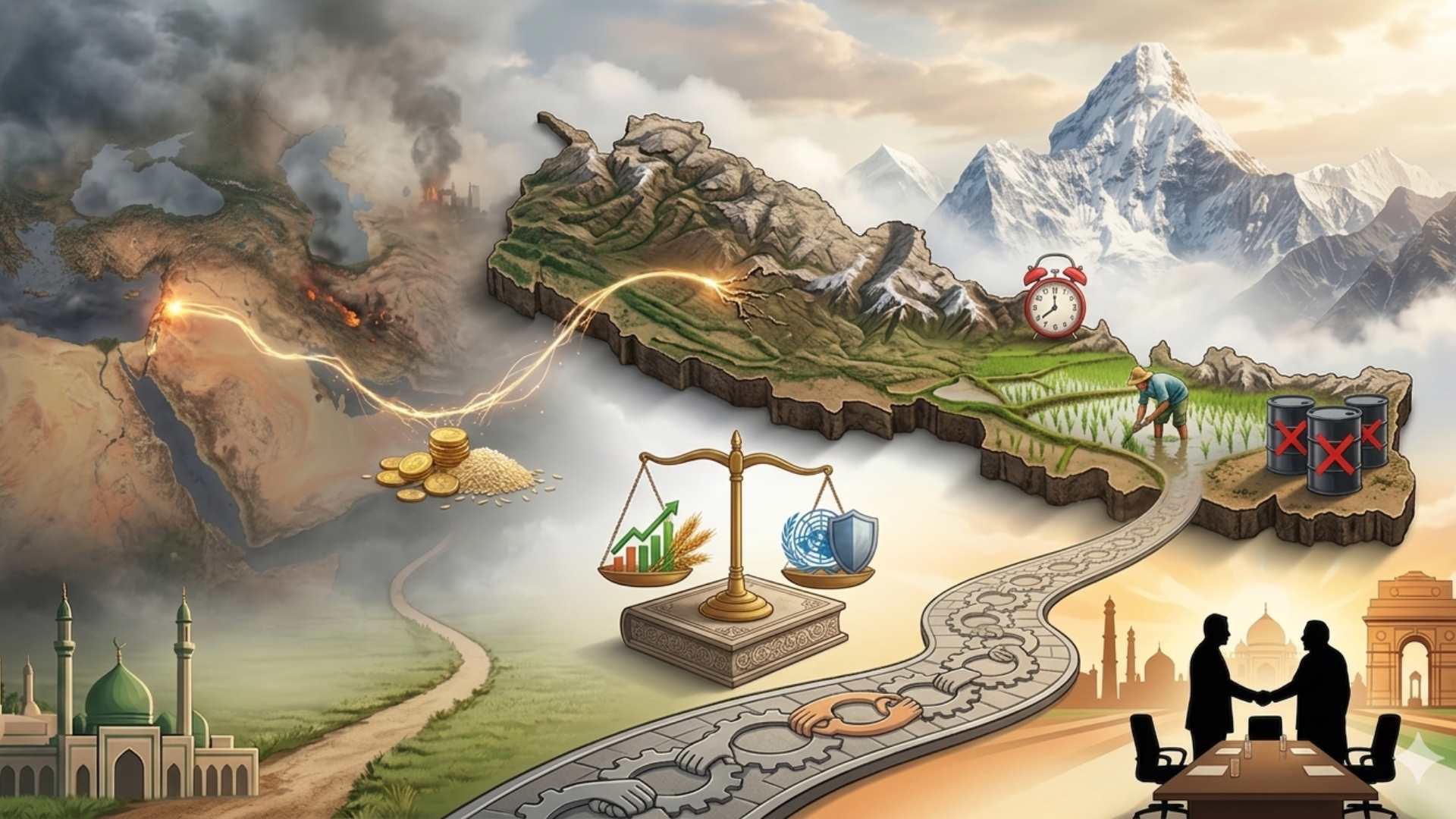
India and Nepal share one of South Asia's most complex bilateral relationships — bound by an open border, deep civilisational ties, and the 1950 Treaty of Peace and Friendship, yet periodically strained by territorial disputes, economic dependence, and great-power competition. Nepal's remittance economy — contributing over 25% of GDP — makes it acutely vulnerable to regional conflicts. With a new Gen-Z government under PM Balendra Shah (Rastriya Swatantra Party) taking office in 2025, India-Nepal ties enter a potentially reset phase, even as the West Asia conflict tests Kathmandu's economic resilience.
"Non-alignment and territorial integrity are not negotiable — but fast economic growth is our priority." — Shisir Khanal, Nepal's Foreign Minister (2025)
Nepal's Remittance Vulnerability: Key Data
| Indicator | Data |
|---|---|
| Nepalis working in Gulf/West Asia | ~2 million |
| Remittance share of Nepal's GDP | ~25–27% |
| Nepal citizens killed in West Asia conflict | 1 |
| Nepal citizens injured | 27 |
| India-Nepal bilateral mechanisms | 40+ |
Background: Structural Features of India-Nepal Relations
Treaties & Framework:
- 1950 Treaty of Peace and Friendship — open border, special privileges for citizens of both nations
- 1996 Mahakali Treaty — hydropower cooperation
- BIMSTEC & SAARC — multilateral engagement platforms
Chronic Irritants:
- 2015 economic blockade — perceived by Nepal as Indian pressure during constitution drafting
- Territorial disputes: Kalapani-Lipulekh-Limpiyadhura (Nepal's claim vs. India's position)
- China's expanding BRI footprint in Nepal — India's strategic concern
- Perception gap: Nepal sees India as overbearing; India sees Nepal drifting toward Beijing
The New Government's Foreign Policy Posture
Continuity:
- Non-alignment as constitutional principle
- Territorial integrity and sovereignty as non-negotiable
- Nepal's "equidistance" between India and China continues
Change in approach:
- Structured, mechanism-first diplomacy before political visits
- Economic growth as the primary foreign policy driver
- Emphasis on prioritising Nepal's needs before engaging India's 40+ bilateral mechanisms
- Democratic consolidation: rule of law, anti-corruption focus — no political vendetta against previous leadership
West Asia Conflict: Impact on Nepal
Nepal is a non-party but deeply affected state — a textbook case of how regional conflicts produce asymmetric global spillovers.
| Impact Area | Nature of Challenge |
|---|---|
| Remittances | Risk of exodus of 2 million Gulf workers |
| Fuel prices | Import-dependent economy absorbs full price shock |
| Fertiliser supply | Rice planting season threatened |
| Food security | Compounded by landlocked geography |
| Macroeconomic stability | Multiplier effect on inflation and trade deficit |
Pakistan's diplomatic role: Islamabad hosted inconclusive U.S.-Iran ceasefire talks — Nepal's FM welcomed South Asia's visibility in global diplomacy, reflecting a broader SAARC-region interest in conflict resolution beyond its borders.
India-Nepal Reset: Opportunities & Challenges
Opportunities:
- PM Modi's early congratulatory outreach signals India's priority for Nepal ties
- Mechanism-first approach (technical visits → ministerial → PM visit) is mature diplomacy
- Shared interest in hydropower, connectivity, and trade facilitation
- Gen-Z leadership less ideologically rigid; more transactional and growth-oriented
Challenges:
- Territorial disputes remain structurally unresolved
- 2015 blockade memory still shapes Nepali public opinion and political discourse
- China offers Nepal BRI infrastructure without political conditionalities — India must compete on delivery
- Domestic political instability in Nepal (frequent government changes) makes sustained engagement difficult
NCERT Connect
- Class 12 Political Science — Contemporary World Politics: Non-Alignment Movement, South-South cooperation
- Class 12 Political Science — Politics in India since Independence: India's neighbourhood policy
- Geography Class 11: Landlocked countries and trade dependency
Conclusion
Nepal's new government represents both an opportunity and a test for India's neighbourhood-first policy. The structured, mechanism-driven approach to PM Shah's visit suggests a more self-assured Kathmandu — one that will engage New Delhi on its own terms rather than as a dependent partner. For India, the imperative is clear: deliver on connectivity, hydropower, and economic integration before China's infrastructure diplomacy deepens Nepal's westward pivot. The West Asia conflict is a reminder that South Asia's economic fragility — rooted in remittance dependence and import vulnerability — demands deeper regional cooperation, not just bilateral optics.