GS2 Neighbourhood Relations

Khanal reiterates Nepal's claim over Kalapani

Nepal's Stance on the India Border Dispute: No Third-Party Mediation

Foreign Minister Shisir Khanal emphasizes diplomatic processes while asserting Nepal's claims on Kalapani-Lipulekh-Limpiyadhura trijunction.
Dhinesh Balasubramanian Dhinesh Balasubramanian
4 mins read

“Neighbourhood relations are strongest when historical disputes are managed alongside future-oriented cooperation.”

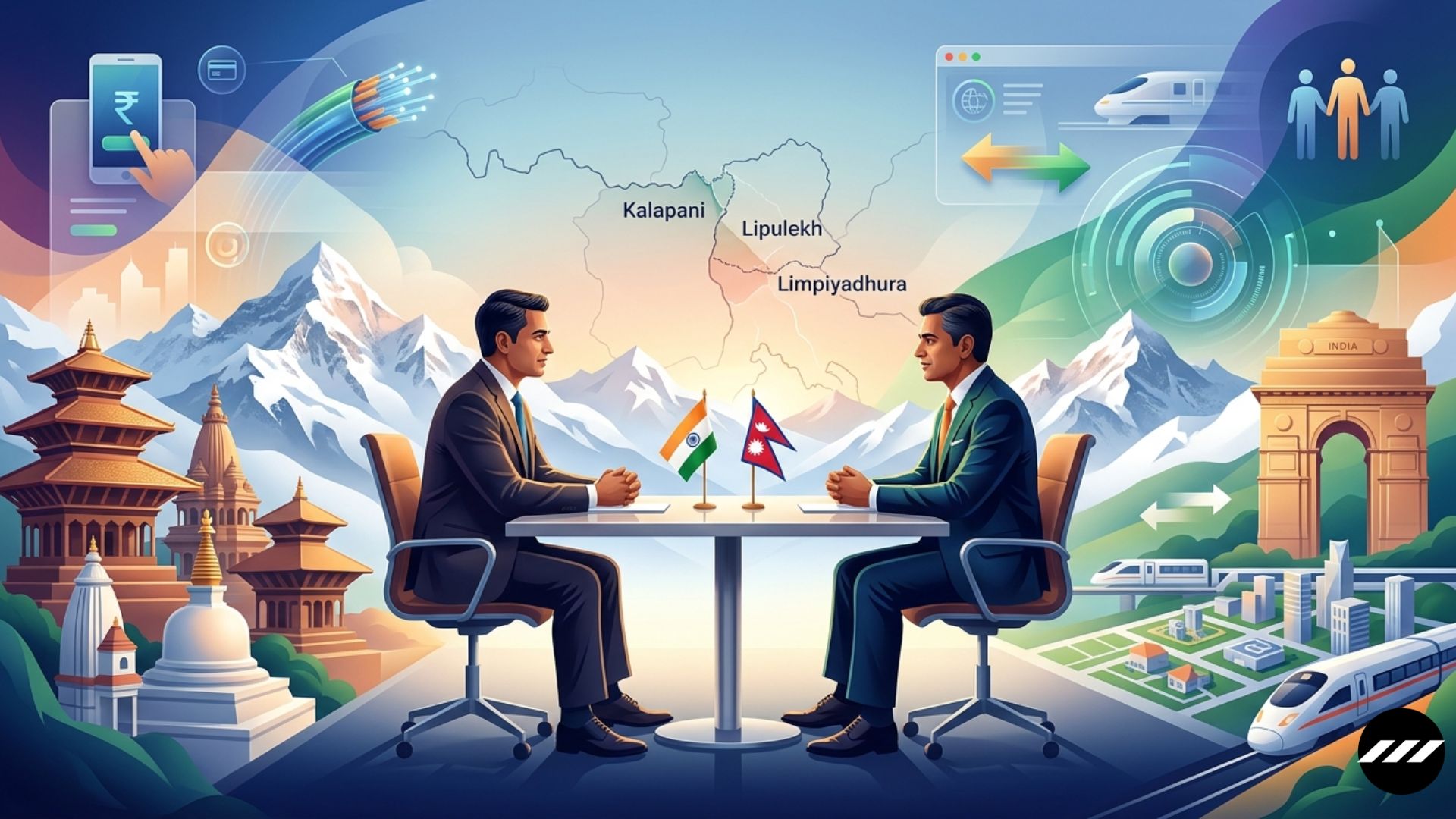
Recent statements by Nepal’s Foreign Minister Shisir Khanal during his visit to New Delhi have highlighted both the continuing border dispute over Kalapani-Lipulekh-Limpiyadhura and Nepal's desire to redefine bilateral relations through a development-centric approach.

The Kalapani-Lipulekh-Limpiyadhura Dispute

The dispute concerns a tri-junction area involving:

  • India
  • Nepal
  • China

Nepal’s Position

According to Foreign Minister Khanal:

  • Nepal seeks resolution through bilateral diplomatic mechanisms.
  • Kathmandu is not seeking third-party mediation.
  • Nepal only wishes to access historical documents that may exist in British archives, museums, or libraries.
  • Nepal maintains that the disputed territory historically belongs to Nepal.

Why Was Britain Mentioned?

Nepal argues that:

  • The dispute has roots in the colonial-era boundary arrangements.
  • Historical records from the British period may help clarify territorial claims.

This created controversy after Prime Minister Balendra Shah stated that Nepal had been in contact with both the United Kingdom and China regarding the issue.

India's Response

India reiterated its long-standing position:

  • The dispute should be resolved through established bilateral mechanisms.
  • There is no scope for third-party involvement.
  • Existing diplomatic channels remain available for dialogue.

Recent Trigger: Kailash-Mansarovar Yatra

The issue resurfaced after India announced the resumption of the Kailash-Mansarovar Yatra 2026.

Key Features

RouteStatus
Lipulekh PassUsed in coordination with China
Nathu La Pass (Sikkim)Alternative route

Nepal objected because:

  • Lipulekh lies in territory claimed by Nepal.
  • Kathmandu sent diplomatic notes to both India and China.
Example:
India views Lipulekh as a traditional route for
Kailash-Mansarovar pilgrims, while Nepal considers
the area part of its sovereign territory. Thus,
even routine administrative decisions acquire
diplomatic significance.

A New Political Reality in Nepal

A major backdrop to these developments is Nepal’s changing domestic politics.

Rise of the Rastriya Swatantra Party (RSP)

The RSP emerged after:

  • Growing public dissatisfaction with traditional parties.
  • The 2025 Gen-Z-led political movement.
  • The fall of Prime Minister K.P. Sharma Oli's government following a crackdown on Nepal’s digital ecosystem.

Foreign Minister Khanal described the current leadership as:

  • A new generation of politicians.
  • Focused on meritocracy and accountability.
  • Free from older political baggage.

Core Governance Agenda

  • Good governance.
  • Direct accountability.
  • Administrative efficiency.
  • Delivery-oriented politics.

From Geopolitics to Development Diplomacy

One of the most significant messages from Nepal was its desire to change the framework of bilateral engagement.

Traditional Lens

  • Border disputes.
  • Strategic competition.
  • Geopolitical sensitivities.
  • Security concerns.

Emerging Lens

Traditional ApproachNew Approach
Geopolitical frictionDevelopment diplomacy
Strategic anxietiesEconomic cooperation
Historical grievancesFuture-oriented engagement
Security-centric dialogueConnectivity and prosperity

According to Nepal, relations should not remain trapped in twentieth-century geopolitical thinking.

Expanding Economic and Digital Connectivity

A major outcome of the visit was the operationalisation of:

Peer-to-Peer (P2P) Cross-Border Payments

The initiative is based on cooperation between:

  • Nepal Clearing House Limited (NCHL)
  • National Payments Corporation of India (NPCI)

Expected Benefits

  • Easier digital transactions.
  • Enhanced financial connectivity.
  • Greater support for tourism and trade.
  • Improved people-to-people linkages.
Example:
A Nepali traveller in India or an Indian tourist
in Nepal can increasingly make digital payments
through interoperable payment systems, reducing
transaction barriers.

High-Level Political Engagement

Nepal indicated that:

  • High-level visits between both countries will increase.
  • Nepal's Finance Minister is expected to visit India soon.
  • Prime Minister Balendra Shah is currently prioritising domestic governance reforms before undertaking major foreign visits.

The Eminent Persons Group (EPG) Report

The EPG was established by both countries to suggest ways to improve bilateral relations.

Current Status

  • The report remains unpublished.
  • According to Nepal, it can only be formally submitted to and acted upon by the Prime Ministers of both countries.
  • Nepal’s Foreign Minister stated that he has no authority to release or modify it.

Thus, the future of the report remains a political decision at the highest level.

Way Forward

  • Strengthen bilateral border dialogue mechanisms.
  • Maintain regular political and diplomatic engagement.
  • Expand digital and economic connectivity initiatives.
  • Encourage historical and cartographic research to address disputes.
  • Build trust through people-centric development projects.
  • Revive discussion on the EPG recommendations.
  • Balance dispute management with broader cooperation.

Conclusion

India and Nepal continue to share deep civilizational, cultural and economic ties despite periodic disagreements over boundary issues. The emergence of a new political leadership in Nepal offers an opportunity to shift the focus from recurring geopolitical tensions towards development diplomacy, connectivity and mutual prosperity. The success of this approach will depend on managing sensitive disputes through dialogue while simultaneously expanding areas of cooperation that benefit citizens on both sides of the border.

Attribution

Original content sources and authors
Kallol Bhattacherjee Author Kallol Bhattacherjee The Hindu Source The Hindu

Syllabus classification

How this article maps to GS papers

Main syllabus

GS2Neighbourhood Relations

Also covers

GS3Internal Security

Quick Q&A

What is the Kalapani-Lipulekh-Limpiyadhura border dispute and why does it remain significant in India-Nepal relations?
The Kalapani-Lipulekh-Limpiyadhura dispute refers to a territorial disagreement between India and Nepal over a strategically important tri-junction area situated near India, Nepal and Tibet (China). The roots of the dispute can be traced to the Treaty of Sugauli of 1816 signed between the British East India Company and Nepal after the Anglo-Nepal War. According to Nepal, the Kali River originates from Limpiyadhura, which would place Kalapani and Lipulekh within Nepali territory. India, however, maintains that the river originates further east, thereby placing the disputed territory within India. The issue acquired renewed attention in 2020 after India inaugurated a road connecting Dharchula to Lipulekh Pass for the Kailash-Mansarovar Yatra. In 2026, the controversy resurfaced when India announced the pilgrimage route through Lipulekh in coordination with China, leading Nepal to issue diplomatic protests to both countries. The dispute is significant because the region has strategic, historical and geopolitical importance. Lipulekh serves as a gateway for trade with Tibet and for religious pilgrimages. It also has implications for Himalayan security and India-China relations. From a UPSC perspective, the topic is relevant to GS Paper II (International Relations), GS Paper I (Modern History) and interview discussions concerning neighbourhood diplomacy. The dispute demonstrates how colonial-era boundaries continue to influence contemporary geopolitics and highlights the importance of diplomatic mechanisms and peaceful dispute resolution in South Asia.
Why is the recent shift in Nepal's political leadership and diplomatic approach important for India and UPSC aspirants?
The emergence of Prime Minister Balendra Shah and the Rastriya Swatantra Party represents a significant transformation in Nepal's political landscape. Their rise followed the political upheaval and Gen-Z-led protests of 2025, which weakened traditional parties such as the Nepali Congress and CPN-UML. Foreign Minister Shisir Khanal described this development as a new political reality centred on meritocracy, accountability and governance. This shift is important because it indicates a departure from traditional geopolitical narratives and a movement towards development diplomacy. Instead of allowing historical disputes to dominate bilateral relations, the new leadership seeks to emphasize economic cooperation, connectivity and institutional reforms. For India, Nepal is a priority partner under the Neighbourhood First policy. Political stability in Nepal affects border management, security, trade, hydropower cooperation and people-to-people ties. For UPSC aspirants, the issue is relevant to GS Paper II, current affairs and interview preparation. It highlights themes such as democratic transitions, youth participation in politics and the changing nature of diplomacy. Supporters see the new leadership as reform-oriented, while critics argue that nationalist positions on border issues could still generate tensions. Thus, balancing nationalism with developmental cooperation remains an important challenge for both countries.
How do India and Nepal seek to resolve their border differences through diplomatic mechanisms and bilateral engagement?
India and Nepal have consistently maintained that their bilateral disputes should be addressed through established diplomatic mechanisms rather than external mediation. Foreign Minister Shisir Khanal reiterated in June 2026 that Nepal is not seeking third-party mediation but merely historical documents from institutions in the United Kingdom to strengthen its claims. India's Ministry of External Affairs has emphasized that both countries already possess institutional frameworks to discuss unresolved boundary issues. These include bilateral mechanisms aimed at examining historical records, maps and administrative practices. Diplomatic engagement remains the preferred approach because both nations share extensive economic, cultural and strategic ties. Open borders, defence cooperation and people-to-people contacts make confrontation undesirable. The principles of peaceful settlement of disputes under Article 33 of the UN Charter also support negotiation and mediation by mutual consent. Recent meetings between External Affairs Minister S. Jaishankar and Nepal's Foreign Minister indicate the continuation of dialogue despite differences. Simultaneously, both countries are expanding cooperation in digital payments, trade and connectivity. From a UPSC perspective, this issue is linked to GS Paper II under International Relations and India's neighbourhood policy. The case illustrates the importance of confidence-building measures and preventive diplomacy in ensuring regional stability.
What is the critical analysis of the debate surrounding third-party involvement in the India-Nepal border dispute?
The debate over third-party involvement in the India-Nepal border dispute has generated diverse perspectives. Supporters of Nepal's position argue that the historical roots of the dispute lie in British-era treaties and maps, making archival records from British institutions relevant. According to this view, obtaining documentary evidence does not amount to seeking mediation but rather facilitates informed negotiations. India's position is based on the principle that bilateral issues should be resolved directly between the concerned parties. This approach is consistent with India's broader diplomatic stance and reflects concerns about the internationalization of regional disputes. Strategically, involving third parties could complicate the issue, particularly because China is also a stakeholder in the Himalayan region. Increased external involvement may intensify geopolitical competition and affect regional stability. Academics present mixed opinions. Realist scholars emphasize sovereignty and bilateralism, while liberal theorists highlight the usefulness of international institutions and historical archives in conflict resolution. From the UPSC perspective, the topic is relevant to GS Paper II and ethical dimensions of diplomacy. It raises questions regarding sovereignty, international law and the balance between historical justice and strategic interests. A balanced assessment suggests that while historical documentation from foreign archives can assist negotiations, the final settlement must emerge through mutual trust and bilateral mechanisms.
What are the major examples of development diplomacy and economic connectivity strengthening India-Nepal relations in recent years?
Development diplomacy refers to the use of economic cooperation, infrastructure and connectivity projects to strengthen international relations. Nepal's current leadership has emphasized this approach as a means of moving beyond historical grievances and focusing on mutual prosperity. One of the most notable examples is the operationalisation of Peer-to-Peer cross-border digital payment transactions under the Memorandum of Understanding between Nepal Clearing House Limited and India's National Payments Corporation of India. This initiative facilitates financial connectivity and supports tourism, trade and remittances. Other examples include integrated check posts, cross-border petroleum pipelines, railway connectivity projects, electricity trade and hydropower cooperation. India has also supported Nepal through grants, infrastructure projects and post-earthquake reconstruction assistance. These initiatives demonstrate that economic interdependence can reduce tensions and generate mutual benefits. India remains Nepal's largest trading partner and a major source of investment and energy cooperation. For UPSC aspirants, these developments are relevant to GS Paper II and GS Paper III. They illustrate concepts such as regional integration, digital economy and sustainable development. Despite challenges arising from political instability and nationalist sentiments, development diplomacy offers a pragmatic framework for transforming traditional relationships into partnerships based on shared growth.
How does the 2026 Kailash-Mansarovar Yatra controversy serve as a case study in Himalayan geopolitics and neighbourhood diplomacy?
The 2026 Kailash-Mansarovar Yatra controversy provides an important case study in the intersection of religion, diplomacy and geopolitics. India announced the resumption of the pilgrimage through Lipulekh Pass and Nathu La in coordination with China. Nepal objected to the use of Lipulekh because it considers the area part of its sovereign territory. The controversy illustrates how infrastructure and pilgrimage routes can acquire strategic dimensions. For India, the route facilitates religious tourism and connectivity with Tibet. For Nepal, the issue touches upon sovereignty and historical claims. China's role adds another layer because Tibet remains a sensitive geopolitical region. The case demonstrates that even non-military activities such as pilgrimage can influence diplomatic relations. Nepal responded through official diplomatic notes to both India and China rather than adopting confrontational measures, highlighting the importance of peaceful diplomacy. From the perspective of International Relations theory, the episode reflects the interaction between realism, which emphasizes territorial interests, and liberalism, which promotes dialogue and cooperation. For UPSC preparation, the case is highly relevant to GS Paper II and interview discussions on neighbourhood policy, border management and India's relations with China and Nepal. The broader lesson is that sensitive border issues require careful management and sustained communication to prevent escalation.

Practice questions

1 question for mains preparation

Shared borders can be both sources of cooperation and conflict. Discuss the challenges and opportunities in India–Nepal relations in the context of recent developments.

10 marks · 150 words · 8 mins
