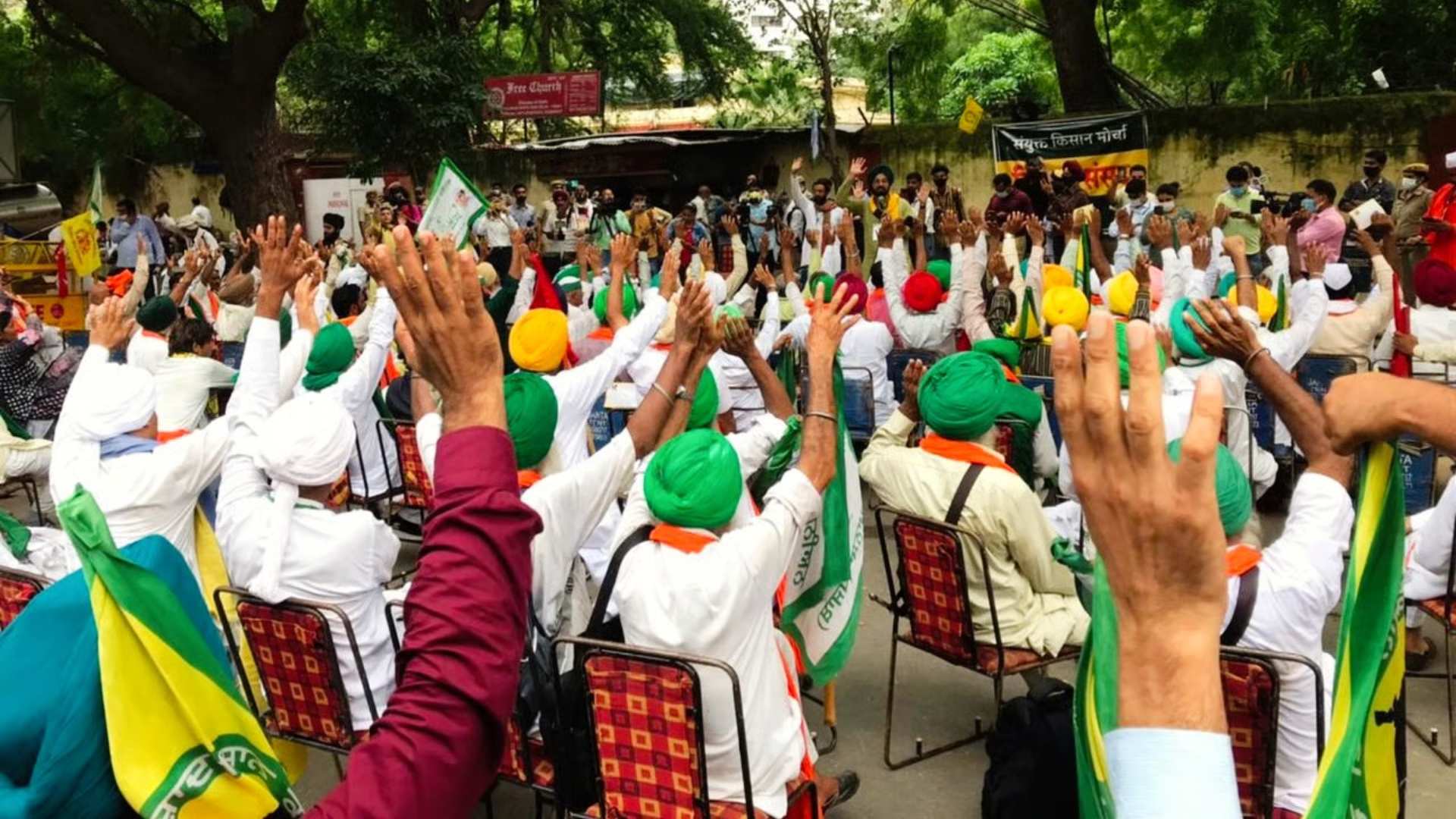
Farmers Protest Against India-US Trade Deal Scheduled for February 12

As farmers' unions call for a strike, RSS affiliates back the deal, raising debates in Parliament over agricultural sector implications.
S
Surya
5 mins read
India-US trade deal sparks protests
Not Started

1. Context: India–US Interim Trade Agreement and Agriculture Sensitivities

India and the United States have announced an interim trade agreement framework, with the Union Commerce and Agriculture Ministers asserting that the interests of Indian farmers have been adequately safeguarded. The agreement has emerged amid a complex global trade environment, marked by tariff wars, geopolitical pressures, and supply chain realignments.

Agriculture remains a politically and economically sensitive sector in India due to its role in livelihoods, food security, and social stability. Any perception of external pressure influencing agricultural trade policy carries implications for domestic legitimacy and policy credibility.

The debate around the agreement highlights the tension between integrating with global markets and protecting vulnerable domestic producers. If not managed carefully, trade policy can become a flashpoint for social unrest and parliamentary confrontation.

“Trade policy is not merely about tariffs, but about livelihoods, food security and national priorities.”Economic Survey of India (Conceptual position)

The governance logic is that trade agreements must balance external economic opportunities with internal socio-economic stability. Ignoring agricultural sensitivities risks political backlash and weakened trust in trade diplomacy.


2. Government Position: Safeguards and Strategic Autonomy

The government has maintained that the interim framework protects Indian agriculture through calibrated market access and quantitative restrictions. Officials and allied economic think tanks argue that India has negotiated from a position of relative strength.

The Swadeshi Jagran Manch (SJM) emphasised that India’s tariff levels under the agreement are lower than those imposed on competing countries, suggesting competitive neutrality rather than concessionary surrender. It also underscored continuity with India’s earlier decision to exit the RCEP to protect farmers and the dairy sector.

By asserting the right to raise tariffs if quantitative restrictions are violated, the government signals policy autonomy and regulatory flexibility. Failure to enforce such safeguards, however, could weaken future negotiating credibility.

“We should trust our government and ministers on the issue since they are answerable to our Parliament and the people.”Ashwani Mahajan, Swadeshi Jagran Manch

The development rationale is that strategic autonomy in trade depends not only on negotiation outcomes but also on credible enforcement. Weak follow-through would dilute policy sovereignty.


3. Role of Ideological Affiliates: Conditional Support from RSS-linked Bodies

Affiliates of the Rashtriya Swayamsevak Sangh, including the Bharatiya Kisan Sangh (BKS), have adopted a cautious but non-confrontational stance. While welcoming the interim agreement, they have raised red flags on specific issues such as genetically modified (GM) products.

The insistence on a complete prohibition of GM imports reflects long-standing concerns around biosafety, seed sovereignty, and farmer dependence on multinational corporations. Ambiguity on such issues can generate mistrust even among ideologically aligned stakeholders.

If clarity is not provided, conditional support could shift towards opposition, complicating consensus-building around trade reforms.

“Genetically modified products should not be allowed in the country under any circumstances.”Bharatiya Kisan Sangh (Statement)

The governance logic is that stakeholder buy-in depends on transparency. Unresolved ambiguities can erode even supportive constituencies.


4. Opposition and Farmer Organisations: Protest and Parliamentary Challenge

Several farmer organisations and trade unions have announced nationwide protests and strikes, alleging that the agreement opens Indian agriculture to subsidised US farm products. Opposition parties have echoed these concerns, framing the issue around sovereignty, livelihoods, and federal accountability.

Groups such as the Samyukt Kisan Morcha (SKM) and the CPI(M) argue that zero or low tariffs on US agricultural exports could intensify agrarian distress, especially in sectors already facing cost pressures. The issue has thus moved beyond trade policy into the realm of mass mobilisation.

If grievances are not institutionally addressed, extra-parliamentary protests risk disrupting governance and policy continuity.

“The India–US trade deal framework represents a meek surrender… and a blatant attack on the rights and livelihoods of our farmers.”Dipankar Bhattacharya, CPI(M)

The governance rationale is that democratic legitimacy requires both parliamentary scrutiny and stakeholder consultation. Ignoring dissent can escalate policy conflict.


5. Key Concerns: Tariffs, Subsidies, and Farmer Viability

Critics argue that Indian farmers may be forced to compete with heavily subsidised US agricultural products, particularly in fruits, cotton, tree nuts, and soybean oil. Such competition could erode price realisation for Indian producers.

Past experiences with trade agreements are cited, where certain farming communities allegedly faced income pressures. The concern is less about immediate market access and more about long-term viability and resilience of Indian agriculture.

Without adequate safeguards, trade liberalisation could exacerbate regional disparities and agrarian distress.

Challenges:

  • Alleged zero or low tariffs on select US agricultural exports
  • Competition with heavily subsidised US farm products
  • Vulnerability of apple and cotton farmers already under stress

“Trade liberalisation without adequate domestic support can deepen rural distress.”World Bank (Agriculture and Trade assessments)

The development logic is that agriculture requires calibrated liberalisation. Sudden exposure without adjustment mechanisms risks livelihood insecurity.


6. Geopolitical Undertones and Energy Linkages

The trade discussions also intersect with broader geopolitical issues, including references by the US to monitoring India’s energy purchases. While savings from discounted Russian oil have declined, such statements raise concerns about external influence on sovereign economic decisions.

Trade agreements increasingly carry strategic dimensions, linking economics with foreign policy choices. Managing this overlap requires diplomatic balance to avoid perceptions of external pressure.

If economic engagements are seen as compromising autonomy, domestic acceptance of trade diplomacy may weaken.

“Strategic autonomy is preserved not by isolation, but by diversified and balanced partnerships.”S. Jaishankar, Foreign Policy Statements

The governance rationale is that economic diplomacy must reinforce, not constrain, strategic independence. Perceived overreach can undermine domestic consensus.


Conclusion

The India–US interim trade agreement reflects the complex balancing act between global economic engagement and domestic agricultural protection. While the government asserts adequate safeguards, sustained legitimacy will depend on transparency, enforcement of restrictions, and responsiveness to farmer concerns.

“Globalisation works best when it carries those at the margins along with it.”Joseph Stiglitz

A forward-looking approach requires integrating trade policy with agrarian resilience, institutional dialogue, and strategic autonomy to ensure that international agreements translate into inclusive and sustainable development outcomes.

Quick Q&A

Everything you need to know

The interim India–US trade agreement framework represents a calibrated and cautious approach to trade liberalisation, reflecting India’s long-standing sensitivity around agriculture while engaging with a major global economic partner.

Unlike comprehensive free trade agreements, the current framework is presented by the government as a limited, step-by-step arrangement. Ministers have emphasised that strict quantitative restrictions have been imposed on sensitive agricultural imports such as soybean oil and animal feed, with the option to raise tariffs if the United States violates agreed thresholds. This approach reflects India’s broader trade philosophy of retaining policy space in agriculture, a sector that supports nearly half of the country’s population and is closely linked to livelihoods and food security.

The framework must also be understood in light of India’s earlier decisions, such as exiting the Regional Comprehensive Economic Partnership (RCEP), to protect farmers and the dairy sector. According to supporters like the Swadeshi Jagran Manch, India has consistently sought to ensure that relative tariff levels remain favourable when compared with competing exporting nations. For instance, the cited 18% tariff on Indian goods entering the US is lower than that faced by several competitors, suggesting a negotiated trade-off rather than unilateral concession.

However, the interim nature of the deal also means that many details remain politically and economically contested. While the government frames the agreement as safeguarding farmer interests, the absence of full transparency fuels suspicion among farmer groups and opposition parties. Thus, the agreement embodies a broader tension in India’s trade policy: engaging global markets to enhance exports while attempting to shield vulnerable domestic sectors from destabilising external competition.

Agriculture is contentious because it sits at the intersection of livelihoods, political economy, and national sovereignty in India.

Unlike manufacturing or services, agriculture employs a large share of the population but contributes a relatively smaller share to GDP. Any perception that trade agreements could expose Indian farmers to competition from heavily subsidised US agricultural products immediately raises fears of income loss and agrarian distress. Farmer organisations such as the Samyukt Kisan Morcha (SKM) and Bharatiya Kisan Union argue that Indian farmers cannot compete with US producers who benefit from advanced technology, large-scale operations, and state subsidies.

The issue is further complicated by historical experience. Apple growers in Himachal Pradesh and Jammu & Kashmir have already reported distress following earlier trade agreements with countries like New Zealand. Such examples reinforce apprehensions that tariff reductions on products like fruits, cotton, or soybean oil could replicate similar outcomes nationwide. Opposition parties frame this not merely as an economic concern but as a question of sovereignty and policy autonomy, arguing that trade commitments may constrain India’s future ability to protect its farmers.

Finally, agriculture carries deep symbolic and political significance. Any reform or trade opening in this sector is quickly interpreted through the lens of trust in government intent, especially after recent farm law protests. As a result, even limited or interim trade concessions become flashpoints, making agriculture the most politically sensitive component of India–US trade talks.

The divergent reactions stem from differences in ideological orientation, risk perception, and trust in state institutions.

Organisations affiliated with the RSS ecosystem, such as the Swadeshi Jagran Manch (SJM) and Bharatiya Kisan Sangh (BKS), have adopted a nuanced position. While historically sceptical of free trade, they appear willing to trust the government’s assurances, emphasising safeguards like quantitative restrictions and the option to raise tariffs. Their stance reflects a belief that the current political leadership is accountable to Parliament and can course-correct if national interests are threatened.

In contrast, groups like the SKM, All India Kisan Sabha, and Left parties adopt a more adversarial view. They interpret the agreement as part of a broader pattern of policy-making that prioritises corporate and multinational interests over small farmers. Their opposition is also shaped by ideological resistance to globalisation and deep mistrust of US trade practices, which they view as coercive and asymmetrical.

Political parties further amplify these differences. The Congress and Left parties frame the deal as a surrender to external pressure, using the language of sovereignty and autonomy. These divergent reactions illustrate that trade policy in India is not merely an economic issue but a deeply political one, shaped by ideology, historical memory, and competing visions of development.

The argument that the trade agreement undermines agricultural viability and sovereignty has both valid concerns and notable limitations.

On the one hand, critics rightly point out that exposure to subsidised US agricultural products can depress domestic prices and hurt small farmers. Zero or low tariffs on items such as cotton, fruits, and soybean oil could exacerbate existing agrarian distress, especially when Indian farmers already face rising input costs and climate uncertainty. From a sovereignty perspective, commitments in trade agreements can reduce future policy flexibility, making it harder for governments to respond to domestic crises.

On the other hand, the government and its supporters argue that the interim framework retains key safeguards. Quantitative restrictions, tariff escalation options, and India’s demonstrated willingness to walk away from unfavourable deals—as seen in RCEP—suggest that sovereignty is not entirely compromised. Moreover, engagement with the US can open export opportunities for Indian goods, potentially benefiting segments of the rural economy integrated into global value chains.

The real issue lies less in the agreement itself and more in the absence of domestic preparedness. Without investment in productivity, market access, and risk mitigation for farmers, any trade opening becomes threatening. Thus, the agreement’s impact on sovereignty and viability ultimately depends on complementary domestic reforms rather than trade policy alone.

A balanced strategy would require synchronising trade diplomacy with domestic agricultural reform.

First, transparency is crucial. The government should place detailed agreement provisions before Parliament and engage in structured consultations with farmer organisations. This would reduce misinformation and build trust. Second, sensitive commodities should be protected through well-defined tariff-rate quotas and automatic safeguard mechanisms triggered by import surges, ensuring farmers are insulated from sudden shocks.

Third, trade engagement must be accompanied by domestic competitiveness measures. These include investment in irrigation, storage, value addition, and extension services, as well as targeted income support for vulnerable crops and regions. Lessons can be drawn from countries like Vietnam, which combined trade openness with strong state support to enhance farm productivity.

Finally, India should use trade negotiations strategically to secure gains in areas such as technology transfer, market access for high-value agricultural exports, and cooperation on standards. By aligning external engagement with internal reform, India can reassure farmers that trade agreements are tools for shared growth rather than instruments of dispossession.

Attribution

Original content sources and authors

Sign in to track your reading progress

Comments (0)

Please sign in to comment

No comments yet. Be the first to comment!