1. DBT in Fertilisers: Rationale and Emerging Debate
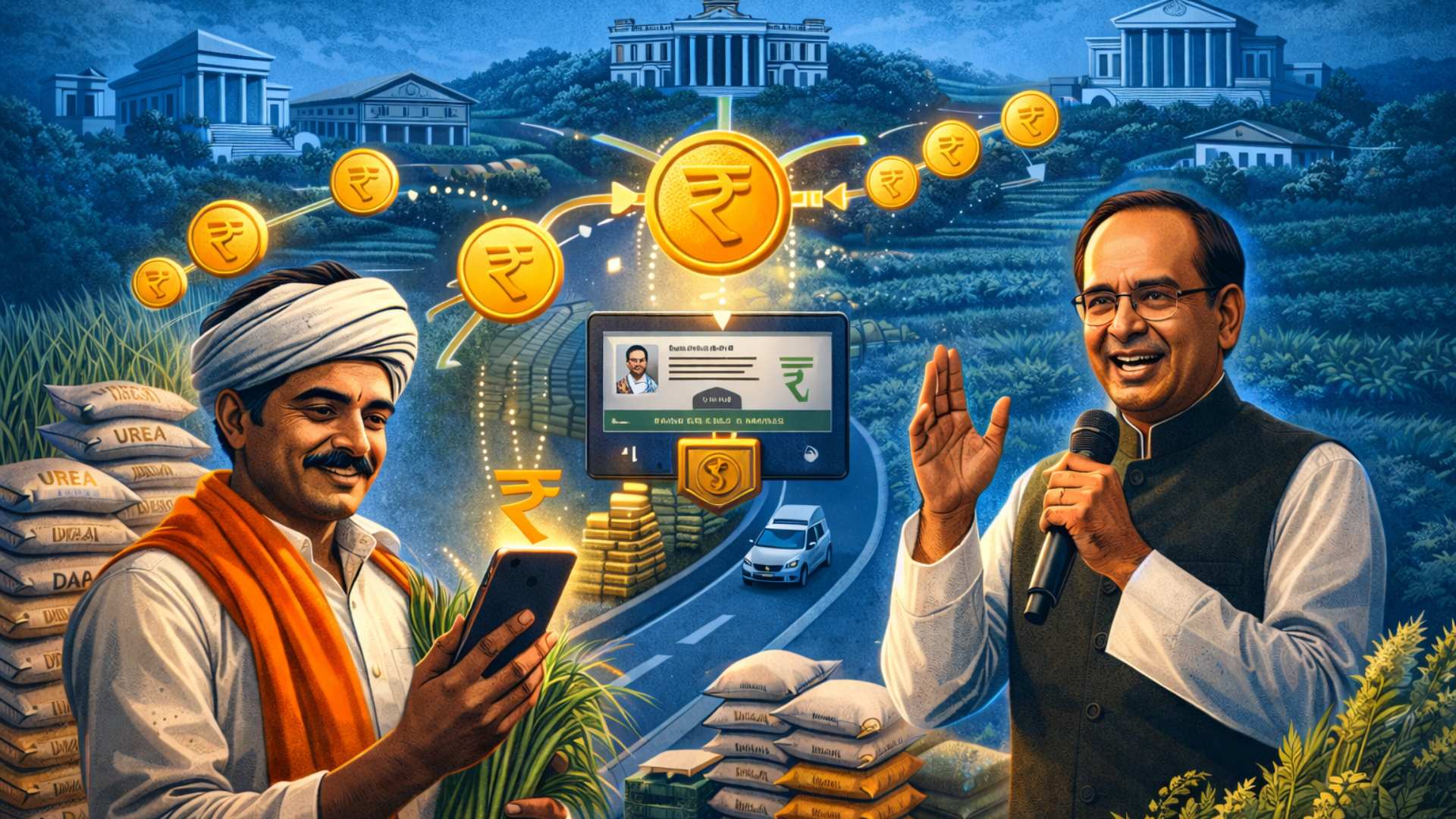
The Union Agriculture Minister has called for a national debate on introducing Direct Benefit Transfer (DBT) in fertilisers. The objective is to prevent diversion of subsidised fertilisers and empower farmers to choose nutrients based on agronomic need rather than distorted price signals.
Currently, fertiliser subsidy is embedded in the product price. Urea is sold at a heavily subsidised retail rate, leading to excessive consumption and imbalance in nutrient use. The proposal envisions transferring subsidy directly into farmers’ bank accounts using technology-enabled platforms.
“There should be manthan on this… fertiliser subsidy can be transferred directly to the farmer’s account.” — Shivraj Singh Chouhan
If subsidy delivery is restructured, it could rationalise usage patterns and reduce leakages. However, any abrupt transition without consensus may disrupt input access and farm economics.
Shifting from product-based subsidy to income support aims to improve efficiency and reduce distortions. If ignored, rising subsidy burdens and nutrient imbalance could undermine fiscal sustainability and soil health.
Key Data:
- Urea consumption (FY26 expected): ~40 million tonnes
- Subsidy allocation (FY26): ₹1.86 trillion (↑ 11.05% from ₹1.68 trillion)
- Retail price of urea: ₹5,630 per tonne
- Domestic production cost: ₹32,000–35,000 per tonne
- Imported urea cost: ₹36,000 per tonne (at $420/tonne)
2. Subsidy Burden and Nutrient Imbalance
India’s fertiliser subsidy regime has kept urea prices unchanged for over a decade. The large gap between cost of production/import and retail price has incentivised overuse of nitrogenous fertilisers relative to phosphatic and potassic nutrients.
Higher acreage under maize and rice, combined with low urea prices, has driven record consumption. This has fiscal implications and environmental consequences, particularly for soil quality and groundwater contamination.
The rising subsidy outgo also constrains fiscal space for investment in irrigation, research, and diversification.
Price distortions alter farmer behaviour, encouraging input overuse rather than optimal use. If not corrected, this can reduce long-term productivity and increase ecological stress.
3. Agricultural Dependence and Structural Challenges
Despite economic diversification, 48% of India’s workforce remains dependent on agriculture, down from over 70% earlier. However, productivity remains relatively low compared to other sectors.
Ensuring food and nutrition security for a population exceeding 1.4 billion remains central to policy. At the same time, pressure on land and farm incomes necessitates alternative employment growth in industry, services, and IT.
The structural challenge lies in raising farm productivity while gradually reducing disguised unemployment in agriculture.
High workforce dependence on low-productivity agriculture limits income growth. Without diversification and productivity enhancement, rural distress and fiscal pressures may persist.
4. MSP, Price Support and Bhavantar Model
The government maintains that MSP ensures at least 50% return over cost of production. Large-scale procurement of wheat and rice continues, with interventions extended to perishable crops such as tomatoes, onions and potatoes.
Under PM-AASHA, states can procure at MSP, and transport costs are sometimes borne by the Centre. The “Bhavantar” price-deficiency payment model compensates farmers for the gap between MSP and market price without physical procurement.
“If the MSP is ₹5,000 and the market price is ₹4,000, the ₹1,000 difference can be transferred directly to the farmer’s account.” — Shivraj Singh Chouhan
This reduces storage and handling costs but depends on state capacity and accurate price assessment.
Price-deficiency payments aim to balance fiscal prudence with farmer income security. If poorly designed, they risk delayed payments or inadequate compensation.
5. Digital Agriculture and Direct Transfers
Over 85 million farmers have been issued digital farmer IDs capturing landholding and crop details. This database supports targeted DBT and reduces over-claiming.
The Budget has prioritised digital agriculture platforms integrating crop advisory, weather updates, disease detection (via photo uploads), and market access through e-NAM.
Such technological integration aims to enhance transparency, improve market efficiency, and support evidence-based policymaking.
Digitisation strengthens last-mile delivery and reduces leakages. Without reliable databases and state-level implementation, however, benefits may not reach intended recipients.
6. Rural Employment and Income Support Reforms
The rural employment programme, now renamed Vikshit Bharat Grameen Rojgar Yojana (VB-G RAM G), remains demand-driven.
Key Changes:
- Budget allocation increased from ₹86,000 crore to ₹1.51 trillion
- ₹95,600 crore provided upfront
- Employment days increased from 100 to 125
- Automatic unemployment allowance if wages delayed beyond 15 days
Greater gram sabha involvement in project prioritisation seeks to improve asset quality and accountability.
Strengthening rural employment programmes supports consumption stability and reduces agrarian pressure. Without monitoring, however, asset quality and fiscal efficiency may suffer.
7. Research, Diversification and Productivity Push
The government has outlined six guiding principles: increasing production and productivity, reducing cultivation cost, ensuring remunerative prices, compensating losses, promoting diversification and value addition, and protecting soil health.
Over 16,000 scientists have been directed to undertake field-level engagement, addressing more than 500 identified issues, including red rot in sugarcane and pink bollworm in cotton.
A productivity push is also planned in coconut, cashew, cocoa and coffee through replanting with high-yield varieties.
Research-driven diversification reduces monoculture risks and enhances income stability. If extension services remain weak, scientific innovation may not translate into field-level gains.
8. Trade Policy and Federal Coordination
The minister clarified that free-trade agreements have not granted concessions on core crops such as wheat and rice. Instead, export opportunities are expected to expand for spices, tea, coffee and textiles.
Agriculture remains a concurrent responsibility in practice: the Centre formulates policy, while states implement schemes at the grassroots level.
“Policies must reach the field. Research must reach the farm. And benefits must reach the farmer directly.” — Shivraj Singh Chouhan
Effective coordination between Centre and states determines programme success.
Federal alignment ensures uniform standards while allowing state-specific adaptation. Weak coordination may dilute reform impact.
Conclusion
The debate on DBT in fertilisers reflects a broader shift towards efficiency, transparency, and fiscal sustainability in agricultural policy. Rationalising subsidies, strengthening digital delivery systems, enhancing productivity, and promoting diversification are essential for long-term farm income stability.
A calibrated reform approach—balancing farmer welfare, fiscal prudence, environmental sustainability, and federal coordination—will determine whether India’s agricultural transformation becomes structurally durable and inclusive.